Results by title
8 books match the query 'Coalition governments'
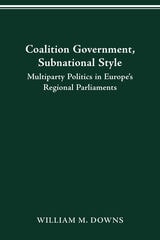
COALITION GOVERNMENT, SUBNATIONAL STYLE
Multiparty Politics in Europe’s Regional ParliamentsWilliam M. Downs
The Ohio State University Press, 1998
Coalition Government, Subnational Style examines parliamentary democracy in subnational legislative assemblies. Comparing three different European democracies—Germany, France, and Belgium—William M. Downs provides a powerful account of the ways politicians and political parties negotiate the composition of new governments following elections in which no single party wins a clear majority.
Downs argues that postelection alliance building is a window onto many of the political processes fundamental to representative democracy: the interpretations of electoral verdicts; the compromises of campaign pledges; the trade-offs between policy and power; the temporary cooperation between long-term adversaries; the collective decision making; and the blurring of lines of accountability through collective responsibility.
The study reports findings from an unprecedented collection of information, including cross-national survey responses, interviews with political elites, and three decades of postelection studies of coalition building in the German state parliaments, the French regional assemblies, and the Belgian provincial councils and regional parliaments. Coalition Government, Subnational Style conclusively demonstrates that the struggles for government status at subnational levels are profoundly important to both parties and voters and that the outcomes of these struggles can result in governments of varying political complexions. Downs's findings question key assumptions of democratic theory and raise important concerns about individual and organizational behavior in changing institutional and electoral environments, ultimately allowing for a deeper understanding of representation, power, and cooperation outside the more familiar arena of national parliamentary politics.
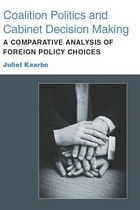
Coalition Politics and Cabinet Decision Making
A Comparative Analysis of Foreign Policy ChoicesJuliet Kaarbo
University of Michigan Press, 2013
Every day, coalition cabinets make policy decisions critical to international politics. Juliet Kaarbo examines the dynamics of these multiparty cabinets in parliamentary democracies in order to assess both the quality of coalition decision making and the degree to which coalitions tend to favor peaceful or military solutions. Are coalition cabinets so riddled by conflict that they cannot make foreign policy effectively, or do the multiple voices represented in the cabinet create more legitimate and imaginative responses to the international system? Do political and institutional constraints inherent to coalition cabinets lead to nonaggressive policies? Or do institutional and political forces precipitate more belligerent behavior?
Employing theory from security studies and political psychology as well as a combination of quantitative cross-national analyses and twelve qualitative comparative case studies of foreign policy made by coalition cabinets in Japan, the Netherlands, and Turkey, Kaarbo identifies the factors that generate highly aggressive policies, inconsistency, and other policy outcomes. Her findings have implications not merely for foreign policy but for all types of decision making and policy-making by coalition governments.

Coalition Strategies of Marxist Parties
Trond Gilberg, ed.
Duke University Press, 1988

Federal Judiciary and Institutional Change
Deborah J. Barrow, Gary Zuk, and Gerard S. Gryski
University of Michigan Press, 1996
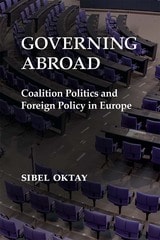
Governing Abroad
Coalition Politics and Foreign Policy in EuropeSibel Oktay
University of Michigan Press, 2022
From Austria to New Zealand, coalition governments often pave the road to foreign policy. In Western Europe, nearly 90 percent of postwar governments include two or more political parties. Israel, the Middle East’s only consolidated democracy according to many, has never experienced single-party rule in its history. Even the United Kingdom, known for its long streak of single-party rule, now navigates multiparty cabinets. Coalitions are everywhere, but we still have little understanding of how they act in foreign affairs. History shows that coalitions can sometime engage in powerful international commitments such as participating in military operations, but at other times, they postpone their decisions, water down their policy positions, or promise to do less than they otherwise would. What explains these differences in behavior?
Governing Abroad unpacks the little-known world of coalition governments to find out. Oktay argues that the specific constellation of parties in government explains why some coalitions can make more assertive foreign policy decisions than others. Building on the rich literature in political science on coalitions, legislatures, and voting behavior, the book weaves together sophisticated statistical analyses of foreign policy events across thirty European countries alongside in-depth case studies from Denmark, the Netherlands, and Finland. It brings political parties back into the study of foreign policy, demonstrating that the size of the coalition, the ideological proximity of the governing parties, and their relationship with the parliamentary opposition together influence the government’s ability to act in the international arena. This book challenges our existing perceptions about the constraints and weaknesses of coalition governments. It sheds new light on the conditions that allow them to act decisively abroad.

Partnering with Extremists
Coalitions between Mainstream and Far-Right Parties in Western EuropeKimberly A. Twist
University of Michigan Press, 2019
As long as far-right parties—known chiefly for their vehement opposition to immigration—have competed in contemporary Western Europe, many have worried about these parties’ acceptability to democratic voters and mainstream parties. Yet, rather than treating the far right as pariahs, major mainstream-right parties have included the far right in 15 governing coalitions from 1994 to 2017. Parties do not care equally about all issues at any given time, and Kimberly Twist demonstrates that far-right parties will agree to support the mainstream right’s goals more readily than many other parties, making them appealing partners.
Partnering with Extremists builds on existing work on coalition formation and party goals to propose a theory of coalition formation that works across countries and over time. The evidence comes from 19 case studies of coalition formation in Austria and the Netherlands, countries where far-right parties have been excluded when they could have been included and included when the mainstream right had other options. The argument is then extended to countries where coalitions are less common, France and the United Kingdom, and to cases of mainstream-right adoption of far-right themes. Twist incorporates both office and policy considerations in her argument and reimagines “policy” to be a two-dimensional factor; it matters not just where parties are located on an issue but how firmly they hold those positions.

Power-Sharing
Institutional and Social Reform in Divided SocietiesIan O'Flynn & David Russell, Editors
Pluto Press, 2005
Power-Sharing seeks to explore the unintended consequences of power-sharing for the communities themselves, their individual members, and for others in society. More specifically, it is distinctive in questioning explicitly whether power sharing: perpetuates inter-communal conflict by institutionalising difference at the political level; inhibits conflict resolution by encouraging extremism; stifles internal diversity; and fails to leave sufficient space for individual autonomy.
This book not only provides a theoretical exploration and critique of these questions, but comprehensively examines specific test cases where power-sharing institutions have been established, including in Northern Ireland, Belgium, Bosnia-Herzegovina, Macedonia and Lebanon. It also explores such issues as the role of political leaders, human rights
instruments, the position of women, and the prospects for reconciliation within such societies.
Furthermore it provides a detailed set of policy recommendations to meet the challenges of transition in deeply-divided societies.
The Causes of Post-Mobilization Leadership Change and Continuity
A Comparative Analysis of Post-Color Revolution in Ukraine, Kyrgyzstan, and GeorgiaVasili Rukhadze
University of Michigan Press, 2021
Vasili Rukhadze examines the factors that contributed to post-uprising leadership durability in the Ukraine, Kyrgyzstan, and Georgia in 2004–12, after these countries underwent their so-called “Color Revolutions.” Using structured, focused comparison and process tracing, he argues that the key independent variable influencing post-mobilization leadership durability is ruling coalition size and cohesion. He demonstrates that if the ruling coalitions are large and fragmented, as in the Ukraine and Kyrgyzstan, the coalitions disintegrate, thus facilitating the downfall of the governments. Alternatively, if the ruling coalition is small and cohesive, as in Georgia, the coalition maintains unity, hence helping the government to stay in power.
This study advances the debate on regime changes. By drawing a clear distinction between political leaderships that come to power as a result of popular uprisings and governments that take power through normal democratic processes, military coup, or any other means, the research offers one of the first studies on post-mobilization leadership. Rukhadze helps scholars differentiate between the factors that affect durability of post-uprising leadership from those factors that impact durability of all other political leadership, in turn equipping researchers with new tools to study power politics.