Results by title
4 books match the query 'Coeducation'
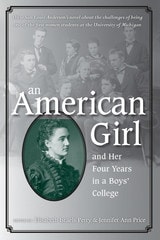
An American Girl, and Her Four Years in a Boys' College
Olive San Louie Anderson
University of Michigan Press, 2006
In 1870, the University of Michigan-one of the oldest, largest, and most prestigious public universities in the United States-admitted its first woman student. An American Girl, and Her Four Years in a Boys' College, written by one of the first woman graduates from the University of Michigan and published pseudonymously in 1878, describes what it was like to be a member of this tiny group of brave coeds. The story is told through the eyes of Wilhelmine Elliot, an untraditional girl who enrolls at the fictional University of Ortonville, a thinly disguised stand-in for the University of Michigan.
Will's challenges mirror those of other women college students of the era, including the reactions of male faculty and students, relationships with other women students and with family and friends back home, and social attitudes toward the women's movement and liberal religious values. The editors' engaging introduction places the novel in its relevant historical and literary contexts, as do helpful annotations throughout the text.
"The 1870s were an important moment of debate over women's roles and responsibilities. What's here is very interesting not only about higher education, and 'strong-minded women,' but about religion, domesticity, independence, marriage, and homosocial bonding."
--Carol Lasser, Oberlin College
Olive San Louie Anderson (ca. 1852-86) graduated from the University of Michigan in 1875 and published An American Girl in 1878 under the name SOLA. Elisabeth Israels Perry is John Francis Bannon Professor of History, Saint Louis University. Jennifer Ann Price is a Ph.D. candidate in American Studies at Saint Louis University.
[more]
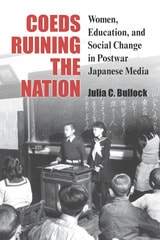
Coeds Ruining the Nation
Women, Education, and Social Change in Postwar Japanese MediaJulia C. Bullock
University of Michigan Press, 2019
In the late 1800s, Japan introduced a new, sex-segregated educational system. Boys would be prepared to enter a rapidly modernizing public sphere, while girls trained to become “good wives and wise mothers” who would contribute to the nation by supporting their husbands and nurturing the next generation of imperial subjects. When this system was replaced by a coeducational model during the American Occupation following World War II, adults raised with gender-specific standards were afraid coeducation would cause “moral problems”—even societal collapse. By contrast, young people generally greeted coeducation with greater composure.
This is the first book in English to explore the arguments for and against coeducation as presented in newspaper and magazine articles, cartoons, student-authored school newsletters, and roundtable discussions published in the Japanese press as these reforms were being implemented. It complicates the notion of the postwar years as a moment of rupture, highlighting prewar experiments with coeducation that belied objections that the practice was a foreign imposition and therefore “unnatural” for Japanese culture. It also illustrates a remarkable degree of continuity between prewar and postwar models of femininity, arguing that Occupation-era guarantees of equal educational opportunity were ultimately repurposed toward a gendered division of labor that underwrote the postwar project of economic recovery. Finally, it excavates discourses of gender and sexuality underlying the moral panic surrounding coeducation to demonstrate that claims of rampant sexual deviance and other concerns were employed as disciplinary mechanisms to reinforce an ideology of harmonious gender complementarity and to dissuade women from pursuing conventionally masculine prerogatives.
This is the first book in English to explore the arguments for and against coeducation as presented in newspaper and magazine articles, cartoons, student-authored school newsletters, and roundtable discussions published in the Japanese press as these reforms were being implemented. It complicates the notion of the postwar years as a moment of rupture, highlighting prewar experiments with coeducation that belied objections that the practice was a foreign imposition and therefore “unnatural” for Japanese culture. It also illustrates a remarkable degree of continuity between prewar and postwar models of femininity, arguing that Occupation-era guarantees of equal educational opportunity were ultimately repurposed toward a gendered division of labor that underwrote the postwar project of economic recovery. Finally, it excavates discourses of gender and sexuality underlying the moral panic surrounding coeducation to demonstrate that claims of rampant sexual deviance and other concerns were employed as disciplinary mechanisms to reinforce an ideology of harmonious gender complementarity and to dissuade women from pursuing conventionally masculine prerogatives.
[more]
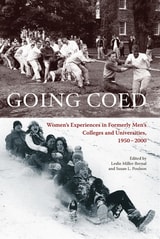
Going Coed
Women's Experiences in Formerly Men's Colleges and Universities, 1950-2000Leslie Miller-Bernal
Vanderbilt University Press, 2004
More than a quarter-century ago, the last great wave of coeducation in the United States resulted in the admission of women to almost all of the remaining men's colleges and universities. In thirteen original essays, Going Coed investigates the reasons behind this important phenomenon, describes how institutions have dealt with the changes, and captures the experiences of women who attended these schools.
[more]
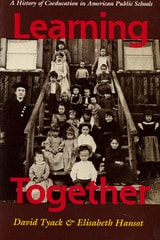
Learning Together
A History of Coeducation in American Public SchoolsDavid Tyack
Russell Sage Foundation, 1992
Now available in paperback, this award-winning book provides a comprehensive history of gender policies and practices in American public schools. David Tyack and Elisabeth Hansot explore the many factors that have shaped coeducation since its origins. At the very time that Americans were creating separate spheres for adult men and women, they institutionalized an education system that brought boys and girls together. How did beliefs about the similarities and differences of boys and girls shape policy and practice in schools? To what degree did the treatment of boys and girls differ by class, race, region, and historical period? Debates over gender policies suggest that American have made public education the repository of their hopes and anxieties about relationships between the sexes. Thus, the history of coeducation serves as a window not only on constancy and change in gender practices in the schools but also on cultural conflicts about gender in the broader society. "Learning Together presents a rich and exhaustive search through [the] 'tangled history' of gender and education that links both the silences and the debates surrounding coeducation to the changing roles of women and men in our society....It is the generosity and capaciousness of Tyack and Hansot's scholarship that makes Learning Together so important a book." —Science
[more]