Results by title
50 books match the query 'Cognitive Psychology & Cognition' and 7 start with a
A Passion for Specificity
Confronting Inner Experience in Literature and ScienceMarco Caracciolo and Russell Hurlburt
The Ohio State University Press, 2016
In an analytical yet increasingly intimate conversation, A Passion for Specificity:Confronting Inner Experience in Literature and Science investigates the differences between experience as conveyed in literature and experience as apprehended through scientific method. Can experiences be shared? How much do language and metaphor shape experiential reports? Where is the dividing line between a humanistic and a scientific approach to experience? In a series of exchanges, Marco Caracciolo and Russell Hurlburt demonstrate that those are necessarily personal issues, and they don’t flinch—they relentlessly examine whether Caracciolo’s presuppositions distort his understanding of reading experiences and whether Hurlburt’s attachment to the method he invented causes him to take an overly narrow view of experience. Delving ever more personally, they aim Hurlburt’s experience sampling methods—beeping people to discover what was in their stream of inner experience at the moment immediately before the beep—at Caracciolo’s own experiences, an exercise that puts Caracciolo’s presuppositions to the test and leads him to discover things about experience (his own and literature’s) that he had thought impossible.
A Passion for Specificity, with its personal revelations, unexpected twists, and confrontational style, reads like an epistolary novel, but it is a serious exploration of ideas at the heart of literature and science. It is a thoughtful attempt at advancing the emerging “cognitive humanities,” clarifying a number of core issues in the cross-pollination of literature, psychology, philosophy, and consciousness science.
A Passion for Specificity, with its personal revelations, unexpected twists, and confrontational style, reads like an epistolary novel, but it is a serious exploration of ideas at the heart of literature and science. It is a thoughtful attempt at advancing the emerging “cognitive humanities,” clarifying a number of core issues in the cross-pollination of literature, psychology, philosophy, and consciousness science.
[more]
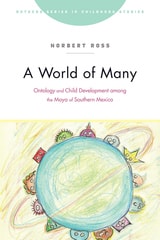
A World of Many
Ontology and Child Development among the Maya of Southern MexicoNorbert Ross
Rutgers University Press, 2023
A World of Many explores the world-making efforts of Tzotzil Maya children from two different localities within the municipality of Chenalhó, Chiapas. The research demonstrates children’s agency in creating their worlds, while also investigating the role played by the surrounding social and physical environment. Different experiences with schooling, parenting, goals and values, but also with climate change, water scarcity, as well as racism and settler colonialism form part of the reason children create their emerging worlds. These worlds are not make believe or anything less than the ontological products of their parents. Instead, Norbert Ross argues that by creating different worlds, the children ultimately fashion themselves into different human beings - quite literally being different in the world. A World of Many combines experimental research from the cognitive sciences with critical theory, exploring children’s agency in devising their own ontologies. Rather than treating children as somewhat incomplete humans, it understands children as tinkerers and thinkers, makers of their worlds amidst complex relations. It regards being as a constant ontological production, where life and living constitutes activism. Using experimental paradigms, the book shows that children locate themselves differently in these emerging worlds they create, becoming different human beings in the process.
[more]
Achievement-Related Motives in Children
Charles P. Smith
Russell Sage Foundation, 1969
Examines the conditions under which motives to achieve are fostered in children. The papers included in this volume reflect the major traditions of research in the field and bring together a set of studies for achieving a better understanding of the ways in which achievement-related personality characteristics develop and function in evaluative or competitive situations.
[more]
Affective Ecologies
Empathy, Emotion, and Environmental NarrativeAlexa Weik von Mossner
The Ohio State University Press, 2017
Affective Ecologies: Empathy, Emotion, and Environmental Narrative explores our emotional engagement with environmental narrative. Focusing on the American cultural context, Alexa Weik von Mossner develops an ecocritical approach that draws on the insights of affective science and cognitive narratology. This approach helps to clarify how we interact with environmental narratives in ways that are both biologically universal and culturally specific. In doing so, it pays particular attention to the thesis that our minds are both embodied (in a physical body) and embedded (in a physical environment), not only when we interact with the real world but also in our engagement with imaginary worlds.
How do we experience the virtual environments we encounter in literature and film on the sensory and emotional level? How do environmental narratives invite us to care for human and nonhuman others who are put at risk? And how do we feel about the speculative futures presented to us in ecotopian and ecodystopian texts? Weik von Mossner explores these central questions that are important to anyone with an interest in the emotional appeal and persuasive power of environmental narratives.
How do we experience the virtual environments we encounter in literature and film on the sensory and emotional level? How do environmental narratives invite us to care for human and nonhuman others who are put at risk? And how do we feel about the speculative futures presented to us in ecotopian and ecodystopian texts? Weik von Mossner explores these central questions that are important to anyone with an interest in the emotional appeal and persuasive power of environmental narratives.
[more]

American Beliefs About Intelligence
Orville G., Jr. Brim
Russell Sage Foundation, 1969
Based on two national surveys--one of adults and one of secondary school students, this volume reports on their experiences with and their attitudes toward standardized tests of intelligence. The authors analyze the relations between a person's beliefs about the nature of intelligence, his estimate of his own intelligence, his attitudes concerning tests, and other personal characteristics.
[more]
Anatomy of a Train Wreck
The Rise and Fall of Priming ResearchRuth Leys
University of Chicago Press, 2024
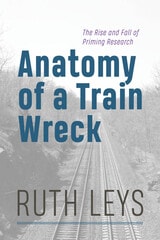
A history of “priming” research that analyzes the field’s underlying assumptions and experimental protocols to shed new light on a contemporary crisis in social psychology.
In 2012, a team of Belgian scientists reported that they had been unable to replicate a canonical experiment in the field of psychology known as “priming.” The original experiment, performed by John Bargh in the nineties, had purported to show that words connoting old age unconsciously influenced—or primed—research subjects, causing them to walk more slowly. When subsequent researchers could not replicate these results, Nobel-winning psychologist Daniel Kahneman warned of a “train wreck looming” if Bargh and his colleagues could not address doubts about their work. Since then, the inability to replicate other well-known priming experiments has helped precipitate an ongoing debate over what has gone wrong in psychology, raising fundamental questions about the soundness of research practices in the field.
Anatomy of a Train Wreck offers the first detailed history of priming research from its origins in the early 1980s to its recent collapse. Ruth Leys places priming experiments in the context of contemporaneous debates over not only the nature of automaticity but also the very foundations of social psychology. While these latest discussions about priming have largely focused on methodology—including sloppy experimental practices, inadequate statistical methods, and publication bias—Leys offers a genealogy of the theoretical expectations and scientific paradigms that have guided and motivated priming research itself. Examining scientists’ intellectual strategies, their responses to criticism, and their assumptions about the nature of subjectivity, Anatomy of a Train Wreck raises crucial questions about the evidence surrounding unconscious influence and probes the larger stakes of the replication crisis: psychology’s status as a science.
[more]
Animal Minds
Beyond Cognition to ConsciousnessDonald R. Griffin
University of Chicago Press, 2001
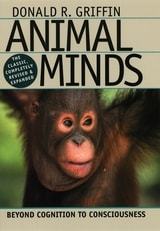
In Animal Minds, Donald R. Griffin takes us on a guided tour of the recent explosion of scientific research on animal mentality. Are animals consciously aware of anything, or are they merely living machines, incapable of conscious thoughts or emotional feelings? How can we tell? Such questions have long fascinated Griffin, who has been a pioneer at the forefront of research in animal cognition for decades, and is recognized as one of the leading behavioral ecologists of the twentieth century.
With this new edition of his classic book, which he has completely revised and updated, Griffin moves beyond considerations of animal cognition to argue that scientists can and should investigate questions of animal consciousness. Using examples from studies of species ranging from chimpanzees and dolphins to birds and honeybees, he demonstrates how communication among animals can serve as a "window" into what animals think and feel, just as human speech and nonverbal communication tell us most of what we know about the thoughts and feelings of other people. Even when they don't communicate about it, animals respond with sometimes surprising versatility to new situations for which neither their genes nor their previous experiences have prepared them, and Griffin discusses what these behaviors can tell us about animal minds. He also reviews the latest research in cognitive neuroscience, which has revealed startling similarities in the neural mechanisms underlying brain functioning in both humans and other animals. Finally, in four chapters greatly expanded for this edition, Griffin considers the latest scientific research on animal consciousness, pro and con, and explores its profound philosophical and ethical implications.
With this new edition of his classic book, which he has completely revised and updated, Griffin moves beyond considerations of animal cognition to argue that scientists can and should investigate questions of animal consciousness. Using examples from studies of species ranging from chimpanzees and dolphins to birds and honeybees, he demonstrates how communication among animals can serve as a "window" into what animals think and feel, just as human speech and nonverbal communication tell us most of what we know about the thoughts and feelings of other people. Even when they don't communicate about it, animals respond with sometimes surprising versatility to new situations for which neither their genes nor their previous experiences have prepared them, and Griffin discusses what these behaviors can tell us about animal minds. He also reviews the latest research in cognitive neuroscience, which has revealed startling similarities in the neural mechanisms underlying brain functioning in both humans and other animals. Finally, in four chapters greatly expanded for this edition, Griffin considers the latest scientific research on animal consciousness, pro and con, and explores its profound philosophical and ethical implications.
[more]