Results by title
3 books match the query 'Cohen, Arthur A.'
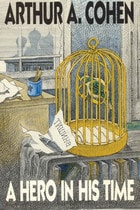
A Hero in His Time
Arthur A. Cohen
University of Chicago Press, 1987
All his life Yuri Maximovich Isakovsky, a minor Russian poet, editor of a journal of folk music, sometime English translator, has assiduously avoided power and politics—in fact, attention of any kind. How can it be, then, that the Soviet government has chosen him to attend a conference in the fabled land of bourgeois temptation itself, New York City? And not only that, but to do a "piece of work" for the KGB, to deliver a code message embedded in the text of a certain poem to be read in public along with his own . . .
"Cohen has achieved here a tour de force, bringing the idea of poetry to life in a messy little man, no hero at all, not even that much of a poet. . . . [The novel] is stately as well as funny, an authentically noble account of a celebrant. . . . It is the true article."—Geoffrey Wolff, New York Times Book Review
"Arthur Cohen catches fire. . . . A Hero in His Time represents for him a great imaginative leap, for we are shown the interior mental landscape of a middle-aged Russian-Jewish minor poet and . . . most astonishing is that we believe, without question, in this poet."—Doris Grumbach, Village Voice
"A tremendous achievement. . . . To have made this tremendous imaginative leap from the heart of American Jewishness to the heart of Russian Jewishness was a daring thing to do, and it has been accomplished with absolute conviction."—The Sunday Times (London)
"A rich compound of high seriousness and robust comedy."—Newsweek
[more]
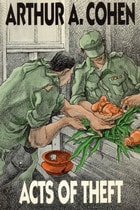
Acts of Theft
Arthur A. Cohen
University of Chicago Press, 1987
A gripping, world-spanning drama of crime, art, and our shared cultural heritage
This unforgettable novel tells the story of an Austrian nobleman who as a young man at the end of World War I, finds himself irresistibly drawn to thievery. Forty years later, living in Mexico, he has made stealing his trade, pillaging Mayan tombs to illicitly secure pre-Columbian art, which he sells on the black market. At the same time, he creates his own sculptures, which the market refuses to reward. Eventually, his activities catch the eye of a dedicated, solitary Mexican police detective, and a reckoning--one that has its roots in the long history of European plunder of the riches of the New World--is set in violent motion.
Praised on publication by Cynthia Ozick, the Washington Post, and more, this unforgettable novel harks back to the great nineteenth-century social novels while still being fully of its late-twentieth-century time.
[more]
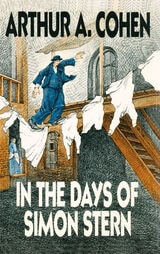
In the Days of Simon Stern
Arthur A. Cohen
University of Chicago Press, 1987
Nathan, a blind Jewish scribe, tells the story of the coming of the Messiah in the person of one Simon Stern—from his birth on the Lower East Side, through his career as a millionaire dealer in real estate, to his building of a refuge for the Jewish remnant of World War II.
"A majestic work of fiction that should stand world literature's test of time, to be read and reread. A masterpiece."—Commonweal
"This book ensnares one of the most extraordinarily daring ideas to inhabit an American novel in a number of years. For one thing, it is that risky devising, dreamed of only by the Thomas Manns of the world, a serious and vastly conceived fiction bled out of the theological imagination. For another, it is clearly an 'American' novel—altogether American, despite its Jewish particularity: it is not so much about the history of the Jews as it is about the idea of the New World as haven. . . . In its teeming particularity every vein of this book runs with a brilliance of Jewish insight and erudition to be found in no other novelist. Arthur Cohen is the first writer of any American generation to compose a profoundly Jewish fiction on a profoundly Western theme."—Cynthia Ozick, New York Times Book Review
"This stately, ambitious amalgam of Jewish myth, history, theology, and speculations on the Jewish soul is like an enormous Judaic archeological ruin—often hard for the uninitiated to interpret, but impressive. . . . Intelligent, inventive, fascinating."—New Yorker
[more]