Results by title

12 books match the query 'Collection management'
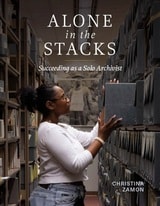
cover of Alone in the Stacks

Alone in the Stacks

Christina Zamon

Society of American Archivists, 2024
[more]
cover of Archival Accessioning

Archival Accessioning

Audra Eagle Yun

Society of American Archivists, 2021
An archival accessioning program is the keystone of responsible collection stewardship and essential to providing both equitable access and meaningful contextualization of archives. In Archival Accessioning, editor Audra Eagle Yun approaches the acquisition of materials as a holistically oriented, programmatic activity that establishes and maintains baseline control for archival holdings. Combining principles, best practice, and real-world examples from eleven archival practitioners, Archival Accessioning is a forward-thinking guide that archivists can apply in a variety of institutional settings. Those working with archives, special collections, and local history materials will learn how to • Identity core components of archival accessioning and critically analyze such work, • Establish a thoughtful and successful program for taking intellectual and physical custody of materials, and • Adapt firsthand professional perspectives to improve or modify existing practices. This book’s set of principles, applied procedures, and variety of examples will benefit archivists, records managers, and librarians as well as information science students at all levels.
[more]
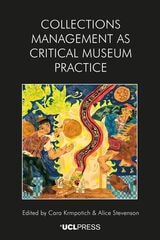
cover of Collections Management as Critical Museum Practice

Collections Management as Critical Museum Practice

Edited by Cara Krmpotich and Alice Stevenson

University College London, 2024

A reframing of collections management in museums worldwide.

Collections Management as Critical Museum Practice redefines collections management as a political, critical, and social project, contradicting its misperception as a set of fixed procedures and universal practices. Highlighting national museums and community-led heritage work worldwide, this book explores the complexities of numbering, digitization, and description alongside the realities of climate change, global pandemics, and natural disasters. The contributors draw on their local experiences to emphasize the varying practices, ethics, and workplace pragmatics defining this work.
[more]
cover of Extensible Processing for Archives and Special Collections: Reducing Processing Backlogs

Extensible Processing for Archives and Special Collections

Reducing Processing Backlogs

Daniel A. Santamaria

American Library Association, 2015
[more]
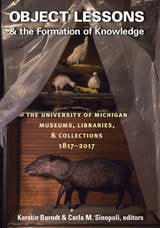
cover of Object Lessons and the Formation of Knowledge: The University of Michigan Museums, Libraries, and Collections 1817–2017

Object Lessons and the Formation of Knowledge

The University of Michigan Museums, Libraries, and Collections 1817–2017

Kerstin Barndt and Carla M. Sinopoli, editors

University of Michigan Press, 2017
Object Lessons and the Formation of Knowledge explores the museums, libraries, and special collections of the University of Michigan on its bicentennial. Since its inception, U-M has collected and preserved objects: biological and geological specimens; ethnographic and archaeological artifacts; photographs and artistic works; encyclopedia, textbooks, rare books, and documents; and many other items. These vast collections and libraries testify to an ambitious vision of the research university as a place where knowledge is accumulated, shared, and disseminated through teaching, exhibition, and publication. Today, two hundred years after the university’s founding, museums, libraries, and archives continue to be an important part of U-M, which maintains more than twenty distinct museums, libraries, and collections. Viewed from a historic perspective, they provide a window through which we can explore the transformation of the academy, its public role, and the development of scholarly disciplines over the last two centuries. Even as they speak to important facets of Michigan’s history, many of these collections also remain essential to academic research, knowledge production, and object-based pedagogy. Moreover, the university’s exhibitions and displays attract hundreds of thousands of visitors per year from the campus, regional, and global communities. Beautifully illustrated with color photographs of these world-renowned collections, this book will appeal to readers interested in the history of museums and collections, the formation of academic disciplines, and of course the University of Michigan.
[more]
cover of Provenance Research for Mediterranean Antiquities: Methods and Resources

Provenance Research for Mediterranean Antiquities

Methods and Resources

Judith Barr

J. Paul Getty Trust, The, 2026

This practical volume is the first to gather resources specific to the provenance of Mediterranean antiquities in an accessible, comprehensive guidebook.

The first of its kind, this book is an accessible, comprehensive primer of methods and resources for researching the provenance of Mediterranean (Greek, Roman, and Etruscan) antiquities. In addition to outlining effective strategies for documentation and investigation, the volume features an annotated guide to key archives, databases, and twentieth-century dealers to facilitate a broad spectrum of research endeavors. Building upon a decade-long review of the Getty Museum’s antiquities collection, it draws together instructive case studies, legal perspectives, and practical experience to provide an efficient reference for museum professionals, scholars, collectors, and students. The authors aim to emphasize the need for diligent provenance research and to shorten the learning curve for such projects.

The free online edition of this open-access publication is available at getty.edu/publications/provenance-research and includes zoomable illustrations. Also available are free PDF and EPUB downloads of the book.
[more]
cover of Still Life: Ecologies of the Modern Imagination at the Art Museum

Still Life

Ecologies of the Modern Imagination at the Art Museum

Fernando Domínguez Rubio

University of Chicago Press, 2020

How do you keep the cracks in Starry Night from spreading? How do you prevent artworks made of hugs or candies from disappearing? How do you render a fading photograph eternal—or should you attempt it at all? These are some of the questions that conservators, curators, registrars, and exhibition designers dealing with contemporary art face on a daily basis. In Still Life, Fernando Domínguez Rubio delves into one of the most important museums of the world, the Museum of Modern Art (MoMA) in New York, to explore the day-to-day dilemmas that museum workers face when the immortal artworks that we see in the exhibition room reveal themselves to be slowly unfolding disasters.

Still Life offers a fascinating and detailed ethnographic account of what it takes to prevent these disasters from happening. Going behind the scenes at MoMA, Domínguez Rubio provides a rare view of the vast technological apparatus—from climatic infrastructures and storage facilities, to conservation labs and machine rooms—and teams of workers—from conservators and engineers to guards and couriers—who fight to hold artworks still.

As MoMA reopens after a massive expansion and rearranging of its space and collections, Still Life not only offers a much-needed account of the spaces, actors, and forms of labor traditionally left out of the main narratives of art, but it also offers a timely meditation on how far we, as a society, are willing to go to keep the things we value from disappearing into oblivion.
[more]
cover of The Library Innovation Toolkit: Ideas, Strategies, and Programs

The Library Innovation Toolkit

Ideas, Strategies, and Programs

Anthony Molaro

American Library Association, 2015

[more]
cover of The Library Liaison's Training Guide to Collection Management

The Library Liaison's Training Guide to Collection Management

Alison M. Armstrong

American Library Association, 2020

Library liaisons often have primary jobs that do not involve collection development, but their familiarity with collection practices makes all the difference in faculty relations. And time pressures mean that on-boarding needs to be as streamlined as possible. This concise, field-tested training manual will put your liaison on solid footing. Plus, end of the chapter prompts make it easy to tailor your approach to local practices. With the help of this resource, your new liaison will get up to speed on such topics as

  • tracking budget balances in assigned departments;
  • differentiating between the needs of an individual faculty member and their department;
  • how to say no to monograph requests;
  • benchmarking titles with peer institutions or coordinating within a consortium;
  • 17 questions to ask when evaluating a database;
  • considerations when making weeding decisions;
  • four key conversations to have annually between liaisons and collection development librarians; and
  • gathering data for program accreditation reports.
[more]
cover of The Museum in the Cultural Sciences: Collecting, Displaying, and Interpreting Material Culture in the Twentieth Century

The Museum in the Cultural Sciences

Collecting, Displaying, and Interpreting Material Culture in the Twentieth Century

Edited by Peter N. Miller

Bard Graduate Center, 2021

In early twentieth-century Berlin, Wilhelm von Bode sparked a controversy with his sweeping proposal to reorganize a group of the city’s museums. Debates about the role and structure of museums played out in 1907 and 1910 with two striking series of articles that appeared in the journal Museumskunde: Journal for the Administration and Technology of Public and Private Collections. The first was a six-part essay by Otto Lauffer on history museums, and the second was a ten-part piece by Oswald Richter regarding ethnographic museums. Together, they initiated a century of significant dialogue.

The Museum in the Cultural Sciences offers the first full English translations of these articles, which remain influential in conversations about the implications of art, historical, and ethnographic museums. They show how sophisticated the discussion of museums and museum display was in the early twentieth century and how much could be gained from revisiting these reflections today. Accompanied by short commentaries from museum professionals, these articles offer an intervention into and intensification of the current debate about the function and purpose of museums.
[more]
cover of The Politics of Collecting: Race and the Aestheticization of Property

The Politics of Collecting

Race and the Aestheticization of Property

Eunsong Kim

Duke University Press, 2024
In The Politics of Collecting, Eunsong Kim traces how racial capitalism and colonialism situated the rise of US museum collections and conceptual art forms. Investigating historical legal and property claims, she argues that regimes of expropriation—rather than merit or good taste—are responsible for popular ideas of formal innovation and artistic genius. In doing so, she details how Marcel Duchamp’s canonization has more to do with his patron’s donations to museums than it does the quality of Duchamp’s work, and she uncovers the racialized and financialized logic behind the Archive of New Poetry’s collecting practices. Ranging from the conception of philanthropy devised by the robber barons of the late nineteenth century to ongoing digitization projects, Kim provides a new history of contemporary art that accounts for the complicated entanglement of race, capital, and labor behind storied art institutions and artists. Drawing on history, theory, and economics, Kim challenges received notions of artistic success and talent and calls for a new vision of art beyond the cultural institution.
[more]
cover of Using and Curating Archaeological Collections

Using and Curating Archaeological Collections

S. Terry Childs

University Press of Colorado, 2019

All archaeologists have responsibilities to support the collections they produce, yet budgeting for and managing collections over the length of a project and beyond is not part of most archaeologists’ training. While this book in the SAA Press Archaeology in Action Series highlights major challenges that archaeologists and curators face with regard to collections, it also stresses the values, uses, and benefits of collections. It also demonstrates the continued significance of archaeological collections to the profession, tribes, and the public and provides critical resources for archaeologists to carry out their responsibilities. Many lament that the archaeological record is finite and disappearing. In this context, collections are even more important to preserve for future use, and this book will help all stakeholders do so.
[more]