Results by title
9 books match the query 'Collective memory in literature'
Changing the Subject
Writing Women across the African DiasporaK. Merinda Simmons
The Ohio State University Press, 2014
The starting point for this study is the nineteenth-century Caribbean narrative The History of Mary Prince (1831). Simmons puts Prince’s narrative in conversation with three twentieth-century novels: Zora Neale Hurston’s Their Eyes Were Watching God, Gloria Naylor’s Mama Day, and Maryse Condé’s I, Tituba, Black Witch of Salem. She incorporates autobiography theory to shift the critical focus from the object of study—slave histories—to the ways people talk about those histories and to the guiding interests of such discourses. In its reframing of women’s migration narratives, Simmons’s study unsettles theoretical certainties and disturbs the very notion of a cohesive diaspora.
Constructing Communities in Vergil's Aeneid
Cultural Memory, Identity, and IdeologyTedd A. Wimperis
University of Michigan Press, 2024
Where previous studies of identity and memory in the Aeneid have focused on the poem’s constructions of Roman identity, Constructing Communities turns the spotlight onto the characters themselves to show how the world inside the poem is replicating, as if in miniature, real forms of contemporary political and cultural discourse, reflecting an historical milieu where appeals to Roman identity were vigorously asserted in political rhetoric. The book applies this evidence to a broad literary analysis of the Aeneid, as well as a reevaluation of its engagement with Roman imperial ideology in the Age of Augustus.
Cultures of War in Graphic Novels
Violence, Trauma, and MemoryProrokova, Tatiana
Rutgers University Press, 2018
Cultures of War in Graphic Novels examines the representation of small-scale and often less acknowledged conflicts from around the world and throughout history. The contributors look at an array of graphic novels about conflicts such as the Boxer Rebellion (1899-1901), the Irish struggle for national independence (1916-1998), the Falkland War (1982), the Bosnian War (1992-1995), the Rwandan genocide (1994), the Israel-Lebanon War (2006), and the War on Terror (2001-). The book explores the multi-layered relation between the graphic novel as a popular medium and war as a pivotal recurring experience in human history. The focus on largely overlooked small-scale conflicts contributes not only to advance our understanding of graphic novels about war and the cultural aspects of war as reflected in graphic novels, but also our sense of the early twenty-first century, in which popular media and limited conflicts have become closely interrelated.
Curating Worlds
Museum Practices in Contemporary LiteratureEmma Bond
Northwestern University Press, 2025
Showing how museum practices shed new light on literary form
How and why do books deploy objects in order to narrate the past? To answer this question, Emma Bond sifts through collections of objects stored in boxes, drawers, baskets, and displayed on shelves in contemporary texts by authors such as Valeria Luiselli, Maaza Mengiste, Orhan Pamuk, and Olga Tokarczuk and interprets them using a framework of museum practices. These practices, which include collection, curation, conservation, and display, have helped to turn real-life museums into three-dimensional narrative spaces. Curating Worlds: Museum Practices in Contemporary Literature shows how we can use this same set of practices to shed light on literary form itself: how stories are created, shaped, and communicated. Harnessing museum practices as an innovative lens for critical interpretation, Bond provides a fresh theoretical framework to engage with the meanings of object collections in literature and to make sense of the lives, and afterlives, of things today.
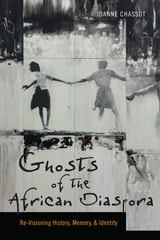
Ghosts of the African Diaspora
Re-Visioning History, Memory, and IdentityJoanne Chassot
Dartmouth College Press, 2018
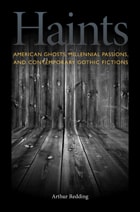
Haints
American Ghosts, Millennial Passions, and Contemporary Gothic FictionsArthur Redding
University of Alabama Press, 2011
In Haints: American Ghosts, Millennial Passions, and Contemporary Gothic Fictions, Arthur Redding argues that ghosts serve as lasting witnesses to the legacies of slaves and indigenous peoples whose stories were lost in the remembrance or mistranslation of history.
Authors such as Toni Morrison and Leslie Marmon Silko deploy the ghost as a means of reconciling their own violently repressed heritage with their identity as modern Americans. And just as our ancestors were haunted by ghosts of the past, today their descendants are haunted by ghosts of contemporary crises: urban violence, racial hatred, and even terrorism. In other cases that Redding studies—such as James Baldwin’s The Evidence of Things Not Seen and Toni Cade Bambara’s Those Bones Are Not My Child—gothic writers address similar crises to challenge traditional American claims of innocence and justice.
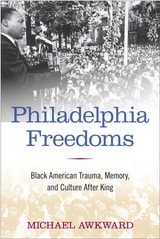
Philadelphia Freedoms
Black American Trauma, Memory, and Culture after KingMichael Awkward
Temple University Press, 2013
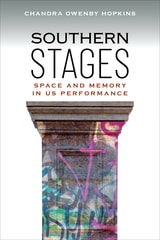
Southern Stages
Space and Memory in US PerformanceHopkins, Chandra
University of Iowa Press, 2025
Through the eyes of actors and everyday people, Southern Stages offers an engaging new model for interrogating the performance of southernness, as well as how memory and imagination intersect in spaces that have shaped hundreds of years of American history. Chandra Owenby Hopkins employs cultural memory and lived realities of Black and white communities to examine the earliest and most enduring southern stages: the playhouse and the public square.
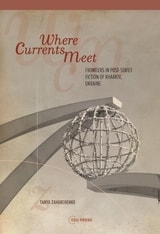
Where Currents Meet
Frontiers of Memory in Post-Soviet Fiction of Kharkiv, UkraineTanya Zaharchenko
Central European University Press, 2016
Where Currents Meet, Tanya Zaharchenko’s path-breaking study of literature and cultural memory, moves decisively beyond the simplistic view of a post-Soviet Ukraine divided between east and west. It positions the Ukrainian and Russian components of cultural experience in the country’s east as elements of a complex continuum. Combining insights from memory studies and border studies, Zaharchenko analyzes a generation of younger riters in the city of Kharkiv—a “doubletake generation” that came of age at the time of the Soviet Union’s collapse and now revisits this experience through fiction. In the works of Serhiy Zhadan, Andreĭ Krasniashchikh, Yuri Tsaplin, Oleh Kotsarev, and others the author reveals how borderlands and frontiers, both geographical and conceptual, acquire zonal qualities of their own as these writers navigate the historical legacy they have inherited.