Results by title
15 books match the query 'College administrators'

A Chancellor's Tale
Transforming Academic MedicineRalph Snyderman, MD
Duke University Press, 2016

A Man in Charge
A NovelMorris Philipson
University of Chicago Press, 2000
Burnin' Daylight
Building a Principle-Driven Writing ProgramRyan J. Dippre
Utah State University Press, 2024
WPAs face a range of challenges on a regular basis: organizing class schedules, leading professional learning events, conducting program assessments, responding to student needs, meeting with deans and provosts, and more. Additionally, WPAs need to learn about and direct their programs strategically when considering the kind of program they currently have, the sort of program they envision, and how they can transition from one to another. Burnin’ Daylight acts as a roadmap for IRB-approved research and provides WPAs—specifically, new and returning WPAs—with a detailed yet flexible plan for understanding the inner workings of a writing program and how to develop a future trajectory for it.
Burnin’ Daylight is for writing program administrators of all experience levels and other administrators interested in taking a “principled practices” approach to their work.
Divided Conversations
Identities, Leadership, and Change in Public Higher EducationKristin G. Esterberg
Vanderbilt University Press, 2013
Many faculty believe that one of their own who becomes an administrator has gone over to "the dark side." One provost recalled going for a beer with a faculty colleague and hearing the colleague complain about the latest memo "from the administration." He had to remind his friend of many years that he was the author of the offending document. Now he was "the administration." He realized that former colleagues now appeared in his office wearing suits and ties and referring to him by his title rather than his first name.
The disciplines serve as the tribes into which individual scholars are organized; the discipline is where a faculty member finds his community and identity. Administrators, on the other hand, identify with each other in trying to get the tribes to work together. Though most administrators came from the faculty ranks, their career paths take a different shape, especially in terms of mobility to another institution. It's not surprising that the two groups talk past each other.
A chapter is devoted to chairs of departments, who occupy an interesting middle ground. To their faculty, they can come across as a nurturing parent or a petty bureaucrat. The authors recommend training for chairs and administrative internships offered by the American Council on Education and other organizations.
The men and women on the campuses of the public universities described in the book make clear the challenges that universities face in terms of budgets, legislative politics, collective bargaining, rankings, and control of academic programs. If public institutions are truly to serve a public purpose, faculty and administrators must find ways to engage each other in shared conversation and management and find ways of engaging the university with the community.
Leading for Tomorrow
A Primer for Succeeding in Higher Education LeadershipPamela L. Eddy
Rutgers University Press, 2020
Using an engaging case study approach, Leading for Tomorrow provides readers with real-world examples that will help them reflect on their own management and communication styles. It also shows newly minted administrators how they can follow best practices while still developing a style of leadership that is authentic and uniquely their own.
The book’s case studies offer practical solutions for how to deal with emerging trends and persistent problems in the field of higher education, from decreasing state funding to political controversies on campus. Leading for Tomorrow gives readers the tools they need to get the best out of their team, manage conflicts, support student success, and instill a campus culture of innovation that will meet tomorrow’s challenges.
Making Administrative Work Visible
Data-Driven Advocacy for Understanding the Labor of Writing Program AdministrationLeigh Graziano
Utah State University Press, 2023
The collection has three parts, each of which focuses on the most confounding challenges facing WPAs as well as the most compelling sites of their contributions to administration, labor in higher education, and the discipline’s collective obligation to forwarding the goals of social justice and advocacy: Advocating through Representations of WPA Labor, Advocating by Accounting for Time and Labor, and Advocating in and through Complex Institutional Contexts. The chapters use data to share and track the work functions, job titles, grand narratives, program assessments, tenure and promotion, email practices, and more undertaken by WPAs in their administrative capacities. Chapters also surface narratives for future data and studies to be done by other scholars.
By taking up and answering questions about the range of WPA work—and the invisibility of much of that work—Making Administrative Work Visible creates avenues toward accounting for and acknowledging the complex activity systems in which WPAs lead the work of the university and advocate for data-driven strategies needed to sustain this foundational area of higher education.
Contributors: Kamila Albert, Brooke Anderson, Sheila Carter-Tod, Amy Cicchino, Ana Cortés Lagos, Kristi Murray Costello, Jennifer Cunningham, Ryan Dippre, Kimberly Emmons, Genevieve García de Müeller, Jill Gladstein, Caleb González, Michael Healy, Lyra Hilliard, Kristine Johnson, Seth Kahn, Rita Malenczyk, Troy Mikanovich, Lilian Mina, Angela Mitchell, Greer Murphy, Kate Navickas, Michael Neal, Patti Poblete, Jan Rieman, Heather Robinson, Katelyn Stark, Mary Stewart, Natalie Stillman-Webb, Lizbett Tinoco, Lisa Tremain, Martha Wilson Schaffer

My Iowa Journey
Philip G. Hubbard
University of Iowa Press, 1999
Philip Hubbard's life story begins in 1921 in Macon, a county seat in the Bible Belt of north central Missouri, whose history as a former slave state permeated the culture of his childhood. When he was four his mother moved her family 140 miles north to Des Moines in search of the greater educational opportunity that Iowa offered African American students. In this recounting of the effects of that journey on the rest of his life, Phil Hubbard merges his private and public life and career into an affectionate, powerful, and important story.
Hubbard graduated from the University of Iowa with a degree in electrical engineering in 1946; by 1954 he had received his Ph.D. in hydraulics. The College of Engineering extended a warm academic welcome, but nonacademic matters were totally different: Hubbard was ineligible for the housing and other amenities offered to white students. Intelligent, patient, keenly aware of discrimination yet willing to work from within the university system, he advanced from student to teacher to administrator, retiring in 1991 after decades of leadership in the classroom and the conference room.
Hubbard's major accomplishments included policies that focused on human rights; these policies transformed the makeup of students, faculty, and staff by seeking to eliminate discrimination based on race, religion, or other nonacademic factors and by substituting affirmative action for the traditional old-boy methods of selecting faculty and administrators. At the same time that he was advancing the cause of human rights and cultural diversity in education, his family was growing and thriving, and his descriptions of home life reveal one source of his strength and inspiration.
The decades that Hubbard covers were vital in the evolution of the nation and its educational institutions. His dedication to the agenda of public higher education has always been matched by his sensitivity to the negative effects of discrimination and his gentle perseverance toward his goals of inclusion, acceptance, and fairness. His vivid personal and institutional story will prove valuable at this critical juncture in America's racial history.
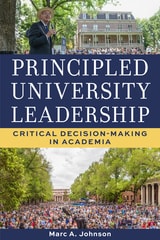
Principled University Leadership
Critical Decision-Making in AcademiaMarc A. Johnson
University of Nevada Press, 2025
Rooted in Johnson’s small-town origins and passion for civic engagement, this narrative offers unique insights into the path to university leadership and the key decisions leaders face. It is an invaluable resource for aspiring and current academic leaders seeking guidance in navigating the complexities of higher education.
Stepping Away
Returning to the Faculty After Senior Academic LeadershipLisa Jasinski
Rutgers University Press, 2023
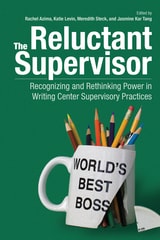
The Reluctant Supervisor
Recognizing and Rethinking Power in Writing Center Supervisory PracticesRachel Azima
Utah State University Press, 2026
The discipline of writing center studies has long emphasized collaboration in every context, including leadership. But what does this emphasis mean for supervision, which is inherently hierarchical? The Reluctant Supervisor attends to how power—institutional, racial, and otherwise—operates in work relationships, staff policies, and administrative decisions.
Giving sustained attention to writing center administrators as supervisors (in addition to their roles as leaders, directors, mentors, and teachers), contributors write from the specificities of their local contexts, institutional positions, and embodied histories in ways that deepen our understanding of writing center supervisory practice.
The Reluctant Supervisor wrestles with the tensions, contradictions, and challenges necessary to name, own, and recognize supervision as a fundamental part of writing center work. It provides valuable perspectives for aspiring, new, and experienced writing center professionals and others in higher education looking to develop a more reflective supervisory practice—especially those who want to center equity and justice in their workplaces.
The Way It Was
Duane C. Spriestersbach
University of Iowa Press, 1999
The fall of 1964 was an exciting time at the University of Iowa. Its fourteenth president, Howard Bowen, had just arrived, and on a sunny October afternoon he made his first speech to the faculty. This occasion was note worthy enough—former president Virgil Hancher had held the job for twenty-four years—to attract the attention of a professor of speech pathology who had previously confined his considerable energies to teaching and research. Bowen's vision of what the university could become was so intriguing, so compelling, that this professor wrote and offered to help him achieve his objectives in any way possible. This quixotic offer changed Duane Spriestersbach's life and becomes the starting point for his story of his years as a University of Iowa administrator.
Drawing upon his personal files, the university archives, and interviews with many faculty members and administrators, Spriestersbach has created both an institutional and a personal history of the university. Judged by any standard, these years were tumultuous ones for higher education. Economic pressures from the state legislature, issues surrounding grants from such agencies as the National Institutes of Health and the National Science Foundation, the civil rights movement, student and faculty protests during the Vietnam era, massive changes in the physical and administrative shape of the campus, and the computerization of all parts of campus life had far-reaching consequences. Spriestersbach was at the center of these events at the University of Iowa; his perspective is unique, refreshing, and educational.
Spriestersbach's account of the Vietnam years and of the evolution of computers at Iowa will be particularly interesting to readers. He reported to four presidents, served as acting president, managed hundreds of meetings both dramatic and mundane, and reacted to many administrative restructurings. In this story of his life at the University of Iowa, he reveals the truth behind these words from his 1964 letter to President Bowen: “I think I am an idealist, a person with imagination, and a guy in a hurry. I believe investigation will show that I am a person with competitive administrative and executive abilities.”
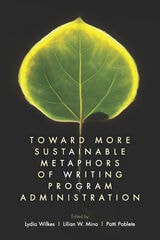
Toward More Sustainable Metaphors of Writing Program Administration
edited by Lydia Wilkes, Lilian W. Mina, and Patti Poblete afterword by Douglas Hesse
Utah State University Press, 2022
This volume presents twelve chapters that reclaim and revise established metaphors; offer new metaphors based on sustainable, relational, or emotional labor practices and phenomena; and reveal the improvisational, artisanal nature of WPA work. Chapters resonate across three sections. The first section focuses on organic relationships captured in phrases like “putting out fires” and "seeing forests for the trees” alongside unexpected comparisons to ground and light. The second describes institutional landscapes featuring generative juxtapositions such as the WPA as a labor activist or a mapper of emotional geography. And the third discusses performance crafts like improv comedy and artisanal making.
Toward More Sustainable Metaphors of Writing Program Administration offers new and revised ways of thinking and acting for WPAs, who are constantly negotiating the paradoxical demands of their work and continually striving to act ethically in conflicted, and even fraught, situations. It will inspire practicing, aspiring, and former WPAs working in a time of transformation by highlighting more sustainable ways of enacting WPA identity.
Contributors: Jacob Babb, John Belk, Katherine Daily O'Meara, Ryan J. Dippre, Douglas Hesse, Andrew Hollinger, Rona Kaufman, Cynthia D. Mwenja, Manny Piña, Scott Rogers, Robyn Tasaka, Alexis Teagarden, Christy I. Wenger, Lydia Wilkes
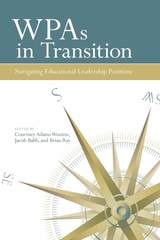
WPAs in Transition
Navigating Educational Leadership PositionsCourtney Adams Wooten
Utah State University Press, 2017
WPAs in Transition shares a wide variety of professional and personal perspectives about the costs, benefits, struggles, and triumphs experienced by writing program administrators making transitions into and out of leadership positions. Contributors to the volume come from various positions, as writing center directors, assistant writing program administrators, and WPAs; mixed settings, including community colleges, small liberal arts colleges, and research institutions; and a range of career stages, from early to retiring. They recount insightful anecdotes and provide a scholarly context in which WPAs can share experiences related to this long-ignored aspect of their work.
During such transitions, WPAs and other leaders who function as both administrators and faculty face the professional and personal challenges of redefining who they are, the work they do, and with whom they collaborate. WPAs in Transition creates a grounded and nuanced experiential understanding of what it means to navigate changing roles, advancing the dialogue around WPAs’ and other administrators’ identities, career paths, work-life balance, and location, and is a meaningful addition to the broader literature on administration and leadership.
Contributors: Mark Blaauw-Hara, Christopher Blankenship, Jennifer Riley Campbell, Nicole I. Caswell, Richard Colby, Steven J. Corbett, Beth Daniell, Laura J. Davies, Jaquelyn Davis, Holland Enke, Letizia Guglielmo, Beth Huber, Karen Keaton Jackson, Rebecca Jackson, Tereza Joy Kramer, Jackie Grutsch McKinney, Kerri K. Morris, Liliana M. Naydan, Reyna Olegario, Kate Pantelides, Talinn Phillips, Andrea Scott, Paul Shovlin, Bradley Smith, Cheri Lemieux Spiegel, Sarah Stanley, Amy Rupiper Taggart, Molly Tetreault, Megan L. Titus, Chris Warnick
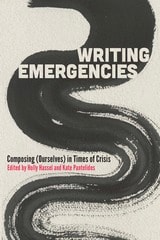
Writing Emergencies
Composing (Ourselves) in Times of CrisisHolly Hassel
Utah State University Press, 2026
Despite the adage “there are no writing emergencies,” at times situations invite or require immediate written response. In a modern era of social media and with the constancy of “crisis,” knowing when, how, and why to respond quickly is increasingly important. In Writing Emergencies, a diverse group of authors contribute scholarly, narrative-based discussions of writing emergencies, descriptions of more and less successful strategies, and a reflective conclusion that offers implications for writing studies praxis and theory.
In this collection, contributors demonstrate the reality of writing emergencies—in their own writing lives, classrooms, and programs—and they offer both self- and community-focused approaches for response. Chapters focus on discernment and prioritization, recognizing that all stressors are not necessarily emergencies. Instead, expanding our vocabulary for (and subsequent understanding) of the kinds of difficulties we come across can build our professional capacity and support greater career sustainability. The volume also illustrates the role of coalitions in navigating writing emergencies and how purposefully building and activating these coalitions subverts some challenges before they become emergencies, particularly those that are recurrent or manufactured.
Writing Emergencies both names and grapples with writing emergencies and offers insights for capacity-building in the acts of filtering and prioritizing competing urgent demands. The findings are meaningful for all leaders, students, and teachers who center care in their relationships with others.

Yo Soy
From a Migrant Field Worker to a University ProfessorRoberto E. Villarreal
University of North Texas Press, 2025