Results by title
4 books match the query 'Colonial Modernity'
Formations of Colonial Modernity in East Asia
Tani E. Barlow, ed.
Duke University Press, 1997
The essays in Formations of Colonial Modernity in East Asia challenge the idea that notions of modernity and colonialism are mere imports from the West, and show how colonial modernity has evolved from and into unique forms throughout Asia. Although the modernity of non-European colonies is as indisputable as the colonial core of European modernity, until recently East Asian scholarship has tried to view Asian colonialism through the paradigm of colonial India (for instance), failing to recognize anti-imperialist nationalist impulses within differing Asian countries and regions.
Demonstrating an impatience with social science models of knowledge, the contributors show that binary categories focused on during the Cold War are no longer central to the project of history writing. By bringing together articles previously published in the journal positions: east asia cultures critique, editor Tani Barlow has demonstrated how scholars construct identity and history, providing cultural critics with new ways to think about these concepts—in the context of Asia and beyond.
Chapters address topics such as the making of imperial subjects in Okinawa, politics and the body social in colonial Hong Kong, and the discourse of decolonization and popular memory in South Korea. This is an invaluable collection for students and scholars of Asian studies, postcolonial studies, and anthropology.
Contributors. Charles K. Armstrong, Tani E. Barlow, Fred Y. L. Chiu, Chungmoo Choi, Alan S. Christy, Craig Clunas, James A. Fujii, James L. Hevia, Charles Shiro Inouye, Lydia H. Liu, Miriam Silverberg, Tomiyama Ichiro, Wang Hui
[more]
Intimate Empire
Collaboration and Colonial Modernity in Korea and JapanNayoung Aimee Kwon
Duke University Press, 2015
In Intimate Empire Nayoung Aimee Kwon examines intimate cultural encounters between Korea and Japan during the colonial era and their postcolonial disavowal. After the Japanese empire’s collapse in 1945, new nation-centered histories in Korea and Japan actively erased these once ubiquitous cultural interactions that neither side wanted to remember. Kwon reconsiders these imperial encounters and their contested legacies through the rise and fall of Japanese-language literature and other cultural exchanges between Korean and Japanese writers and artists in the Japanese empire. The contrast between the prominence of these and other forums of colonial-era cultural collaboration between the colonizers and the colonized, and their denial in divided national narrations during the postcolonial aftermath, offers insights into the paradoxical nature of colonial collaboration, which Kwon characterizes as embodying desire and intimacy with violence and coercion. Through the case study of the formation and repression of imperial subjects between Korea and Japan, Kwon considers the imbrications of colonialism and modernity and the entwined legacies of colonial and Cold War histories in the Asia-Pacific more broadly.
[more]
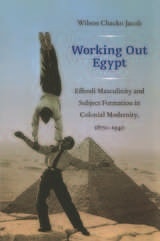
Working Out Egypt
Effendi Masculinity and Subject Formation in Colonial Modernity, 1870–1940Wilson Chacko Jacob
Duke University Press, 2011
Working Out Egypt is both a rich cultural history of the formation of an Egyptian national subject in the late nineteenth century and early twentieth and a compelling critique of modern Middle Eastern historiography. Wilson Chacko Jacob describes how Egyptian men of a class akin to the cultural bourgeoisie (the effendiyya) struggled to escape from the long shadow cast by colonial depictions of the East as degenerate, feminine, and temporally behind an active and virile Europe. He argues that during British colonial rule (1882–1936), attempts to create a distinctively modern and Egyptian self free from the colonial gaze led to the formation of an ambivalent, performative subjectivity that he calls “effendi masculinity.” Jacob traces effendi masculinity as it took hold during the interwar years, in realms from scouting and competitive sports to sex talk and fashion, considering its gendered performativity in relation to a late-nineteenth-century British discourse on masculinity and empire and an explicitly nationalist discourse on Egyptian masculinity. He contends that as an assemblage of colonial modernity, effendi masculinity was simultaneously local and global, national and international, and particular and universal. Until recently, modern Egyptian history has not allowed for such paradoxes; instead, Egyptian modernity has been narrated in the temporal and spatial terms of a separate Western modernity.
[more]
Yellow Music
Media Culture and Colonial Modernity in the Chinese Jazz AgeAndrew F. Jones
Duke University Press, 2001
Yellow Music is the first history of the emergence of Chinese popular music and urban media culture in early-twentieth-century China. Andrew F. Jones focuses on the affinities between "yellow” or “pornographic" music—as critics derisively referred to the "decadent" fusion of American jazz, Hollywood film music, and Chinese folk forms—and the anticolonial mass music that challenged its commercial and ideological dominance. Jones radically revises previous understandings of race, politics, popular culture, and technology in the making of modern Chinese culture.
The personal and professional histories of three musicians are central to Jones's discussions of shifting gender roles, class inequality, the politics of national salvation, and emerging media technologies: the American jazz musician Buck Clayton; Li Jinhui, the creator of "yellow music"; and leftist Nie Er, a former student of Li’s whose musical idiom grew out of virulent opposition to this Sinified jazz. As he analyzes global media cultures in the postcolonial world, Jones avoids the parochialism of media studies in the West. He teaches us to hear not only the American influence on Chinese popular music but the Chinese influence on American music as well; in so doing, he illuminates the ways in which both cultures were implicated in the unfolding of colonial modernity in the twentieth century.
The personal and professional histories of three musicians are central to Jones's discussions of shifting gender roles, class inequality, the politics of national salvation, and emerging media technologies: the American jazz musician Buck Clayton; Li Jinhui, the creator of "yellow music"; and leftist Nie Er, a former student of Li’s whose musical idiom grew out of virulent opposition to this Sinified jazz. As he analyzes global media cultures in the postcolonial world, Jones avoids the parochialism of media studies in the West. He teaches us to hear not only the American influence on Chinese popular music but the Chinese influence on American music as well; in so doing, he illuminates the ways in which both cultures were implicated in the unfolding of colonial modernity in the twentieth century.
[more]