Results by title
7 books match the query 'Comets'
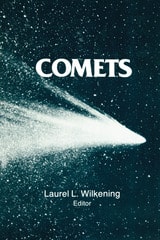
Comets
Laurel L. Wilkening
University of Arizona Press, 1982
"The volume is highly recommended to all interested in comets and the Solar System."—Journal of the British Astronomical Association
"A good representation of the studies that are currently being done on comets, and it is an extremely good source of information on a wide variety of topics."—International Comet Quarterly
"Extremely well-written and informative. . . . A must for library collections."—The Observatory

Comets
Laurel L. Wilkening
University of Arizona Press, 1982
"The volume is highly recommended to all interested in comets and the Solar System."—Journal of the British Astronomical Association
"A good representation of the studies that are currently being done on comets, and it is an extremely good source of information on a wide variety of topics."—International Comet Quarterly
"Extremely well-written and informative. . . . A must for library collections."—The Observatory
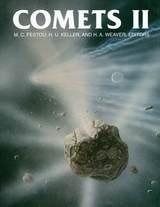
Comets II
Edited by M. C. Festou, H. U. Keller, and H. A. Weaver
University of Arizona Press, 2004
Comets II situates comet science in the global context of astrophysics for the first time by beginning with a series of chapters that describe the connection between stars and planets. It continues with a presentation of the formation and evolution of planetary systems, enabling the reader to clearly see the key role played in our own solar system by the icy planetesimals that were the seeds of the giant planets and transneptunian objects.
The book presents the key results obtained during the 1990s, in particular those collected during the apparition of the exceptional comets C/Hyakutake and C/Hale-Bopp in 1996-1997. The latest results obtained from the in situ exploration of comets P/Borrelly and P/Wild 2 are also discussed in detail.
Each topic of is designed to be accessible to students or young researchers looking for basic, yet detailed, complete and accurate, information on comet science. With its emphasis on the origin of theories and the future of research, Comets II will enable scientists to make connections across disciplinary boundaries and will set the stage for discovery and new understanding in the coming years.
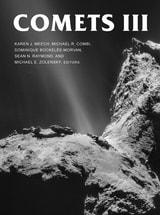
Comets III
Karen J. Meech, Michael R. Combi, Dominique Bockelée-Morvan, Sean N. Raymond, and Michael E. Zolensky
University of Arizona Press, 2024
With the contributions of more than eighty authors spanning twenty-five chapters, Comets III investigates the early solar system origins of comets and the clues provided by the composition and distribution of their present population for their long-term dynamical evolution and interrelations with other members of the solar system. Organized thematically, each section is designed to enable connections across disciplinary boundaries in both planetary science and planetary formation astrophysics.
This comprehensive volume explores recent advancements in space missions, telescopic observations, and robotic surveys, providing new understandings of the origins and dynamics of comets. Intended for both researchers and students, Comets III offers insights into unresolved questions and sets the stage for future advancements.
Hazards Due to Comets and Asteroids
Edited by T. Gehrels
University of Arizona Press, 1995
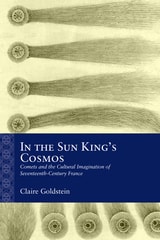
In the Sun King's Cosmos
Comets and the Cultural Imagination of Seventeenth-Century FranceClaire Goldstein
Northwestern University Press, 2025
Offering a new history of a formative cultural and political era through the cosmic phenomena that captured the public’s imagination
In the winters of 1664–65 and 1680–81, the French public was galvanized by two bright comets whose elliptical orbits could not be mapped with contemporary geometry and that thus seemed to appear in random and unpredictable locations. Bookending the period during which Louis XIV’s sun king mythology was created, these comets defied the heliocentric order to which French politics and culture aspired. As Claire Goldstein demonstrates, literary texts, cultural institutions, and architecture inspired by comets offer a different perspective on the relationship between sensory experience, ideology, and artistic form.
In the Sun King’s Cosmos: Comets and the Cultural Imagination of Seventeenth-Century France presents an alternative view of a formative era in cultural and political history, when distinctly modern forms of power and control were established through a regime of the spectacular. Goldstein shows how comets allow us to see the seventeenth century in ways that complicate the narrative of a race toward rationalization, classicism, and modernity, indexing instead a messy period in which the spectacular was sometimes also inscrutable.
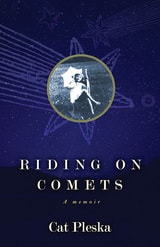
Riding on Comets
A MemoirCat Pleska
West Virginia University Press, 2015
Riding on Comets is the true story of an only child growing up in a working-class family during the 1950s and ‘60s.
As the family storyteller, Cat Pleska whispers and shouts about her life growing up around savvy, strong women and hard-working, hard-drinking men. Unlike many family stories set within Appalachia, this story provides an uncommon glimpse into this region: not coal, but an aluminum plant; not hollers, but small-town America; not hillbillies, but a hard-working family with traditional values.
From the dinner table, to the back porch, to the sprawling countryside, Cat Pleska reveals the sometimes tender, sometimes frightening education of a child who listens at the knees of these giants. She mimics and learns every nuance, every rhythm—how they laugh, smoke, cuss, fight, love, and tell stories—as she unwittingly prepares to carry their tales forward, their words and actions forever etched in her mind. And finally, she discovers a life story of her own.