Results by title
32 books match the query 'Commentary & Opinion'
Big Brother and the Grim Reaper
Political Life After DeathBenjamin Ginsberg
Michigan State University Press, 2024
Bring Back the Bureaucrats
Why More Federal Workers Will Lead to Better (and Smaller!) GovernmentJohn DiIulio
Templeton Press, 2014
In Bring Back the Bureaucrats, John J. DiIulio Jr., one of America’s most respected political scientists and an adviser to presidents in both parties, summons the facts and statistics to show us how America’s big government works and why reforms that include adding a million more people to the federal workforce by 2035 might help to slow government’s growth while improving its performance.
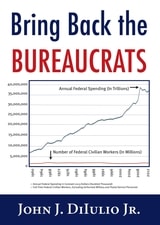
Starting from the underreported reality that the size of the federal workforce hasn’t increased since the early 1960s, even though the federal budget has skyrocketed. The number of federal programs has ballooned; Bring Back the Bureaucrats tells us what our elected leaders won’t: there are not enough federal workers to work for our democracy effectively.
DiIulio reveals that the government in America is Leviathan by Proxy, a grotesque form of debt-financed big government that guarantees terrible government. Washington relies on state and local governments, for-profit firms, and nonprofit organizations to implement federal policies and programs. Big-city mayors, defense industry contractors, nonprofit executives, and other national proxies lobby incessantly for more federal spending. This proxy system chokes on chores such as cleaning up toxic waste sites, caring for hospitalized veterans, collecting taxes, handling plutonium, and policing more than $100 billion annually in “improper payments.” The lack of competent, well-trained federal civil servants resulted in the failed federal response to Hurricane Katrina and the troubled launch of Obamacare’s “health exchanges.”
Bring Back the Bureaucrats is further distinguished by the presence of E. J. Dionne Jr. and Charles Murray, two of the most astute voices from the political left and right, respectively, who offer their candid responses to DiIulio at the end of the book.
Conspiracy Theory in America
By Lance deHaven-Smith
University of Texas Press, 2013
Ever since the Warren Commission concluded that a lone gunman assassinated President John F. Kennedy, people who doubt that finding have been widely dismissed as conspiracy theorists, despite credible evidence that right-wing elements in the CIA, FBI, and Secret Service—and possibly even senior government officials—were also involved. Why has suspicion of criminal wrongdoing at the highest levels of government been rejected out-of-hand as paranoid thinking akin to superstition?
Conspiracy Theory in America investigates how the Founders’ hard-nosed realism about the likelihood of elite political misconduct—articulated in the Declaration of Independence—has been replaced by today’s blanket condemnation of conspiracy beliefs as ludicrous by definition. Lance deHaven-Smith reveals that the term “conspiracy theory” entered the American lexicon of political speech to deflect criticism of the Warren Commission and traces it back to a CIA propaganda campaign to discredit doubters of the commission’s report. He asks tough questions and connects the dots among five decades’ worth of suspicious events, including the assassinations of John and Robert Kennedy, the attempted assassinations of George Wallace and Ronald Reagan, the crimes of Watergate, the Iran-Contra arms-for-hostages deal, the disputed presidential elections of 2000 and 2004, the major defense failure of 9/11, and the subsequent anthrax letter attacks.
Sure to spark intense debate about the truthfulness and trustworthiness of our government, Conspiracy Theory in America offers a powerful reminder that a suspicious, even radically suspicious, attitude toward government is crucial to maintaining our democracy.

Defence and the UK Constitution
Nigel D. White
Haus Publishing, 2025
Defense and security policy lies at the heart of the British state but can appear entirely untrammeled by the constitution. In fact, when political and military leaders exercise their executive powers, the UK Parliament and the judiciary have limited oversight, let alone control, over their actions. Defence and the UK Constitution introduces key constitutional issues to a general audience and pinpoints the differences between the “legal constitution” and the “political constitution,” with reference to the lack of accountability within modern British security structures. Nigel White traces this imbalance back to the 1680 Bill of Rights and examines the evolution of war and emergency powers, placing them within the context of international law.
Advocating for a rebalancing of the efficient and democratic, as well as the legal and political, elements of the constitution, this short work aims to address the inherent “defense paradox” in the UK constitution and to indicate which constitutional changes are needed to safeguard Britain’s democratic principles and limit excessive uses of discretionary power.
Democracy in the Time of Coronavirus
Danielle Allen
University of Chicago Press, 2022
The COVID-19 pandemic has demonstrated some of the strengths of our society, including the rapid development of vaccines. But the pandemic has also exposed its glaring weaknesses, such as the failure of our government to develop and quickly implement strategies for tracing and containing outbreaks as well as widespread public distrust of government prompted by often confusing and conflicting choices—to mask, or not to mask. Even worse is that over half a million deaths and the extensive economic devastation could have been avoided if the government had been prepared to undertake comprehensive, contextually-sensitive policies to stop the spread of the disease.
In Democracy in the Time of Coronavirus, leading political thinker Danielle Allen untangles the US government’s COVID-19 victories and failures to offer a plan for creating a more resilient democratic polity—one that can better respond to both the present pandemic and future crises. Looking to history, Allen also identifies the challenges faced by democracies in other times that required strong government action. In an analysis spanning from ancient Greece to the Reconstruction Amendments and the present day, Allen argues for the relative effectiveness of collaborative federalism over authoritarian compulsion and for the unifying power of a common cause. But for democracy to endure, we—as participatory citizens—must commit to that cause: a just and equal social contract and support for good governance.
Dreams Derailed
Undocumented Youths in the Trump EraWilliam A. Schwab
University of Arkansas Press, 2018
During the 2016 presidential campaign millions of voters, concerned about the economic impact of illegal immigration, rallied behind the notion of a border wall between the United States and Mexico. Well into the Trump presidency, immigration endures as a hotly contested issue in United States politics.
In Dreams Derailed sociologist William A. Schwab shares the stories of immigration reform advocates and follows up on stories told in his 2013 book Right to DREAM, which argued in favor of the DREAM Act that would have provided conditional residency for undocumented youth brought to the United States as children, a version of which was later enacted by executive order and referred to as DACA (Deferred Action for Childhood Arrivals).
Taking as its focal point the Trump administration’s decision to rescind Obama-era DACA protection, Dreams Derailed delves into the economic, political, and social factors that inform the public conversation about immigration, making a clear case for the many benefits of inclusive policies and the protection of undocumented youths. Schwab also takes a close look at the factors that carried Donald Trump to the White House, demonstrates how economic upheaval and the issue of immigration influenced the 2016 presidential election, analyzes current immigration laws, and suggests next steps for reform.
Ed Garvey Unvarnished
Lessons from a Visionary ProgressiveRob Zaleski
University of Wisconsin Press, 2019
Shortly before he died, Garvey expressed his views on everything in a series of detailed, no-holds-barred interviews with journalist Rob Zaleski. In his trademark witty, blunt, and often abrasive style, he offered his impressions of the political climate, worries about the environment, and Act 10 protests on Capitol Square. Garvey's candor during these conversations provides deeper insight into the personal highs and lows he experienced over his rich life. Diehard followers will fondly remember his energetic campaigns, but they may be surprised to learn of his long-simmering disappointment after those losses. Ever timely and meaningful, Garvey's words offer a path for how the Democratic Party, both within Wisconsin and nationally, can regain its soul.
Enchanted America
How Intuition and Reason Divide Our PoliticsJ. Eric Oliver and Thomas J. Wood
University of Chicago Press, 2018
The answer, according to J. Eric Oliver and Thomas J. Wood, can be found in the most important force shaping American politics today: human intuition. Much of what seems to be irrational in American politics arises from the growing divide in how its citizens make sense of the world. On one side are rationalists. They use science and reason to understand reality. On the other side are intuitionists. They rely on gut feelings and instincts as their guide to the world. Intuitionists believe in ghosts and End Times prophecies. They embrace conspiracy theories, disbelieve experts, and distrust the media. They are stridently nationalistic and deeply authoritarian in their outlook. And they are the most enthusiastic supporters of Donald Trump. The primary reason why Trump captured the presidency was that he spoke about politics in a way that resonated with how Intuitionists perceive the world. The Intuitionist divide has also become a threat to the American way of life. A generation ago, intuitionists were dispersed across the political spectrum, when most Americans believed in both God and science. Today, intuitionism is ideologically tilted toward the political right. Modern conservatism has become an Intuitionist movement, defined by conspiracy theories, strident nationalism, and hostility to basic civic norms.
Enchanted America is a clarion call to rationalists of all political persuasions to reach beyond the minority and speak to intuitionists in a way they understand. The values and principles that define American democracy are at stake.
False Black Power?
Jason L. Riley
Templeton Press, 2017
Black civil rights leaders have long supported ethnic identity politics and prioritized the integration of political institutions, and seldom has that strategy been questioned. In False Black Power?, Jason L. Riley takes an honest, factual look at why increased black political power has not paid off in the ways that civil rights leadership has promised.
Recent decades have witnessed a proliferation of black elected officials, culminating in the historic presidency of Barack Obama. However, racial gaps in employment, income, homeownership, academic achievement, and other measures not only continue but in some cases have even widened. While other racial and ethnic groups in America have made economic advancement a priority, the focus on political capital for blacks has been a disadvantage, blocking them from the fiscal capital that helped power upward mobility among other groups.
Riley explains why the political strategy of civil rights leaders has left so many blacks behind. The key to black economic advancement today is overcoming cultural handicaps, not attaining more political power. The book closes with thoughtful responses from key thought leaders Glenn Loury and John McWhorter.
Humanity's Last Stand
Confronting Global CatastropheMark Schuller
Rutgers University Press, 2021
Humanity’s Last Stand dares to ask these big questions, exploring the interconnections between climate change, global capitalism, xenophobia, and white supremacy. As it unearths how capitalism was born from plantation slavery and the slaughter of Indigenous people, it also invites us to imagine life after capitalism. The book teaches its readers how to cultivate an anthropological imagination, a mindset that remains attentive to local differences even as it identifies global patterns of inequality and racism.
Surveying the struggles of disenfranchised peoples around the globe from frontline communities affected by climate change, to #BlackLivesMatter activists, to Indigenous water protectors, to migrant communities facing increasing hostility, anthropologist Mark Schuller argues that we must develop radical empathy in order to move beyond simply identifying as “allies” and start acting as “accomplices.” Bringing together the insights of anthropologists and activists from many cultures, this timely study shows us how to stand together and work toward a more inclusive vision of humanity before it’s too late.
More information and instructor resources (https://humanityslaststand.org)
I Heart Obama
Erin Aubry Kaplan
University Press of New England, 2016
Justice by Means of Democracy
Danielle Allen
University of Chicago Press, 2023
“A sweeping vision.”—Ezra Klein, The New York Times • “An important book.”—Peter Coy, The New York Times • “Liberals and non-liberals alike should applaud its arrival.”—Max Foley-Keene, Commonweal • “A major work of political philosophy.”—Gregory Laski, Public Books • “Compelling. . . . Superb.”—Josiah Ober • “Without doubt one of the most important books ever written on democracy.”—Margeret Levi
From leading thinker Danielle Allen, a bold and urgent articulation of a new political philosophy: power-sharing liberalism.
At a time of great social and political turmoil, when many residents of the leading democracies question the ability of their governments to deal fairly and competently with serious public issues, and when power seems more and more to rest with the wealthy few, this book reconsiders the very foundations of democracy and justice. Scholar and writer Danielle Allen argues that the surest path to a just society in which all are given the support necessary to flourish is the protection of political equality; that justice is best achieved by means of democracy; and that the social ideals and organizational design principles that flow from recognizing political equality and democracy as fundamental to human well-being provide an alternative framework not only for justice but also for political economy. Allen identifies this paradigm-changing new framework as “power-sharing liberalism.”
Liberalism more broadly is the philosophical commitment to a government grounded in rights that both protect people in their private lives and empower them to help govern public life. Power-sharing liberalism offers an innovative reconstruction of liberalism based on the principle of full inclusion and non-domination—in which no group has a monopoly on power—in politics, economy, and society. By showing how we all might fully share power and responsibility across all three sectors, Allen advances a culture of civic engagement and empowerment, revealing the universal benefits of an effective government in which all participate on equal terms.

Land of Shame and Glory
Britain 2021–22Peter Hennessy
Haus Publishing, 2023
2021 and 2022 were two of the most turbulent and disruptive years experienced by Britain in peacetime. Land of Shame and Glory: Britain 2021–22 addresses a series of unprecedented challenges that laid bare the fragility of Britain and the Union during this time. Beginning with the chaotic Fall of Kabul, which exposed Britain's military dependence on the United States, through the prolonged, unsatisfying removal of a prime minister—and the economically catastrophic, short-lived tenure of his successor—that further exposed the vulnerabilities of an unwritten constitution; to the country sweltering in record-breaking temperatures amid dire warnings of climate catastrophe; and finally, to the death of a much-loved monarch, who was a point of consistency during decades of tremendous social and technological change. Peter Hennessy considers the continuities and upheavals of the last seventy years, asking whether there can be said to have been a second Elizabethan Age and lamenting that the post-war period came to its close amid such upheaval and loss.
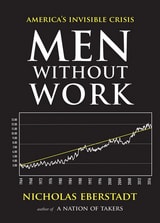
Men Without Work
America's Invisible CrisisNicholas Eberstadt
Templeton Press, 2016
By one reading, things look pretty good for Americans today: the country is richer than ever before and the unemployment rate is down by half since the Great Recession—lower today, in fact, than for most of the postwar era.
But a closer look shows that something is going seriously wrong. This is the collapse of work—most especially among America’s men. Nicholas Eberstadt, a political economist who holds the Henry Wendt Chair in Political Economy at the American Enterprise Institute, shows that while “unemployment” has gone down, America’s work rate is also lower today than a generation ago—and that the work rate for US men has been spiraling downward for half a century. Astonishingly, the work rate for American males aged twenty-five to fifty-four—or “men of prime working age”—was actually slightly lower in 2015 than it had been in 1940: before the War, and at the tail end of the Great Depression.
Today, nearly one in six prime working age men has no paid work at all—and nearly one in eight is out of the labor force entirely, neither working nor even looking for work. This new normal of “men without work,” argues Eberstadt, is “America’s invisible crisis.”
So who are these men? How did they get there? What are they doing with their time? And what are the implications of this exit from work for American society?
Nicholas Eberstadt lays out the issue and Jared Bernstein from the left and Henry Olsen from the right offer their responses to this national crisis.
For more information, please visit http://menwithoutwork.com.

On the Back of an Envelope
A Life in WritingPeter Hennessy
Haus Publishing, 2025
As one of Britain’s foremost constitutional experts and contemporary historians, Peter Hennessy has spent his professional life unpicking the arcane world of Whitehall and Westminster. He began his career as a journalist for the Times, the Economist, and the Financial Times, developing a network of insider contacts who helped him shine a light on some of the dustiest corners of the British establishment. As a journalist, prize-winning contemporary historian, and political commentator, he has chronicled the workings of the British state with wit, affection, and a healthy sense of the absurd over a five-decade career. Now a crossbench peer, he has, in his own words, “moved in with his exhibits.” Hennessy is also a stalwart of BBC election night coverage and a regular commentator on BBC Radio 4, bringing a historical and constitutional perspective on current events.
In this new volume, he brings together selected journalism, unpublished lectures, and new writing alongside personal recollections and reflections on his time observing postwar Britain, how it is governed, and those who do the governing. He reflects on the making and unmaking of prime ministers from Attlee to Truss, life in the House of Lords, and the changing constitutional landscape in the wake of Brexit and amid uncertainty about the future of the Union. Interspersed with lectures, journalism, and new pieces, Hennessy also looks back at a fascinating career, reflecting on his own experiences as a young green graduate navigating the hard-nosed world of Fleet Street in the 1970s, bringing to life a cast of characters from a world now largely gone. He revisits his time as a public historian, academic, and crossbench peer with a levity reflected in his belief that history is “gossip with footnotes.”
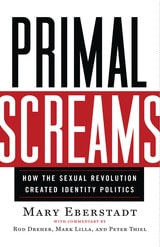
Primal Screams
How the Sexual Revolution Created Identity PoliticsEberstadt, Mary
Templeton Press, 2021
Who am I? The question today haunts every society in the Western world.
Legions of people—especially the young—have become unmoored from a firm sense of self. To compensate, they join the ranks of ideological tribes spawned by identity politics and react with frenzy against any perceived threat to their group.
As identitarians track and expose the ideologically impure, other citizens face the consequences of their rancor: a litany of “isms” run amok across all levels of cultural life, the free marketplace of ideas muted by agendas shouted through megaphones, and a spirit of general goodwill warped into a state of perpetual outrage.
How did we get here? Why have we divided against one another so bitterly? In Primal Screams, acclaimed cultural critic Mary Eberstadt presents the most provocative and original theory to come along in recent years. The rise of identity politics, she argues, is a direct result of the fallout of the sexual revolution, especially the collapse and shrinkage of the family.
As Eberstadt illustrates, humans have forged their identities within the kinship structure from time immemorial. The extended family, in a real sense, is the first tribe and teacher. But with its unprecedented decline across various measures, generations of people have been set adrift and can no longer answer the question Who am I? concerning primordial ties. Desperate for solidarity and connection, they claim membership in politicized groups whose displays of frantic irrationalism amount to primal screams for familial and communal loss.
Written in her impeccable style and with empathy rarely encountered in today’s divisive discourse, Eberstadt’s theory holds immense explanatory power that no serious citizen can afford to ignore. The book concludes with three incisive essays by Rod Dreher, Mark Lilla, and Peter Thiel, each sharing their perspective on the author’s formidable argument.
Reflections
Conversations with Politicians Volume IIPeter Hennessy and Robert Shepherd
Haus Publishing, 2019
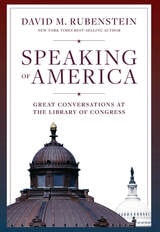
Speaking of America
Great Conversations at the Library of CongressDavid M. Rubenstein
Duke University Press, 2026
Featuring interviews with eminent historians, journalists, and writers, Speaking of America brings together nineteen wide-ranging conversations from philanthropist and financier David M. Rubenstein’s long-running Congressional Dialogues series of interviews at the Library of Congress. Highlights include Ken Burns on documenting American history, Stacy Schiff on Samuel Adams, Manisha Sinha on Reconstruction, and David McCullough on the American frontier.
Published in association with the Library of Congress
Featuring interviews with eminent historians, journalists, and writers, Speaking of America brings together nineteen wide-ranging conversations from philanthropist and financier David M. Rubenstein’s long-running Congressional Dialogues series of interviews at the Library of Congress. Rubenstein and his guests bring to life notable figures, events, and trends drawn from American history and culture and beyond.
Highlights include Ken Burns on bringing American history to life, Stacy Schiff on Samuel Adams, Manisha Sinha on Reconstruction, David McCullough on the American frontier, Beverly Gage on J. Edgar Hoover, Chris Wallace on the presidential election of 1960, Evan Thomas on Justice Sandra Day O’Connor, Eric Schmidt on artificial intelligence, Arthur Brooks on happiness, and David Grann on The Wager, his best-selling story of shipwreck and mutiny. Taken together, the conversations in Speaking of America all build toward the same shared message of dialogue, cooperation, and the importance of knowledge and reflection, highlighting how the study of history can enrich our understanding of current-day challenges in politics and policy.
Speaking of Indigenous Politics
Conversations with Activists, Scholars, and Tribal LeadersJ. Kehaulani Kauanui
University of Minnesota Press, 2018
“A lesson in how to practice recognizing the fundamental truth that every inch of the Americas is Indigenous territory” —Robert Warrior, from the Foreword
Many people learn about Indigenous politics only through the most controversial and confrontational news: the Standing Rock Sioux Tribe’s efforts to block the Dakota Access Pipeline, for instance, or the battle to protect Bears Ears National Monument in Utah, a site sacred to Native peoples. But most Indigenous activism remains unseen in the mainstream—and so, of course, does its significance. J. Kēhaulani Kauanui set out to change that with her radio program Indigenous Politics. Issue by issue, she interviewed people who talked candidly and in an engaging way about how settler colonialism depends on erasing Native peoples and about how Native peoples can and do resist. Collected here, these conversations speak with clear and compelling voices about a range of Indigenous politics that shape everyday life.
Land desecration, treaty rights, political status, cultural revitalization: these are among the themes taken up by a broad cross-section of interviewees from across the United States and from Canada, Mexico, Chile, Bolivia, Peru, Australia, and New Zealand. Some speak from the thick of political action, some from a historical perspective, others from the reaches of Indigenous culture near and far. Writers, like Comanche Paul Chaat Smith, author of Everything You Know about Indians Is Wrong, expand on their work—about gaming and sovereignty, for example, or protecting Native graves, the reclamation of land, or the erasure of Indian identity. These conversations both inform and engage at a moment when their messages could not be more urgent.
Contributors: Jessie Little Doe Baird (Mashpee Wampanoag), Omar Barghouti, Lisa Brooks (Abenaki), Kathleen A. Brown-Pérez (Brothertown Indian Nation), Margaret “Marge” Bruchac (Abenaki), Jessica Cattelino, David Cornsilk (Cherokee Nation), Sarah Deer (Muskogee Creek Nation), Philip J. Deloria (Dakota), Tonya Gonnella Frichner (Onondaga Nation), Hone Harawira (Ngapuhi Nui Tonu), Suzan Shown Harjo (Cheyenne and Hodulgee Muscogee), Rashid Khalidi, Winona LaDuke (White Earth Ojibwe), Maria LaHood, James Luna (Luiseño), Aileen Moreton-Robinson (Quandamooka), Chief Mutáwi Mutáhash (Many Hearts) Marilynn “Lynn” Malerba (Mohegan), Steven Newcomb (Shawnee/Lenape), Jean M. O’Brien (White Earth Ojibwe), Jonathan Kamakawiwo‘ole Osorio (Kanaka Maoli), Steven Salaita, Paul Chaat Smith (Comanche), Circe Sturm (Mississippi Choctaw descendant), Margo Taméz (Lipan Apache), Chief Richard Velky (Schaghticoke), Patrick Wolfe.
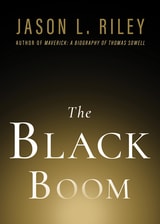
The Black Boom
Riley, Jason L.
Templeton Press, 2021
Economic inequality continues to be one of America’s most hotly debated topics. Still, there has been relatively little discussion of the fact that black-white gaps in joblessness, income, poverty and other measures were shrinking before the pandemic. Why was it happening, and why did this phenomenon go unacknowledged by so much media?
In The Black Boom, Jason L. Riley—acclaimed Wall Street Journal columnist and senior fellow at the Manhattan Institute—digs into the data and concludes that the economic lives of black people improved significantly under policies put into place during the Trump administration. To acknowledge as much is not to endorse the 45th president but to champion policies that achieve a clear moral objective shared by most Americans.
Riley argues that before the Covid-19 pandemic of 2020, the economic fortunes of blacks improved under Trump to an extent unseen under Obama and unseen going back several generations. Black unemployment and poverty reached historic lows, and black wages increased faster than white wages.
Less inequality is something that everyone wants, but disapproval of Trump’s personality and methods too often skewed the media’s appraisal of effective policies advocated by his administration. If we're going to make real progress in improving the lives of low-income minorities, says Riley, we must look beyond our partisan differences at what works and keep doing it. Unfortunately, many press outlets were unable or unwilling to do that.
Riley notes that political reporters were not unaware of this data. Instead, they chose to ignore or downplay it because it was inconvenient. In their view, Trump, because he was a Republican and because he was Trump, had it in for blacks, and thus his policy preferences would be harmful to minorities. To highlight that significant racial disparities were narrowing on his watch—that the administration’s tax and regulatory reforms were mainly boosting the working and middle classes rather than ‘the rich’—would have undermined a narrative that the media preferred to advance, regardless of its veracity.”
As with previous books in our New Threats to Freedom series, The Black Boom includes two essays from prominent experts who take issue with the author’s perspective. Juan Williams, a veteran journalist, and Wilfred Reilly, a political scientist, contribute thoughtful responses to Riley and show that it is possible to share a deep concern for disadvantaged groups while disagreeing on how best to help them.
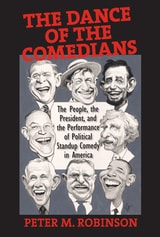
The Dance of the Comedians
The People, the President, and the Performance of Political Standup Comedy in AmericaPeter M. Robinson
University of Massachusetts Press, 2010
Why did Barack Obama court Jon Stewart and trade jokes with Stephen Colbert during the campaign of 2008? Why did Sarah Palin forgo the opportunity to earn votes on the Sunday morning political talk shows but embrace the chance to get laughs on Saturday Night Live? The Dance of the Comedians examines the history behind these questions—the merry, mocking, and highly contested anarchies of standup political comedy that have locked humorists, presidents, and their fellow Americans in an improvisational three-way “dance” since the early years of the American republic.
Peter M. Robinson shows how the performance of political humor developed as a celebration of democracy and an expression of political power, protest, and commercial profit. He places special significance on the middle half of the twentieth century, when presidents and comedians alike—from Calvin Coolidge to Ronald Reagan, from Will Rogers to Saturday Night Live's “Not Ready for Prime Time Players”—developed modern understandings of the power of laughter to affect popular opinion and political agendas, only to find the American audience increasingly willing and able to get in on the act. These years put the long-standing traditions of presidential deference profoundly in play as all three parties to American political humor—the people, the presidents, and the comedy professionals—negotiated their way between reverence for the office of the presidency and ridicule of its occupants.
Although the focus is on humor, The Dance of the Comedians illuminates the process by which Americans have come to recognize that the performance of political comedy has serious and profound consequences for those on all sides of the punch line.
The Dictatorship Syndrome
Alaa Al Aswany
Haus Publishing, 2019
What is the nature of dictatorship? How does it take hold? In what conditions and circumstances is it permitted to thrive? And how do dictators retain power, even when reviled and mocked by those they govern? In this deeply considered and at times provocative short work, Alaa Al Aswany shows us that – as with any disease – to understand the syndrome of dictatorship we must first consider the circumstances of its emergence, along with the symptoms and complications it causes in both the people and the dictator.
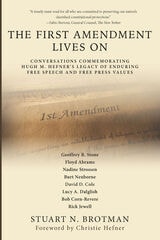
The First Amendment Lives On
Conversations Commemorating Hugh M. Hefner's Legacy of Enduring Free Speech and Free Press ValuesStuart N. Brotman
University of Missouri Press, 2022
Hugh M. Hefner’s legacy of enduring free speech and free press values is embodied in the Hugh M. Hefner First Amendment Awards, established in 1979, which honor leading First Amendment scholars and advocates. Hefner also had a lifelong interest in film censorship issues and supported teaching about them at the University of Southern California for 20 years. His deep commitment to these values was confirmed when the author was granted unrestricted access to over 3,000 personal scrapbooks, which Hefner had kept in order to track free speech and press issues during his lifetime.
The format of the book is an homage to the in-depth conversational interviews Hefner pioneered as the editor and publisher of Playboy magazine. Stuart Brotman conducted in-person conversations with eight persons who in their lifetimes have come to represent a “greatest generation” of free speech and free press scholars and advocates. Notably, these conversations include:
Geoffrey R. Stone
Floyd Abrams
Nadine Strossen
Burt Neuborne
David D. Cole
Lucy A. Dalglish
Bob Corn-Revere
Rick Jewell

The Ground Below Zero
9/11 to Burning Man, New Orleans to Darfur, Haiti to Occupy Wall StreetNicholas Powers
UpSet Press, 0
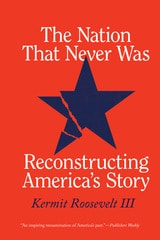
The Nation That Never Was
Reconstructing America's StoryKermit Roosevelt III
University of Chicago Press, 2022
There’s a common story we tell about America: that our fundamental values as a country were stated in the Declaration of Independence, fought for in the Revolution, and made law in the Constitution. But, with the country increasingly divided, this story isn’t working for us anymore—what’s more, it’s not even true. As Kermit Roosevelt argues in this eye-opening reinterpretation of the American story, our fundamental values, particularly equality, are not part of the vision of the Founders. Instead, they were stated in Lincoln’s Gettysburg Address and were the hope of Reconstruction, when it was possible to envision the emergence of the nation committed to liberty and equality.
We face a dilemma these days. We want to be honest about our history and the racism and oppression that Americans have both inflicted and endured. But we want to be proud of our country, too. In The Nation That Never Was, Roosevelt shows how we can do both those things by realizing we’re not the country we thought we were. Reconstruction, Roosevelt argues, was not a fulfillment of the ideals of the Founding but rather a repudiation: we modern Americans are not the heirs of the Founders but of the people who overthrew and destroyed that political order. This alternate understanding of American identity opens the door to a new understanding of ourselves and our story, and ultimately to a better America.
America today is not the Founders’ America, but it can be Lincoln’s America. Roosevelt offers a powerful and inspirational rethinking of our country’s history and uncovers a shared past that we can be proud to claim and use as a foundation to work toward a country that fully embodies equality for all.
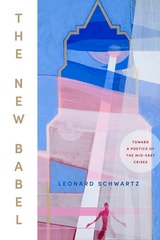
The New Babel
Toward a Poetics of the Mid-East CrisesLeonard Schwartz
University of Arkansas Press, 2016
The New Babel: Toward a Poetics of the Mid-East Crises evokes and investigates—from a Jewish American perspective and in the forms of poetry, essays, and interviews—the Israeli-Palestinian conflict, America’s involvement as both perpetrator and victim of events in the Middle East and Afghanistan, and the multiple ways that poetics can respond to political imperatives.
The poems range from the immediately lyrical to the experimental forms of the “Apple Anyone Sonnets” series, which relies heavily on the Arabic but has Shakespeare as its scaffolding.
In the essays, Schwartz calls on the power of poetry—and of some of the great poets in the Arabic, Jewish, and American traditions—to help rethink the battle lines of the contemporary Mid-East, with the Jewish philosopher Martin Buber looming large.
The interviews provide Schwartz’s discussions with Israeli poet and activist Aharon Shabtai, political philosopher Michael Hardt, and the late, great American poet Amiri Baraka.
In these creative, analytical, and conversational moments, Leonard Schwartz rethinks the battle lines of the contemporary Middle East and calls on the power of language as the essence of our humanity, endlessly fluid, but also the source of an intentional confusion there is a necessity to counter.
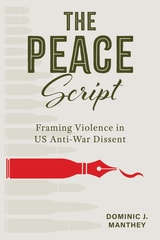
The Peace Script
Framing Violence in US Anti-War DissentDominic J. Manthey
University of Alabama Press, 2025
Exposes how appeals to civility, harmony, and nonaggression can unwittingly underpin exclusionary assumptions about race, gender, and class
Offering an innovative critique of peace rhetoric throughout US history, The Peace Script: Framing Violence in US Anti-War Dissent reexamines the language of dissent with lessons for our era defined by digital activism and fierce political debates. Dominic J. Manthey explores the peace arguments of various movements, including the Copperhead Movement during the Civil War, the Anti-Imperialist League’s stance against US colonialism, Henry Ford's Peace Ship expedition during World War I, the Mothers’ Movement during World War II, and the Vietnam Veterans against the War. Each chapter reveals how these movements, while advocating for peace, often upheld or encouraged racial, gender, and class inequalities.
Manthey navigates the complex terrain of grassroots activism by blending rhetorical criticism and historical insight to tell readers about the “peace script” that has echoed across America’s many wars. Through archival materials and case studies, The Peace Script reveals how anti-war movements craft compelling narratives that dramatize society through heroes, antagonists, and transformative ideals.
Redefining the struggle for peace as not only a fight against warfare but also a battle over space, identity, and the right to live with dignity, The Peace Script is essential for scholars of history, rhetoric, and social justice. Manthey provides a crucial perspective on the intersection of race, memory and power, offering urgent insights into how these legacies continue to shape society today.
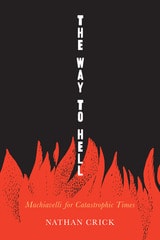
The Way to Hell
Machiavelli for Catastrophic TimesNathan Crick
University of Alabama Press, 2024
An incisive and erudite survey of Machiavelli, the catastrophes of his times and ours, and his counsel for responding to an era of constant crises.
Catastrophe looms. Political, environmental, epidemic, and military crises arrive with increasing frequency. In The Way to Hell, Nathan Crick argues that our perilous times call for the strongest medicine in the Western canon: Machiavelli. Crick reminds contemporary readers about the Florentine master’s advice—that one must learn the road to Hell precisely to avoid taking it.
Like a knowledgeable friend, Crick offers contemporary readers a guide to Machiavelli’s world, work, and warnings. He takes in the sweep of Western history, comparing Machiavelli’s work with ancient sources such as Cicero and Thucydides. And as Machiavelli has never stopped provoking comment, Crick treats readers to a feast of responses to Machiavelli’s work—caustic, learned, and humorous—in the five centuries since he lived.
Including both Machiavelli’s best-known works, The Prince and Discourses on Livy, as well as his personal correspondence and comic plays, Crick asks anew the questions that bedeviled Machiavelli’s beloved Florentine republic: When is force necessary? When are lies justified? Is cruelty defensible? When does social protest slip into violent revolution? What is the correct response to catastrophe?
Like Machiavelli himself, The Way to Hell is witty, stimulating, and challenging. In a world seemingly on the road to Hell, Machiavelli offers an alternative route. His bracing vision exhorts readers to see the dangers in their path and to take action with vigor and determination. Far from a vision of cynicism, Machiavelli offers a beacon of hope for a world that seems on the brink.
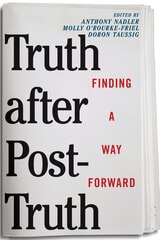
Truth After Post-Truth
Finding a Way ForwardEdited by Anthony Nadler, Molly O’Rourke-Friel, and Doron Taussig
University of Massachusetts Press, 2027
Examining truth, expertise, and authority in the contemporary United States
In an era defined by accusations of “fake news,” declining institutional trust, and deepening political polarization, Truth After Post-Truth reframes the debate about knowledge and democracy in the United States. Rather than treating the so-called post-truth crisis as a failure of public reasoning or the product of bad-faith actors and digital misinformation, this interdisciplinary volume argues that the problem runs deeper and that solutions require renewed democratic deliberation about how public knowledge itself should be produced, evaluated, and shared.
Contributors move beyond familiar diagnoses that blame either misinformed citizens or manipulative media systems. Instead, they interrogate the intellectual and political norms that underwrite claims about truth, expertise, and authority. This book challenges the assumption that restoring democracy depends on returning the public to a fixed set of knowledge practices and calls instead for open debate about which norms and institutions best serve a pluralistic society. Organized around three urgent questions—what relationship a healthy democracy should have to experts, whether a shared and cross-partisan news sphere is necessary or achievable, and whether media reform or media literacy is the more pressing priority—the essays are rigorous, provocative, and often in productive tension with one another. Together, they model the kind of critical engagement needed to rebuild a more resilient democratic information environment.
Timely and forward-looking, Truth After Post-Truth will be essential reading for readers concerned with the future of democratic public life, as well as for scholars and students of media, politics, and communication.
Contributors include the volume editors as well as Mark Andrejevic, Matt Carlson, Vivek Chibber, Belinha de Abreu, John Nerone, Whitney Phillips, Sue Robinson, Michael Schudson, Nik Usher, Andrea Wenzel, and Alex Worsnip.
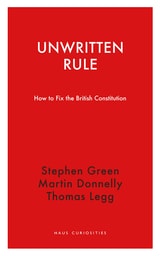
Unwritten Rule
How to Fix the British ConstitutionStephen Green, Thomas Legg, and Martin Donnelly
Haus Publishing, 2021
Not since Ireland broke away from the United Kingdom has the British state been so fragile. Northern Ireland now operates under trading rules that are legally separate from the rest of the nation. In Wales, support for independence is running at a historical high, and Scotland is more conscious than ever of its individual identity and has aspirations for a European future. With public trust and confidence in government at record lows, the United Kingdom faces a crisis that can only be repaired by a new constitutional settlement. Unwritten Rule calls for a radical realignment, embracing a federal approach that would accommodate devolution as the best way of bringing about a successful and diverse national life, increasing democratic control over local and national decision-making, and modernizing national political structures.

Virtue Hoarders
The Case against the Professional Managerial ClassCatherine Liu
University of Minnesota Press, 2021
A denunciation of the credentialed elite class that serves capitalism while insisting on its own progressive heroism
Professional Managerial Class (PMC) elite workers labor in a world of performative identity and virtue signaling, publicizing an ability to do ordinary things in fundamentally superior ways. Author Catherine Liu shows how the PMC stands in the way of social justice and economic redistribution by promoting meritocracy, philanthropy, and other self-serving operations to abet an individualist path to a better world. Virtue Hoarders is an unapologetically polemical call to reject making a virtue out of taste and consumption habits.
Forerunners: Ideas First is a thought-in-process series of breakthrough digital publications. Written between fresh ideas and finished books, Forerunners draws on scholarly work initiated in notable blogs, social media, conference plenaries, journal articles, and the synergy of academic exchange. This is gray literature publishing: where intense thinking, change, and speculation take place in scholarship.
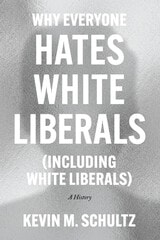
Why Everyone Hates White Liberals (Including White Liberals)
A HistoryKevin M. Schultz
University of Chicago Press, 2025
If there’s one thing most Americans can agree on, it’s that everyone hates white liberals. Conservatives hate them for being culturally tolerant and threatening to usher in communism. Libertarians hate them for believing in the power of the state. Socialists hate them for serving as capitalism’s beard. Even liberals hate liberals—either because they can’t manage to overcome their own prejudices, or precisely because they’re so self-hating.
This is the starting point for Kevin M. Schultz’s lively new history of white liberals in the United States. He efficiently lays out the array of objections to liberals—ineffective, spineless, judgmental, authoritarian, and more—in a historical frame that shows how protean the concept has been throughout the past hundred years. It turns out, he declares, that how you define a “white liberal” is less a reflection of reality and more a Rorschach test revealing your own anxieties.
Sharply assessing how decades of attacks on liberals and liberalism have steadily hollowed out the center of American political life, Schultz also explains precisely what needs to be done to avoid digging ourselves even further into the hole of polarization. The ultimate goal, he argues, is to achieve political fragmentation that will fuel the rise of a true multiparty system, where ideology will matter more, not less.
With a tight command of postwar American history and a spirited voice, Why Everyone Hates White Liberals (Including White Liberals) is a must-read for anyone wishing to understand—and envision a way forward in—the complicated landscape of American politics.