Results by title

8 books match the query 'Common sense'
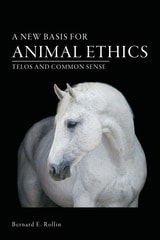
cover of A New Basis for Animal Ethics: Telos and Common Sense

A New Basis for Animal Ethics

Telos and Common Sense

Bernard E. Rollin

University of Missouri Press, 2016
This book, the culmination of forty years of theorizing about the moral status of animals, explicates and justifies society’s moral obligation to animals in terms of the commonsense metaphysics and ethics ofAristotle’s concept of telos. Rollin uses this concept to assert that humans have a responsibility to treat animals ethically. Aristotle used the concept, from the Greek word for "end" or "purpose," as the core explanatory concept for the world we live in. We understand what an animal is by what it does. This is the nature of an animal, and helps us understand our obligations to animals.
 
[more]
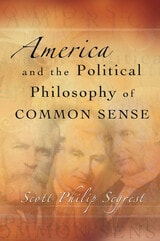
cover of America and the Political Philosophy of Common Sense

America and the Political Philosophy of Common Sense

Scott Philip Segrest

University of Missouri Press, 2009
From Aristotle to Thomas Jefferson, seminal thinkers have declared “common sense” essential for moral discernment and civilized living. Yet the story of commonsense philosophy is not well known today.
 
            In America and the Political Philosophy of Common Sense, Scott Segrest traces the history and explores the personal and social meaning of common sense as understood especially in American thought and as reflected specifically in the writings of three paradigmatic thinkers: John Witherspoon, James McCosh, and William James. The first two represent Scottish Common Sense and the third, Pragmatism, the schools that together dominated American higher thought for nearly two centuries.
 
Educated Americans of the founding period warmly received Scottish Common Sense, Segrest writes, because it reflected so well what they already thought, and he uncovers the basic elements of American common sense in examining the thought of Witherspoon, who introduced that philosophy to them. With McCosh, he shows the furthest development and limits of the philosophy, and with it of American common sense in its Scottish realist phase. With James, he shows other dimensions of common sense that Americans had long embraced but that had never been examined philosophically.
 
            Clearly, Segrest’s work is much more than an intellectual history. It is a study of the American mind and of common sense itself—its essential character and its human significance, both moral and political. It was common sense, he affirms, that underlay the Declaration of Independence and the founders’ ideas of right and obligation that are still with us today. Segrest suggests that understanding this foundation and James’s refreshing of it could be the key to maintaining America’s vital moral core against a growing alienation from common sense across the Western world.
 
Stressing the urgency of understanding and preserving common sense, Segrest’s work sheds new light on an undervalued aspect of American thought and experience, helping us to perceive the ramifications of commonsense philosophy for dignified living.
[more]
cover of Making Sense in Common: A Reading of Whitehead in Times of Collapse

Making Sense in Common

A Reading of Whitehead in Times of Collapse

Isabelle Stengers

University of Minnesota Press, 2023

A leading philosopher seeks to recover “common sense” as a meeting place to reconcile science and philosophy

With her previous books on Alfred North Whitehead, Isabelle Stengers not only secured a reputation as one of the premier philosophers of our times but also inspired a rethinking of critical theory, political thought, and radical philosophy across a range of disciplines. Here, Stengers unveils what might well be seen as her definitive reading of Whitehead.

Making Sense in Common will be greeted eagerly by the growing group of scholars who use Stengers’s work on Whitehead as a model for how to think with conceptual precision through diverse domains of inquiry: environmentalism and ecology, animal studies, media and technology studies, the history and philosophy of science, feminism, and capitalism. On the other hand, the significance of this new book extends beyond Whitehead. Instead, it lies in Stengers’s recovery of the idea of “common sense” as a meeting place—a commons—where opposed ideas of science and humanistic inquiry can engage one another and help to move society forward. Her reconciliation of science and philosophy is especially urgent today—when climate disaster looms all around us, when the values of what we thought of as civilization and modernity are discredited, and when expertise of any kind is under attack.
[more]
cover of The Affection in Between: From Common Sense to Sensing in Common

The Affection in Between

From Common Sense to Sensing in Common

April Flakne

Ohio University Press, 2022
Exposing a fundamental but forgotten capacity to sense with others, this fresh approach to ethics centers on expressive, moving bodies in everyday affective encounters. Common sense has yet to yield its golden promise: robust selves, a stable sense of reality, and bonds of solidarity. The Affection in Between argues that reimagining common sense involves tackling two intractable philosophical puzzles together: the problems of sensory integration and of “other minds.” Construing common sense as either an individual cognitive capacity or a communal body of beliefs and practices, as our tradition of philosophical and political thought has done for too long, constricts possibilities of self and other, ethics and politics. Neither register alone can evade political manipulation and deliver common ground between confident yet unavoidably porous selves. April Flakne begins with a novel interpretation of the neglected Aristotelian concept of sunaisthesis, an embodied, interactive capacity to create overlapping meaning through the cultivation of a sensibility that is neither individual nor communal but unfolds between bodies in movement. Bolstering Aristotle’s concept with classical and contemporary phenomenology, including critical phenomenology, empirical theories of social cognition, and affect theory, Flakne offers fresh answers to a pressing and legitimate skepticism about selfhood and the role that ethics might play in countering disorientation and manufactured division. Through an exploration of the intimate experiences of birth, death, caregiving, and mourning, Flakne brings the ethical and political aspects of interembodied interaction home and into lived experience.
[more]
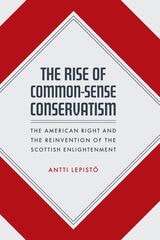
cover of The Rise of Common-Sense Conservatism: The American Right and the Reinvention of the Scottish Enlightenment

The Rise of Common-Sense Conservatism

The American Right and the Reinvention of the Scottish Enlightenment

Antti Lepistö

University of Chicago Press, 2021

In the years following the election of Donald Trump—a victory that hinged on the votes of white Midwesterners who were both geographically and culturally distant from the media’s coastal concentrations—there has been a flurry of investigation into the politics of the so-called “common man.” The notion that the salt-of-the-earth purity implied by this appellation is best understood by conservative politicians is no recent development, though. As Antti Lepistö shows in his timely and erudite book, the intellectual wellsprings of conservative “common sense” discourse are both older and more transnational than has been thought.

In considering the luminaries of American neoconservative thought—among them Irving Kristol, Gertrude Himmelfarb, James Q. Wilson, and Francis Fukuyama—Lepistö argues that the centrality of their conception of the common man accounts for the enduring power and influence of their thought. Intriguingly, Lepistö locates the roots of this conception in the eighteenth-century Scottish Enlightenment, revealing how leading neoconservatives weaponized the ideas of Adam Smith, Thomas Reid, and David Hume to denounce postwar liberal elites, educational authorities, and social reformers. Their reconfiguration of Scottish Enlightenment ideas ultimately gave rise to a defining force in modern conservative politics: the common sense of the common man. Whether twenty-first-century politicians who invoke the grievances of “the people” are conscious of this unusual lineage or not, Lepistö explains both the persistence of the trope and the complicity of some conservative thinkers with the Trump regime.

[more]
cover of The Witch's Flight: The Cinematic, the Black Femme, and the Image of Common Sense

The Witch's Flight

The Cinematic, the Black Femme, and the Image of Common Sense

Kara Keeling

Duke University Press, 2007

Kara Keeling contends that cinema and cinematic processes had a profound significance for twentieth-century anticapitalist Black Liberation movements based in the United States. Drawing on Gilles Deleuze’s notion of “the cinematic”—not just as a phenomenon confined to moving-image media such as film and television but as a set of processes involved in the production and reproduction of social reality itself —Keeling describes how the cinematic structures racism, homophobia, and misogyny, and, in the process, denies viewers access to certain images and ways of knowing. She theorizes the black femme as a figure who, even when not explicitly represented within hegemonic cinematic formulations of raced and gendered subjectivities, nonetheless haunts those representations, threatening to disrupt them by making alternative social arrangements visible.

Keeling draws on the thought of Frantz Fanon, Angela Davis, Karl Marx, Antonio Gramsci, and others in addition to Deleuze. She pursues the elusive figure of the black femme through Haile Gerima’s film Sankofa, images of women in the Black Panther Party, Pam Grier’s roles in the blaxploitation films of the early 1970s, F. Gary Gray’s film Set It Off, and Kasi Lemmons’s Eve’s Bayou.
[more]
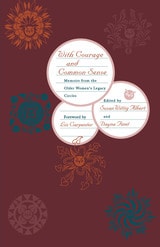
cover of With Courage and Common Sense: Memoirs from the Older Women's Legacy Circles

With Courage and Common Sense

Memoirs from the Older Women's Legacy Circles

Edited by Susan Wittig Albert and Dayna Finet

University of Texas Press, 2003

Women who were sixty or older at the turn of the twenty-first century have lived through some of recent history's most momentous moments—and yet these women often believe that their personal lives and stories are insignificant, not worthy of being recorded for future generations. To change that perception and capture some of these life stories before they are lost, the Story Circle Network, a national organization dedicated to helping women write about their lives, developed the Older Women's Legacy (OWL) Circle Memoir Workshops. During the first two years of the project (1998-2000), nearly 500 older women participated in workshops that offered them the opportunity and encouragement to reflect on and create written records of their lives.

With Courage and Common Sense presents an extensive selection of memoirs from the OWL Circle project. Organized thematically, they describe women's experiences of identity, place, work, family life, love and marriage, loss and healing, adventures great and small, major historical events, and legacies to keep and pass along. Taken as a whole, the memoirs chronicle far-reaching changes in the ways that women participated in the world during the twentieth century. They show how women learned to surmount obstacles, to courageously make the most of the opportunities that came their way, and to move quietly and wisely beyond the limits that were imposed upon them.
[more]
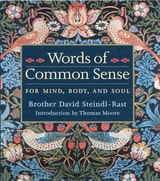
cover of Words Of Common Sense

Words Of Common Sense

Brother David Steindl-Rast

Templeton Press, 2002

Brother David Steindl-Rast takes us on a journey to discover the wisdom preserved in common sense sayings that have been passed down through generations. These timeless words reflect the shared values cherished by people all over the world.

"When you drink from a stream,” says one Chinese proverb, “remember the spring." From these simple words we are reminded to be grateful for even the smallest graces that we receive. Another homespun phrase tells us that "a contented heart is a continual feast," reminding us to look within, rather than without, for the source of our happiness.

Words of Common Sense reveals the thread of human experience expressed in the world’s proverbs and sayings. It helps us connect with cultures other than our own and recognize our shared humanity. These words resonate around the world because they are timeless reflections on how to cultivate a life of love, gratitude, and meaning.

[more]