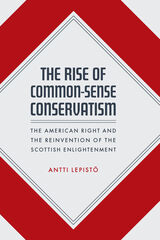
The Rise of Common-Sense Conservatism: The American Right and the Reinvention of the Scottish Enlightenment
University of Chicago Press, 2021
eISBN: 978-0-226-77418-3 | Cloth: 978-0-226-77404-6
Library of Congress Classification JC573.2.U6L46 2021
Dewey Decimal Classification 320.520973
eISBN: 978-0-226-77418-3 | Cloth: 978-0-226-77404-6
Library of Congress Classification JC573.2.U6L46 2021
Dewey Decimal Classification 320.520973
ABOUT THIS BOOK | AUTHOR BIOGRAPHY | REVIEWS | TOC | REQUEST ACCESSIBLE FILE
ABOUT THIS BOOK
In the years following the election of Donald Trump—a victory that hinged on the votes of white Midwesterners who were both geographically and culturally distant from the media’s coastal concentrations—there has been a flurry of investigation into the politics of the so-called “common man.” The notion that the salt-of-the-earth purity implied by this appellation is best understood by conservative politicians is no recent development, though. As Antti Lepistö shows in his timely and erudite book, the intellectual wellsprings of conservative “common sense” discourse are both older and more transnational than has been thought.
In considering the luminaries of American neoconservative thought—among them Irving Kristol, Gertrude Himmelfarb, James Q. Wilson, and Francis Fukuyama—Lepistö argues that the centrality of their conception of the common man accounts for the enduring power and influence of their thought. Intriguingly, Lepistö locates the roots of this conception in the eighteenth-century Scottish Enlightenment, revealing how leading neoconservatives weaponized the ideas of Adam Smith, Thomas Reid, and David Hume to denounce postwar liberal elites, educational authorities, and social reformers. Their reconfiguration of Scottish Enlightenment ideas ultimately gave rise to a defining force in modern conservative politics: the common sense of the common man. Whether twenty-first-century politicians who invoke the grievances of “the people” are conscious of this unusual lineage or not, Lepistö explains both the persistence of the trope and the complicity of some conservative thinkers with the Trump regime.
In considering the luminaries of American neoconservative thought—among them Irving Kristol, Gertrude Himmelfarb, James Q. Wilson, and Francis Fukuyama—Lepistö argues that the centrality of their conception of the common man accounts for the enduring power and influence of their thought. Intriguingly, Lepistö locates the roots of this conception in the eighteenth-century Scottish Enlightenment, revealing how leading neoconservatives weaponized the ideas of Adam Smith, Thomas Reid, and David Hume to denounce postwar liberal elites, educational authorities, and social reformers. Their reconfiguration of Scottish Enlightenment ideas ultimately gave rise to a defining force in modern conservative politics: the common sense of the common man. Whether twenty-first-century politicians who invoke the grievances of “the people” are conscious of this unusual lineage or not, Lepistö explains both the persistence of the trope and the complicity of some conservative thinkers with the Trump regime.
See other books on: American Right | Common sense | Conservatism | Culture conflict | Georgian Era (1714-1837)
See other titles from University of Chicago Press