Results by title
31 books match the query 'Communication in science'

A Scientist's Guide To Talking With The Media
Practical Advice from the Union of Concerned ScientistsGrossman, Daniel
Rutgers University Press, 2006
In A Scientist's Guide to Talking with the Media, Richard Hayes and Daniel Grossman draw on their expertise in public relations and journalism to empower researchers in a variety of fields to spread their message on their own terms. The authors provide tips on how to translate abstract concepts into concrete metaphors, craft soundbites, and prepare for interviews. For those looking for a higher profile, the authors explain how to become a reporter's trusted source-the first card in the Rolodex-on controversial issues.
A must-read for all scientists, this book shows how it is possible for the discoveries that hibernate in lecture halls and academic journals to reach a broader audience in a way that is accurate and effective.

Aetna and the Moon
Explaining Nature in Ancient Greece and RomeLiba Taub
Oregon State University Press, 2008
Eloquent Science
A Practical Guide to Becoming a Better Writer, Speaker and ScientistDavid M. Schultz
American Meteorological Society, 2009
Eloquent Science evolved from a workshop aimed at offering atmospheric science students formal guidance in communications, tailored for their eventual scientific careers. Drawing on advice from over twenty books and hundreds of other sources, this volume presents informative and often humorous tips for writing scientific journal articles, while also providing a peek behind the curtain into the operations of editorial boards and publishers of major journals. The volume focuses on writing, reviewing, and speaking and is aimed at the domain of the student or scientist at the start of her career. The volume offers tips on poster presentations, media communication, and advice for non-native speakers of English, as well as appendices on proper punctuation usage and commonly misunderstood meteorological concepts. A further reading section at the end of each chapter suggests additional sources for the interested reader, and sidebars written by experts in the field offer diverse viewpoints on reference topics.
Ethics and Practice in Science Communication
Edited by Susanna Priest, Jean Goodwin, and Michael F. Dahlstrom
University of Chicago Press, 2018
In three sections—how ethics matters, professional practice, and case studies—contributors to this volume explore the many complex questions surrounding the communication of scientific results to nonscientists. Has the science been shared clearly and accurately? Have questions of risk, uncertainty, and appropriate representation been adequately addressed? And, most fundamentally, what is the purpose of communicating science to the public: Is it to inform and empower? Or to persuade—to influence behavior and policy? By inspiring scientists and science communicators alike to think more deeply about their work, this book reaffirms that the integrity of the communication of science is vital to a healthy relationship between science and society today.
Feminist Rhetorical Science Studies
Human Bodies, Posthumanist WorldsEdited by Amanda K. Booher and Julie Jung
Southern Illinois University Press, 2018
Each essay addresses a question: How can feminist rhetoricians of science engage responsibly with emerging theories of the posthuman? Some contributors respond with case studies in medical practice (fetal ultrasound; patient noncompliance), medical science (the neuroscience of sex differences), and health policy (drug trials of the U.S. Food and Drug Administration); others respond with a critical review of object-oriented ontology and a framework for researching women technical writers in the workplace. The contributed essays are in turn framed by a comprehensive introduction and a final chapter from the editors, who argue that a key contribution of feminist posthumanist rhetoric is that it rethinks the agencies of people, things, and practices in ways that can bring about more ethical human relations.
Individually the contributions offer as much variety as consensus on matters of methodology. Together they demonstrate how feminist posthumanist and materialist approaches to science expand our notions of what rhetoric is and does, yet they manage to do so without sacrificing what makes their inquiries distinctively rhetorical.
Handbook for Science Public Information Officers
W. Matthew Shipman
University of Chicago Press, 2015
W. Matthew Shipman’s Handbook for Science Public Information Officers covers all aspects of communication strategy and tactics for members of this growing specialty. It includes how to pitch a story, how to train researchers to navigate interviews, how to use social media effectively, and how to respond to a crisis. The handbook offers a wealth of practical advice while teaching science PIOs how to think critically about what they do and how they do it, so that they will be prepared to take advantage of any situation, rather than being overwhelmed by it.
For all science communicators—whether they’re starting their careers, crossing over from journalism or the research community, or professional communicators looking to hone their PIO skills—Shipman’s Handbook for Science Public Information Officers will become their go-to reference.
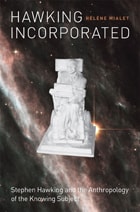
Hawking Incorporated
Stephen Hawking and the Anthropology of the Knowing SubjectHélène Mialet
University of Chicago Press, 2012
These days, the idea of the cyborg is less the stuff of science fiction and more a reality, as we are all, in one way or another, constantly connected, extended, wired, and dispersed in and through technology. One wonders where the individual, the person, the human, and the body are—or, alternatively, where they stop. These are the kinds of questions Hélène Mialet explores in this fascinating volume, as she focuses on a man who is permanently attached to assemblages of machines, devices, and collectivities of people: Stephen Hawking.
Drawing on an extensive and in-depth series of interviews with Hawking, his assistants and colleagues, physicists, engineers, writers, journalists, archivists, and artists, Mialet reconstructs the human, material, and machine-based networks that enable Hawking to live and work. She reveals how Hawking—who is often portrayed as the most singular, individual, rational, and bodiless of all—is in fact not only incorporated, materialized, and distributed in a complex nexus of machines and human beings like everyone else, but even more so. Each chapter focuses on a description of the functioning and coordination of different elements or media that create his presence, agency, identity, and competencies. Attentive to Hawking’s daily activities, including his lecturing and scientific writing, Mialet’s ethnographic analysis powerfully reassesses the notion of scientific genius and its associations with human singularity. This book will fascinate anyone interested in Stephen Hawking or an extraordinary life in science.
Houston, We Have a Narrative
Why Science Needs StoryRandy Olson
University of Chicago Press, 2015
That’s a huge mistake, says Randy Olson: Hollywood has a lot to teach scientists about how to tell a story—and, ultimately, how to do science better. With Houston, We Have a Narrative, he lays out a stunningly simple method for turning the dull into the dramatic. Drawing on his unique background, which saw him leave his job as a working scientist to launch a career as a filmmaker, Olson first diagnoses the problem: When scientists tell us about their work, they pile one moment and one detail atop another moment and another detail—a stultifying procession of “and, and, and.” What we need instead is an understanding of the basic elements of story, the narrative structures that our brains are all but hardwired to look for—which Olson boils down, brilliantly, to “And, But, Therefore,” or ABT. At a stroke, the ABT approach introduces momentum (“And”), conflict (“But”), and resolution (“Therefore”)—the fundamental building blocks of story. As Olson has shown by leading countless workshops worldwide, when scientists’ eyes are opened to ABT, the effect is staggering: suddenly, they’re not just talking about their work—they’re telling stories about it. And audiences are captivated.
Written with an uncommon verve and enthusiasm, and built on principles that are applicable to fields far beyond science, Houston, We Have a Narrative has the power to transform the way science is understood and appreciated, and ultimately how it’s done.
In Defense of Disciplines
Interdisciplinarity and Specialization in the Research UniversityJerry A. Jacobs
University of Chicago Press, 2014
Drawing on diverse sources of data, Jacobs offers a new theory of liberal arts disciplines such as biology, economics, and history that identifies the organizational sources of their dynamism and breadth. Illustrating his thesis with a wide range of case studies including the diffusion of ideas between fields, the creation of interdisciplinary scholarly journals, and the rise of new fields that spin off from existing ones, Jacobs turns many of the criticisms of disciplines on their heads to mount a powerful defense of the enduring value of liberal arts disciplines. This will become one of the anchors of the case against interdisciplinarity for years to come.
Measuring the New World
Enlightenment Science and South AmericaNeil Safier
University of Chicago Press, 2008
On the Frontier of Science
An American Rhetoric of Exploration and ExploitationLeah Ceccarelli
Michigan State University Press, 2013
Reading Practice
The Pursuit of Natural Knowledge from Manuscript to PrintMelissa Reynolds
University of Chicago Press, 2024
Reading Practice tells the story of how ordinary people grew comfortable learning from commonplace manuscripts and printed books, such as almanacs, medical recipe collections, and herbals. From the turn of the fifteenth century to the close of the sixteenth century, these were the books English people read when they wanted to attend to their health or understand their place in the universe. Before then, these works had largely been the purview of those who could read Latin. Around 1400, however, medical and scientific texts became available in Middle English while manuscripts became less expensive. These vernacular manuscripts invited their readers into a very old and learned conversation: Hippocrates and Galen weren’t distant authorities whose word was law, they were trusted guides, whose advice could be excerpted, rearranged, recombined, and even altered to suit a manuscript compiler’s needs. This conversation continued even after the printing press arrived in England in 1476. Printers mined manuscripts for medical and scientific texts that they would publish throughout the sixteenth century, though the pressures of a commercial printing market encouraged printers to package these old texts in new ways. Without the weight of authority conditioning their reactions and responses to very old knowledge, and with so many editions of practical books to choose from, English readers grew into confident critics and purveyors of natural knowledge in their own right.
Melissa Reynolds reconstructs shifting attitudes toward medicine and science over two centuries of seismic change within English culture, attending especially to the effects of the Reformation on attitudes toward nature and the human body. Her study shows how readers learned to be discerning and selective consumers of knowledge gradually, through everyday interactions with utilitarian books.
Science Communication Online
Engaging Experts and Publics on the InternetAshley Rose Mehlenbacher
The Ohio State University Press, 2019
Bringing together genre studies and the rhetoric of science, Mehlenbacher examines a range of new forms of science communication that challenge traditional presumptions about experts and nonexperts—including Twitter and Reddit AMAs, crowdfunding proposals such as Kickstarter and Experiment.com, civic-minded databases such as Safecast, and the PLOS blogging network. Science Communication Online illustrates the unique features of these genres and connects them to their rhetorical functions and the larger context leading to their emergence and evolution—from the democratization of science, challenges to expertise and expert status, and new political economies. Science Communication Online captures the important moment we find ourselves in now—one not defined by science and society but science in society.
Science Without Frontiers
Cosmopolitanism and National Interests in the World of Learning, 1870–1940Robert Fox
Oregon State University Press, 2016
Fostered by international congresses and societies, scientific collaboration flourished across linguistic and national borders from the mid-nineteenth century up until, and even after, the First World War. Projects such as the universal language Esperanto and the Dewey decimal system relied on optimistic visions of the future and were fueled by dramatic improvements in communications and transportation. The Institut international de bibliographie, founded in Brussels in 1895, emerged as a center for this collaborative endeavor.
After the First World War, scientific internationalism met with new challenges as governments increasingly sought to control the uses of science and technology. Fox details the fate of cooperative scientific internationalism in Europe and the challenges posed to it by the rise of totalitarianism and the increasingly conflicting force of nationalism. He explores public expressions of scientific nationalism in museum exhibits and, most tellingly, in rival national pavilions at the Paris International Exposition of 1937.
World War II might have shattered internationalist ideals for good, but grounds for optimism remain in the successes of international organizations like UNESCO and in the potential of electronic media as a way to achieve a vision of universal access to knowledge. Science without Frontiers offers a new way to think about science and culture and its relationship to politics amid the crises of the twentieth century.
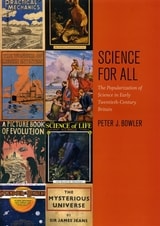
Science for All
The Popularization of Science in Early Twentieth-Century BritainPeter J. Bowler
University of Chicago Press, 2009
Recent scholarship has revealed that pioneering Victorian scientists endeavored through voluminous writing to raise public interest in science and its implications. But it has generally been assumed that once science became a profession around the turn of the century, this new generation of scientists turned its collective back on public outreach. Science for All debunks this apocryphal notion.
Peter J. Bowler surveys the books, serial works, magazines, and newspapers published between 1900 and the outbreak of World War II to show that practicing scientists were very active in writing about their work for a general readership. Science for All argues that the social environment of early twentieth-century Britain created a substantial market for science books and magazines aimed at those who had benefited from better secondary education but could not access higher learning. Scientists found it easy and profitable to write for this audience, Bowler reveals, and because their work was seen as educational, they faced no hostility from their peers. But when admission to colleges and universities became more accessible in the 1960s, this market diminished and professional scientists began to lose interest in writing at the nonspecialist level.
Eagerly anticipated by scholars of scientific engagement throughout the ages, Science for All sheds light on our own era and the continuing tension between science and public understanding.
Science from Sight to Insight
How Scientists Illustrate MeaningAlan G. Gross and Joseph E. Harmon
University of Chicago Press, 2013
Science in Print
Essays on the History of Science and the Culture of PrintEdited by Rima D. Apple, Gregory J. Downey, and Stephen L. Vaughn; Foreword by James A. Secord
University of Wisconsin Press, 2012
Ever since the threads of seventeenth-century natural philosophy began to coalesce into an understanding of the natural world, printed artifacts such as laboratory notebooks, research journals, college textbooks, and popular paperbacks have been instrumental to the development of what we think of today as “science.” But just as the history of science involves more than recording discoveries, so too does the study of print culture extend beyond the mere cataloguing of books. In both disciplines, researchers attempt to comprehend how social structures of power, reputation, and meaning permeate both the written record and the intellectual scaffolding through which scientific debate takes place.
Science in Print brings together scholars from the fields of print culture, environmental history, science and technology studies, medical history, and library and information studies. This ambitious volume paints a rich picture of those tools and techniques of printing, publishing, and reading that shaped the ideas and practices that grew into modern science, from the days of the Royal Society of London in the late 1600s to the beginning of the modern U.S. environmental movement in the early 1960s.
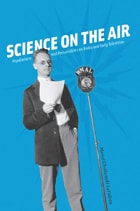
Science on the Air
Popularizers and Personalities on Radio and Early TelevisionMarcel Chotkowski LaFollette
University of Chicago Press, 2008
Marcel Chotkowski LaFollette transports readers to the early days of radio, when the new medium allowed innovative and optimistic scientists the opportunity to broadcast serious and dignified presentations over the airwaves. But the exponential growth of listenership in the 1920s, from thousands to millions, and the networks’ recognition that each listener represented a potential consumer, turned science on the radio into an opportunity to entertain, not just educate.
Science on the Air chronicles the efforts of science popularizers, from 1923 until the mid-1950s, as they negotiated topic, content, and tone in order to gain precious time on the air. Offering a new perspective on the collision between science’s idealistic and elitist view of public communication and the unbending economics of broadcasting, LaFollette rewrites the history of the public reception of science in the twentieth century and the role that scientists and their institutions have played in both encouraging and inhibiting popularization. By looking at the broadcasting of the past, Science on the Air raises issues of concern to all those who seek to cultivate a scientifically literate society today.
Scientific Babel
How Science Was Done Before and After Global EnglishMichael D. Gordin
University of Chicago Press, 2015
So how did we get from there to here? How did French, German, Latin, Russian, and even Esperanto give way to English? And what can we reconstruct of the experience of doing science in the polyglot past? With Scientific Babel, Michael D. Gordin resurrects that lost world, in part through an ingenious mechanism: the pages of his highly readable narrative account teem with footnotes—not offering background information, but presenting quoted material in its original language. The result is stunning: as we read about the rise and fall of languages, driven by politics, war, economics, and institutions, we actually see it happen in the ever-changing web of multilingual examples. The history of science, and of English as its dominant language, comes to life, and brings with it a new understanding not only of the frictions generated by a scientific community that spoke in many often mutually unintelligible voices, but also of the possibilities of the polyglot, and the losses that the dominance of English entails.
Few historians of science write as well as Gordin, and Scientific Babel reveals his incredible command of the literature, language, and intellectual essence of science past and present. No reader who takes this linguistic journey with him will be disappointed.
Starring the Text
The Place of Rhetoric in Science StudiesAlan G. Gross
Southern Illinois University Press, 2006
Starring the Text: The Place of Rhetoric in Science Studies firmly establishes the rhetorical analysis of science as a respected field of study. Alan G. Gross, one of rhetoric’s foremost authorities, summarizes the state of the field and demonstrates the role of rhetorical analysis in the sciences. He documents the limits of such analyses with examples from biology and physics, explores their range of application, and sheds light on the tangled relationships between science and society. In this deep revision of his important Rhetoric of Science, Gross examines how rhetorical analyses have a wide range of application, effectively exploring the generation, spread, certification, and closure that characterize scientific knowledge. Gross anchors his position in philosophical rather than in rhetorical arguments and maintains there is rhetorical criticism from which the sciences cannot be excluded.
Gross employs a variety of case studies and examples to assess the limits of the rhetorical analysis of science. For example, in examining avian taxonomy, he demonstrates that both taxonomical and evolutionary species are the product of rhetorical interactions. A review of Newton’s two formulations of optical research illustrates that their only significant difference is rhetorical, a difference in patterns of style, arrangement, and argument. Gross also explores the range of rhetorical analysis in his consideration of the “evolution of evolution” of Darwin’s notebooks. In his analysis of science and society, he explains the limits of citizen action in executive, judicial, and legislative democratic realms in the struggle to prevent, ameliorate, and provide adequate compensation for occupational disease. By using philosophical, historical, and psychological perspectives, Gross concludes, rhetorical analysis can also supplement other viewpoints in resolving intellectual problems.
Starring the Text, which includes fourteen illustrations, is an updated, readable study geared to rhetoricians, historians, philosophers, and sociologists interested in science. The volume effectively demonstrates that the rhetoric of science is a natural extension of rhetorical theory and criticism.
Sustainability
A Philosophy of Adaptive Ecosystem ManagementBryan G. Norton
University of Chicago Press, 2005
Emphasizing cooperation and adaptation through social learning, Norton provides a practical framework that encourages an experimental approach to language clarification and problem formulation, as well as an interdisciplinary approach to creating solutions. By moving beyond the scientific arena to acknowledge the importance of public discourse, Sustainability offers an entirely novel approach to environmentalism.

The Busy Librarians Guide To Information Literacy In
Jeanne Davidson
Assoc of College & Research Libraries, 2012
The Chicago Guide to Communicating Science
Scott L. Montgomery
University of Chicago Press, 2002
He also traces the evolution of scientific expression over time, providing a context crucial for understanding the nature of technical communication today. Other chapters take up the topics of writing creatively in science; how to design and use graphics; and how to talk to the public about science. Written with humor and eloquence, this book provides a unique and realistic guide for anyone in the sciences wishing to improve his or her communication skills.
Practical and concise, The Chicago Guide to Communicating Science covers:
*Writing scientific papers, abstracts, grant proposals, technical reports, and articles for the general public
*Using graphics effectively
*Surviving and profiting from the review process
*Preparing oral presentations
*Dealing with the press and the public
*Publishing and the Internet
*Writing in English as a foreign language
The Chicago Guide to Communicating Science
Second EditionScott L. Montgomery
University of Chicago Press, 2017
For more than a decade, The Chicago Guide to Communicating Science has been the go-to reference for anyone who needs to write or speak about their research. Whether a student writing a thesis, a faculty member composing a grant proposal, or a public information officer crafting a press release, Scott Montgomery’s advice is perfectly adaptable to any scientific writer’s needs.
This new edition has been thoroughly revised to address crucial issues in the changing landscape of scientific communication, with an increased focus on those writers working in corporate settings, government, and nonprofit organizations as well as academia. Half a dozen new chapters tackle the evolving needs and paths of scientific writers. These sections address plagiarism and fraud, writing graduate theses, translating scientific material, communicating science to the public, and the increasing globalization of research.
The Chicago Guide to Communicating Science recognizes that writers come to the table with different needs and audiences. Through solid examples and concrete advice, Montgomery sets out to help scientists develop their own voice and become stronger communicators. He also teaches readers to think about their work in the larger context of communication about science, addressing the roles of media and the public in scientific attitudes as well as offering advice for those whose research concerns controversial issues such as climate change or emerging viruses.
More than ever, communicators need to be able to move seamlessly among platforms and styles. The Chicago Guide to Communicating Science’s comprehensive coverage means that scientists and researchers will be able to expertly connect with their audiences, no matter the medium.
The Craft of Scientific Communication
Joseph E. Harmon and Alan G. Gross
University of Chicago Press, 2010
The ability to communicate in print and person is essential to the life of a successful scientist. But since writing is often secondary in scientific education and teaching, there remains a significant need for guides that teach scientists how best to convey their research to general and professional audiences. The Craft of Scientific Communication will teach science students and scientists alike how to improve the clarity, cogency, and communicative power of their words and images.
In this remarkable guide, Joseph E. Harmon and Alan G. Gross have combined their many years of experience in the art of science writing to analyze published examples of how the best scientists communicate. Organized topically with information on the structural elements and the style of scientific communications, each chapter draws on models of past successes and failures to show students and practitioners how best to negotiate the world of print, online publication, and oral presentation.
The Discourses of Science
Marcello Pera
University of Chicago Press, 1994
Pera begins with an attack of what he calls the "Cartesian syndrome"—the fixation on method common to both defenders of traditional philosophy of science and its detractors. He argues that in assuming the primacy of methodological rules, both sides get it wrong. Scientific knowledge is neither the simple mirror of nature nor a cultural construct imposed by contingent interests, thus we must replace the idea of scientific method with that of scientific rhetoric.
Pera proposes a new dialectics of science to overcome the tension between normative and descriptive philosophies of science by focusing on the rhetoric in the proposition, defense, and argumentation of theories. Examining the uses of rhetoric in debates drawn from Galileo's Dialogues, Darwin's Origins, and the Big Bang-Steady State controversy in cosmology, Pera shows how the conduct of science involves not just nature and the inquiring mind, but nature, the inquiring mind, and a questioning community which, through the process of attack, defense, and dispute, determines what is science. Rhetoric, then, is an essential element in the constitution of science as the practice of persuasive argumentation through which results gain acceptance.
The Environment and the Press
From Adventure Writing to AdvocacyMark Neuzil
Northwestern University Press, 2008
This history of environmental journalism looks at how the practice now defines issues and sets the public agenda evolving from a tradition that includes the works of authors such as Pliny the Elder, John Muir, and Rachel Carson. It makes the case that the relationship between the media and its audience is an ongoing conversation between society and the media on what matters and what should matter.
The Scientific Journal
Authorship and the Politics of Knowledge in the Nineteenth CenturyAlex Csiszar
University of Chicago Press, 2018
The Scientific Journal tells the story of how that changed. Alex Csiszar takes readers deep into nineteenth-century London and Paris, where savants struggled to reshape scientific life in the light of rapidly changing political mores and the growing importance of the press in public life. The scientific journal did not arise as a natural solution to the problem of communicating scientific discoveries. Rather, as Csiszar shows, its dominance was a hard-won compromise born of political exigencies, shifting epistemic values, intellectual property debates, and the demands of commerce. Many of the tensions and problems that plague scholarly publishing today are rooted in these tangled beginnings. As we seek to make sense of our own moment of intense experimentation in publishing platforms, peer review, and information curation, Csiszar argues powerfully that a better understanding of the journal’s past will be crucial to imagining future forms for the expression and organization of knowledge.
The Scientific Literature
A Guided TourEdited by Joseph E. Harmon and Alan G. Gross
University of Chicago Press, 2007
The scientific article has been a hallmark of the career of every important western scientist since the seventeenth century. Yet its role in the history of science has not been fully explored. Joseph E. Harmon and Alan G. Gross remedy this oversight with The Scientific Literature, a collection of writings—excerpts from scientific articles, letters, memoirs, proceedings, transactions, and magazines—that illustrates the origin of the scientific article in 1665 and its evolution over the next three and a half centuries.
Featuring articles—as well as sixty tables and illustrations, tools vital to scientific communication—that represent the broad sweep of modern science, The Scientific Literature is a historical tour through both the rhetorical strategies that scientists employ to share their discoveries and the methods that scientists use to argue claims of new knowledge. Commentaries that explain each excerpt’s scientific and historical context and analyze its communication strategy accompany each entry.
A unique anthology, The Scientific Literature will allow both the scholar and the general reader to experience first hand the development of modern science.
Writing Science in Plain English
Anne E. Greene
University of Chicago Press, 2013
Writing Science in Plain English, Second Edition
Anne E. Greene
University of Chicago Press, 2025
Scientific writing is often dry, wordy, and difficult to understand. But, as biologist and experienced teacher of scientific writing Anne E. Greene shows in Writing Science in Plain English, writers from all scientific disciplines can learn to produce clear, concise prose by mastering just a few simple principles. This short, focused guide presents roughly a dozen such principles based on what readers need to understand complex information, including concrete subjects, strong verbs, consistent terms, organized paragraphs, and correct sentence structure. Greene illustrates each principle with real-life examples of both good and bad writing and shows how bad writing might be improved. She ends each chapter with revision exercises (and provides suggested answers in a separate key) so that readers can come away with new writing skills after just one sitting. To help readers understand the grammatical terms used in the book, an appendix offers a refresher course on basic grammar.
For this second edition, Greene has incorporated the latest research on what makes writing effective and engaging and has revised or replaced exercises and exercise keys where needed. She has also added new features that make it easier to navigate the book. A new resource for instructors who use Writing Science in Plain English in their classes is a free, online teacher’s guide. Drawn from Greene’s long experience teaching students how to write science clearly, the teacher’s guide provides additional lectures, assignments, and activities that will inform and enliven any class.