Results by title
21 books match the query 'Communication of technical information'
Assembling Critical Components
A Framework for Sustaining Technical and Professional Communication Editionedited by Joanna Schreiber and Lisa Melonçon
University Press of Colorado, 2022
Designing Multilingual Experiences in Technical Communication
Laura Gonzales
Utah State University Press, 2022
Through grounded case studies of multilingual technical communication projects in the US, Mexico, and Nepal, Laura Gonzales illustrates the multiple tensions at play in transnational research and demonstrates how technical communicators can leverage contemporary translation practices and methodologies to engage in research with multilingual communities that is justice-driven, participatory, and reciprocal.
Designing Multilingual Experiences in Technical Communication is of value to researchers and students across fields who are interested in designing projects alongside multilingual communities from historically marginalized backgrounds.
Effective Teaching of Technical Communication
Theory, Practice, and ApplicationMichael J. Klein
University Press of Colorado, 2021
Drawn from quantitative and qualitative work of practitioners in the field, this edited collection provides an update to the Staples and Ornatowski's influential Foundations of Teaching Technical Communication (1997). The collection is organized around the broad themes of expanding pedagogy, shaping curriculum, incorporating technology, and engaging community. In each section, authors illustrate their experiences with teaching in the university technical communication classroom, addressing topics such as rethinking the role of internships, redesigning student learning outcomes for assessment practices, incorporating ethics into the technical communication classroom, using visual communication in community context, and engaging plain language. These sixteen chapters, taken as a whole or individually, provide readers with insights and examples into teaching technical communication in the 21st century.
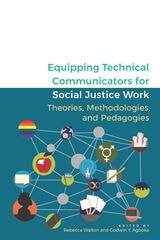
Equipping Technical Communicators for Social Justice Work
Theories, Methodologies, and PedagogiesRebecca Walton
Utah State University Press, 2021
For the field of technical and professional communication to maintain its commitment to this work, how social justice intersects with inclusivity through UX, technological, civic, and legal literacies, as well as through community engagement, must be acknowledged. Equipping Technical Communicators for Social Justice Work will be of significance to established scholar-teachers and graduate students, as well as to newcomers to the field.
Contributors: Kehinde Alonge, Alison Cardinal, Erin Brock Carlson, Oriana Gilson, Laura Gonzales, Keith Grant-Davie, Angela Haas, Mark Hannah, Kimberly Harper, Sarah Beth Hopton, Natasha Jones, Isidore Kafui Dorpenyo, Liz Lane, Emily Legg, Nicole Lowman, Kristen Moore, Emma Rose, Fernando Sanchez, Jennifer Sano-Franchini, Adam Strantz, Cana Uluak Itchuaqiyaq, Josephine Walwema, Miriam Williams, Han Yu
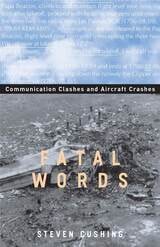
Fatal Words
Communication Clashes and Aircraft CrashesSteven Cushing
University of Chicago Press, 1994
In Fatal Words, Steven Cushing explains how miscommunication has led to dozens of aircraft disasters, and he proposes innovative solutions for preventing them. He examines ambiguities in language when aviation jargon and colloquial English are mixed, when a word is used that has different meanings, and when different words are used that sound alike. To remedy these problems, Cushing proposes a visual communication system and a computerized voice mechanism to help clear up confusing language.
Fatal Words is an accessible explanation of some of the most notorious aircraft tragedies of our time, and it will appeal to scholars in communications, linguistics, and cognitive science, to aviation experts, and to general readers.
Feminist Technical Communication
Apparent Feminisms, Slow Crisis, and the Deepwater Horizon DisasterErin A. Clark
Utah State University Press, 2023
The first book to situate feminisms and technical communication in relationship as the focal point, Feminist Technical Communication traces the thread of feminisms through technical communication’s connection to social justice studies. Clark theorizes “slow crisis,” a concept made readable to technical communicators by apparent feminisms that can help technical communicators readily recognize and address social justice problems. Clark then applies this framework to the Deepwater Horizon Disaster, an extended crisis that has been publicly framed by a traditional view of efficiency that privileges economic impact. Through rich description of apparent feminist information-gathering techniques and a layered analysis this study offers application far beyond this single disaster, making available new crisis-response possibilities that consider the economy without eliding ecological and human health concerns.
Feminist Technical Communication offers a methodological approach to the systematic interrogation of power structures that operate on hidden misogynies. This book is useful to technical communicators, scholars of technical communication and rhetoric, and readers interested in gender studies and public health and is an ideal text for graduate-level seminars focused on feminisms, social justice, and cultural studies.
Handbook for Science Public Information Officers
W. Matthew Shipman
University of Chicago Press, 2015
W. Matthew Shipman’s Handbook for Science Public Information Officers covers all aspects of communication strategy and tactics for members of this growing specialty. It includes how to pitch a story, how to train researchers to navigate interviews, how to use social media effectively, and how to respond to a crisis. The handbook offers a wealth of practical advice while teaching science PIOs how to think critically about what they do and how they do it, so that they will be prepared to take advantage of any situation, rather than being overwhelmed by it.
For all science communicators—whether they’re starting their careers, crossing over from journalism or the research community, or professional communicators looking to hone their PIO skills—Shipman’s Handbook for Science Public Information Officers will become their go-to reference.
Innovative Approaches to Teaching Technical Communication
edited by Tracy Bridgeford, Karla Saari Kitalong, and Dickie Selfe
Utah State University Press, 2004
Programs in technical writing, technical communication, and/or professional communication have recently grown in enrollment as the demand among employers for formally prepared technical writers and editors has grown. In response, scholarly treatments of the subject and the teaching of technical writing are also burgeoning, and the body of research and theory being published in this field is many times larger and more accessible than it was even a decade ago.
Although many theoretical and disciplinary perspectives can potentially inform technical communication teaching, administration, and curriculum development, the actual influences on the field's canonical texts have traditionally come from a rather limited range of disciplines. Innovative Approaches to Teaching Technical Communication brings together a wide range of scholars/teachers to expand the existing canon.
Key Theoretical Frameworks
Teaching Technical Communication in the Twenty-First CenturyAngela M. Haas
Utah State University Press, 2018
The collection provides a valuable resource for teachers new to translating social justice theories to the classroom by presenting concrete examples related to technical communication. Each contribution adopts a particular theoretical approach, explains the theory, situates it within disciplinary scholarship, contextualizes the approach from the author’s experience, and offers additional teaching applications.
The first volume of its kind, Key Theoretical Frameworks for Teaching Technical Communication in the Twenty-First Century links the theoretical with the pedagogical in order to articulate, use, and assess social justice frameworks for designing and teaching courses in technical communication.
Contributors: Godwin Y. Agboka, Matthew Cox, Marcos Del Hierro, Jessica Edwards, Erin A. Frost, Elise Verzosa Hurley, Natasha N. Jones, Cruz Medina, Marie E. Moeller, Kristen R. Moore, Donnie Johnson Sackey, Gerald Savage, J. Blake Scott, Barbi Smyser-Fauble, Kenneth Walker, Rebecca Walton
Keywords in Design Thinking
A Lexical Primer for Technical Communicators and DesignersJason C. K. Tham
University Press of Colorado, 2023
Keywords in Technical and Professional Communication
Han Yu
University Press of Colorado, 2024
Rewriting Work
Lora Anderson
University Press of Colorado, 2024

Rhetorical Mediator
Understanding Agency in Indigenous Translation and Interpretation through Indigenous Approaches to UXNora K. Rivera
Utah State University Press, 2023
In places where Indigenous language translation and interpretation are greatly needed, Indigenous language mediators often lack adequate systems to professionalize their field while withstanding Western practices that do not align with their worldviews. Through a “design thinking” methodology based on her work organizing and participating in an Indigenous-focused interpreter and translator conference, Rivera examines testimonios and semi-structured interviews conducted with Indigenous interpreters and translators to emphasize dialogue and desahogo (emotional release) as Indigenous communication practices.
The Rhetorical Mediator advocates for Indigenous language practices that have been sidelined by Western scholarship and systems, helping to create more equitable processes to directly benefit Indigenous individuals and other underrepresented groups. This book benefits specialists, including UX researchers, technical and professional communicators, interpreters and translators, and Indigenous professionals, as well as academics teaching graduate and undergraduate methods, Indigenous rhetoric and translation, and UX courses.
Rhetorical Memory
A Study of Technical Communication and Information ManagementStewart Whittemore
University of Chicago Press, 2015
In Rhetorical Memory, Stewart Whittemore demonstrates that strategies we use to manage information—techniques often acquired through trial and error, rarely studied, and generally invisible to us—are as important to our success as the end products of our work. First, he situates information management within the larger field of rhetoric, showing that both are tied to purpose, audience, and situation. He then dives into an engaging and tightly focused workplace study, presenting three cases from a team of technical communicators making use of organizational memory during their everyday work. By examining which techniques succeed and which fail, Whittemore illuminates the challenges faced by technical communicators. He concludes with a number of practical strategies to better organize information, that will help employees, managers, and anyone else suffering from information overload.
Solving Problems in Technical Communication
Edited by Johndan Johnson-Eilola and Stuart A. Selber
University of Chicago Press, 2012
The field of technical communication is rapidly expanding in both the academic world and the private sector, yet a problematic divide remains between theory and practice. Here Stuart A. Selber and Johndan Johnson-Eilola, both respected scholars and teachers of technical communication, effectively bridge that gap.
Teaching Professional and Technical Communication
A Practicum in a BookTracy Bridgeford
Utah State University Press, 2018
This practicum features chapters by prominent PTC scholars and teachers on rhetoric, style, ethics, design, usability, genre, and other central concerns of PTC programs. Each chapter includes a scenario or personal narrative of teaching a particular topic, provides a theoretical basis for interpreting the narrative, illustrates the practical aspects of the approach, describes relevant assignments, and presents a list of questions to prompt pedagogical discussions.
Teaching Professional and Technical Communication is not a compendium of best practices but instead offers a practical collection of rich, detailed narratives that show inexperienced PTC instructors how to work most effectively in the classroom.
Contributors: Pam Estes Brewer, Eva Brumberger, Dave Clark, Paul Dombrowski, James M. Dubinsky, Peter S. England, David K. Farkas, Brent Henze, Tharon W. Howard, Dan Jones, Karla Saari Kitalong, Traci Nathans-Kelly, Christine G. Nicometo, Kirk St.Amant
Text at Scale
Corpus Analysis in Technical CommunicationStephen Carradini
University Press of Colorado, 2024

The Busy Librarians Guide To Information Literacy In
Jeanne Davidson
Assoc of College & Research Libraries, 2012

The Chicago Guide to Communicating Science
Scott L. Montgomery
University of Chicago Press, 2002
He also traces the evolution of scientific expression over time, providing a context crucial for understanding the nature of technical communication today. Other chapters take up the topics of writing creatively in science; how to design and use graphics; and how to talk to the public about science. Written with humor and eloquence, this book provides a unique and realistic guide for anyone in the sciences wishing to improve his or her communication skills.
Practical and concise, The Chicago Guide to Communicating Science covers:
*Writing scientific papers, abstracts, grant proposals, technical reports, and articles for the general public
*Using graphics effectively
*Surviving and profiting from the review process
*Preparing oral presentations
*Dealing with the press and the public
*Publishing and the Internet
*Writing in English as a foreign language
The Chicago Guide to Communicating Science
Second EditionScott L. Montgomery
University of Chicago Press, 2017
For more than a decade, The Chicago Guide to Communicating Science has been the go-to reference for anyone who needs to write or speak about their research. Whether a student writing a thesis, a faculty member composing a grant proposal, or a public information officer crafting a press release, Scott Montgomery’s advice is perfectly adaptable to any scientific writer’s needs.
This new edition has been thoroughly revised to address crucial issues in the changing landscape of scientific communication, with an increased focus on those writers working in corporate settings, government, and nonprofit organizations as well as academia. Half a dozen new chapters tackle the evolving needs and paths of scientific writers. These sections address plagiarism and fraud, writing graduate theses, translating scientific material, communicating science to the public, and the increasing globalization of research.
The Chicago Guide to Communicating Science recognizes that writers come to the table with different needs and audiences. Through solid examples and concrete advice, Montgomery sets out to help scientists develop their own voice and become stronger communicators. He also teaches readers to think about their work in the larger context of communication about science, addressing the roles of media and the public in scientific attitudes as well as offering advice for those whose research concerns controversial issues such as climate change or emerging viruses.
More than ever, communicators need to be able to move seamlessly among platforms and styles. The Chicago Guide to Communicating Science’s comprehensive coverage means that scientists and researchers will be able to expertly connect with their audiences, no matter the medium.
Wicked, Incomplete, and Uncertain
User Support in the Wild and the Role of Technical CommunicationJason Swarts
Utah State University Press, 2018
Technical writers traditionally create large volumes of idealized tasks and procedures in help documentation, but this is no longer the only approach, or even the best approach. Shifting responsibility for user support to users via crowdsourcing is a risky alternative. Just as with other mass-collaborative enterprises, contributors to a forum may not be aware of the kind of knowledge they are creating or how their contributions connect with those made by others. Wicked, Incomplete, and Uncertain describes the kinds of writing and help practices in which user forums engage, why users seem to find these forums credible and appealing, and what companies can learn about building user communities to support this form of assistance.
Through investigation of user-forum activities, Swarts identifies a new set of contributions that technical communicators can make—not only by creating content but also by curating content, shaping conversations, feeding information back into the user community, and opening channels of discovery and knowledge creation that can speak to users and software developers alike