Results by title
22 books match the query 'Community and college'
Beyond the Veil of Knowledge
Triangulating Security, Democracy, and Academic ScholarshipPiki Ish-Shalom
University of Michigan Press, 2019
Community Is the Way
Engaged Writing and Designing for Transformative Changeby Aimée Knight
University Press of Colorado, 2022
Creating Citizens
Liberal Arts, Civic Engagement, and the Land-Grant TraditionEdited by Brigitta R. Brunner
University of Alabama Press, 2016
Creating Citizens is a collection of essays about Community and Civic Engagement (CCE) learning at land-grant universities.
In Creating Citizens, professors and administrators at Auburn University’s College of Liberal Arts recount valuable, first-hand experiences teaching Community and Civic Engagement (CCE). They demonstrate that, contrary to many expectations, CCE instruction both complements the mission of liberal arts curricula and powerfully advances the fundamental mission of American land-grand institutions.
The nine essays in Creating Citizens offer structures for incorporating CCE initiatives into university programs, instructional methods and techniques, and numerous case studies and examples undertaken at Auburn University but applicable at any university. Many contributors describe their own rewarding experiences with CCE and emphasize the ways outreach efforts reinvigorate their teaching or research.
Creating Citizens recounts the foundation of land-grant institutions by the Morrill Act of 1862. Their mission is to instruct in agriculture, military science, and mechanics, but these goals augmented rather than replaced an education in the classics, or liberal arts. Land-grant institutions, therefore, have a special calling to provide a broad spectrum of society with an education that not only enriched the personal lives of their students, but the communities they are a part of. Creating Citizens demonstrates the important opportunities CCE instruction represents to any university but are especially close to the heart of the mission of land-grant colleges.
In open societies, the role and mission of public institutions of higher learning that are supported by public subsidies are perennial subjects of interest and debate. Creating Citizens provides valuable insights of interest to educators, education administrators, students, and policy makers involved in the field of higher education.
Education for Democracy
Renewing the Wisconsin IdeaEdited by Chad Alan Goldberg
University of Wisconsin Press, 2020
Using the Wisconsin Idea as a lens, Education for Democracy argues that public higher education institutions remain a bastion of collaborative problem solving. Examinations of partnerships between the state university and people of the state highlight many crucial and lasting contributions to issues of broad public concern such as conservation, LGBTQ+ rights, and poverty alleviation. The contributors restore the value of state universities and humanities education as a public good, contending that they deserve renewed and robust support.
Engaging Place, Engaging Practices
Urban History and Campus-Community PartnershipsEdited by Robin F. Bachin and Amy L. Howard
Temple University Press, 2023
Colleges and universities in urban centers have often leveraged their locales to appeal to students while also taking a more active role in addressing local challenges. They embrace civic engagement, support service-learning, tailor courses to local needs, and even provide university-community collaborations such as lab schools and innovation hubs. Engaging Place, Engaging Practices highlights the significant role the academy, in general, and urban history, in particular, can play in fostering these critical connections.
The editors and contributors to this volume address topics ranging from historical injustices and affordable housing and land use to climate change planning and the emergence of digital humanities. These case studies reveal the intricate components of a city’s history and how they provide context and promote a sense of cultural belonging.
This timely book appreciates and emphasizes the critical role universities must play as intentional—and humble—partners in addressing the past, present, and future challenges facing cities through democratic community engagement.
Going Public
Civic and Community EngagementHiram E. Fitzgerald
Michigan State University Press, 2013
The terms “civic engagement” and “community engagement” have various definitions, but they are united by the sense that individuals who are civically engaged not only are concerned about the quality of life in their communities but also take action to improve conditions for the common good. In the United States, to be civically engaged means to actively participate in a civil democratic society. Going Public examines programs related to civic engagement and the ways in which faculty and students participate in communities in order to improve them. Engagement scholarship is a scholarship of action, a scholarship of practice that takes place both in and with the community. Within the framework of this new scholarship, the mission of the academy does not begin and end with intellectual discovery and fact-finding. Rather, the academy joins forces with the community, and together they use their knowledge and resources to address pressing social, civic, economic, and moral problems. Each chapter in this book tells a unique story of community engagement and the scholarship of practice in a diverse range of settings, documenting successes and failures, the unintended consequences, and the questions yet to be answered.
Handbook of Engaged Scholarship
Contemporary Landscapes, Future Directions: Volume 1: Institutional ChangeHiram E. Fitzgerald
Michigan State University Press, 2010
In the preface to the Handbook of Engaged Scholarship, Hiram Fitzgerald observes that the Kellogg Commission's challenge to higher education to engage with communities was a significant catalyst for action. At Michigan State University, the response was the development of "engaged scholarship," a distinctive, scholarly approach to campus-community partnerships.
Engaged scholars recognize that community based scholarship is founded on an underpinning of mutual respect and recognition that community knowledge is valid and that sustainability is an integral part of the partnership agenda.
In this two-volume collection, contributors capture the rich diversity of institutions and partnerships that characterize the contemporary landscape and the future of engaged scholarship. Volume One addresses such issues as the application of engaged scholarship across types of colleges and universities and the current state of the movement. Volume Two contains essays on such topics as current typologies, measuring effectiveness and accreditation, community-campus partnership development, national organizational models, and the future landscape.
Handbook of Engaged Scholarship
Contemporary Landscapes, Future Directions: Volume 2: Community-Campus PartnershipsHiram E. Fitzgerald
Michigan State University Press, 2010
In the preface to the Handbook of Engaged Scholarship, Hiram Fitzgerald observes that the Kellogg Commission's challenge to higher education to engage with communities was a significant catalyst for action. At Michigan State University, the response was the development of "engaged scholarship," a distinctive, scholarly approach to campus-community partnerships.
Engaged scholars recognize that community based scholarship is founded on an underpinning of mutual respect and recognition that community knowledge is valid and that sustainability is an integral part of the partnership agenda.
In this two-volume collection, contributors capture the rich diversity of institutions and partnerships that characterize the contemporary landscape and the future of engaged scholarship. Volume One addresses such issues as the application of engaged scholarship across types of colleges and universities and the current state of the movement. Volume Two contains essays on such topics as current typologies, measuring effectiveness and accreditation, community-campus partnership development, national organizational models, and the future landscape.
Hope for Justice and Power
Broad-based Community Organizing in the Texas Industrial Areas FoundationKathleen Staudt
University of North Texas Press, 2020
John Bascom and the Origins of the Wisconsin Idea
J. David Hoeveler Jr.
University of Wisconsin Press, 2017
During his term as governor (1901–1906), Robert La Follette routinely consulted with University of Wisconsin researchers to devise groundbreaking programs and legislation. Although the Wisconsin Idea is often attributed to a 1904 speech by Charles Van Hise, then president of the University of Wisconsin, David Hoeveler argues that it originated decades earlier, in the creative and fertile mind of John Bascom.
A philosopher, theologian, and sociologist, Bascom (1827–1922) deeply influenced a generation of students at the University of Wisconsin, including La Follette and Van Hise. Hoeveler documents how Bascom drew concepts from German idealism, liberal Protestantism, and evolutionary theory, transforming them into advocacy for social and political reform. He was a champion of temperance, women's rights, and labor, all of which brought him controversy as president of the university from 1874 to 1887. In a way unmatched by any of his peers at other institutions, Bascom outlined a social gospel that called for an expanded role for state governments and universities as agencies of moral improvement.
Hoeveler traces the intellectual history of the Wisconsin Idea from the nineteenth century to such influential Progressive Era thinkers as Richard T. Ely and John R. Commons, who believed university researchers should be a vital source of expertise for government and citizens.
Knowledge for Social Change
Bacon, Dewey, and the Revolutionary Transformation of Research Universities in the Twenty-First CenturyLee Benson, Ira Harkavy, Matthew Hartley
Temple University Press, 2017
Employing history, social theory, and a detailed contemporary case study, Knowledge for Social Change argues for fundamentally reshaping research universities to function as democratic, civic, and community-engaged institutions dedicated to advancing learning and knowledge for social change. The authors focus on significant contributions to learning made by Francis Bacon, Benjamin Franklin, Seth Low, Jane Addams, William Rainey Harper, and John Dewey—as well as their own work at Penn’s Netter Center for Community Partnerships—to help create and sustain democratically-engaged colleges and universities for the public good.
Knowledge for Social Change highlights university-assisted community schools to effect a thoroughgoing change of research universities that will contribute to more democratic schools, communities, and societies. The authors also call on democratic-minded academics to create and sustain a global movement dedicated to advancing learning for the “relief of man’s estate”—an iconic phrase by Francis Bacon that emphasized the continued betterment of the human condition—and to realize Dewey’s vision of an organic “Great Community” composed of participatory, democratic, collaborative, and interdependent societies.
Liberating Service Learning and the Rest of Higher Education Civic Engagement
Randy Stoecker
Temple University Press, 2016
Randy Stoecker has been “practicing” forms of community-engaged scholarship, including service learning, for thirty years now, and he readily admits, “Practice does not make perfect.” In his highly personal critique, Liberating Service Learning and the Rest of Higher Education Civic Engagement, the author worries about the contradictions, unrealized potential, and unrecognized urgency of the causes as well as the risks and rewards of this work.
Here, Stoecker questions the prioritization and theoretical/philosophical underpinnings of the core concepts of service learning: 1. learning, 2. service, 3. community, and 4. change. By “liberating” service learning, he suggests reversing the prioritization of the concepts, starting with change, then community, then service, and then learning. In doing so, he clarifies the benefits and purpose of this work, arguing that it will create greater pedagogical and community impact.
Liberating Service Learning and the Rest of Higher Education Civic Engagement challenges—and hopefully will change—our thinking about higher education community engagement.
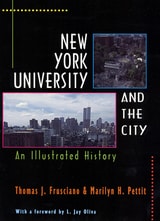
New York University and the City
An Illustrated HistoryFrusciano, Thomas J
Rutgers University Press, 1997
In New York University and the City, Thomas J. Frusciano and Marilyn H. Pettit situate the history of a unique urban university within the context of the social, political, and economic history of New York City. The authors trace the movement northward on Manhattan Island of both university and city, from the commercial hustle and bustle around City Hall, where the first classes were held in 1832, to the rural environs of Greenwich Village, and ultimately even farther north in 1894 to the undergraduate extension on the "secluded hilltop" of University Heights in the Bronx.
Vividly illustrated with both historical and contemporary images, New York University and the City explores various themes in the history of higher education and how NYU responded to changes in urban demographics, curriculum demands, and physical space during critical periods in the city's development. The relationship between university and city is further examined through extensive biographical portraits of the many historical personalities who made contributions to the development of both city and university.
The founding of New York University in 1831 is a watershed in the history of higher education in the United States. Albert Gallatin, former secretary of the treasury, led a group that proposed the creation of an institution of higher learning in New York City that would "correspond with the spirit and wants of the age and country," a nondenominational institution that would enlarge the opportunities of education for those qualified and inclined. NYU was expected to educate not only gentlemen scholars but also the sons of the great commercial metropolis. It also reflected and symbolized the aspirations of the city. By 1931, NYU was the nation's largest private university. Frusciano and Pettit chronicle the university's growth and struggles to its ultimate position as one of the most prestigious academic research institutions in the world.
Outcomes of Engaged Education
From Transfer to TransformationLinda Flower
University Press of Colorado, 2025
Preparing Students to Engage in Equitable Community Partnerships
A HandbookElizabeth A. Tryon
Temple University Press, 2023
Preparing Students to Engage in Equitable Community Partnerships provides a wealth of valuable resources and activities to help impart ideas of identity, privilege, oppression, bias, and power dynamics to best support students and community in these relationships. Believing that authenticity only comes about in an atmosphere of mutual respect and self-awareness, the authors argue for cultural and intellectual humility.
Each chapter looks at topics and issues through different lenses, complete with underlying theories, and relates those discussions to concrete classroom activities, facilitation strategies, and scholarly frames. In addition, the authors include contributions from a diverse group of practitioners at community colleges, private colleges, historically Black colleges and universities, and minority-serving institutions.
Preparing Students to Engage in Equitable Community Partnerships is a much-needed, comprehensive resource for community-engaged professionals as they prepare students for building relationships when entering a community for learning or research purposes.

Pursuing Opportunitites Through Partnerships
Higher Education and CommunitiesBRUCE A. BEHRINGER
West Virginia University Press, 2004
In 1998, the W.W. Kellogg Foundation provided funding for four universities to collaborate with surrounding communities on mutually beneficial projects, through the Expanding Community Partnerships Program. In a series of innovative learning collaborations, East Tennessee University, the University of Texas at El Paso, West Virginia University, and Northeastern University established strong, sustainable partnerships with organizations in their local communities. Although each university approached its partnering differently, they all shared the goal of benefiting the underserved communities where they are located and transforming their institutions by enhancing students’ educational experiences and strengthening faculty, student, administration, and staff relationships with local residents. This book shares those relationship-building experiences of the four universities and communities. Highly recommended for all public and higher education administrators; for students and teachers of education, business, and sociology; and for those interested in innovative business and social-service models.
Pushing Back the Gates
Neighborhood Perspectives on University-Driven Revitalization in West PhiladelphiaHarley F Etienne
Temple University Press, 2013
As college and university administrators expand and develop their urban campuses, they have also become developers—and primary drivers—of neighborhood change. But how do institutions contend with urban real estate needs, revitalization opportunities, and community outreach? And how do the residents benefit? Pushing Back the Gates provides a lively discussion of neighborhood-level perspectives of the dynamic changes brought about by institutions' urban planning efforts.
Harley Etienne outlines the rationale for university-driven development and neighborhood revitalization balanced by caution for the limitations of the model. He provides a summary of the University of Pennsylvania's West Philadelphia Initiatives and the challenges and successes of this unique plan. Etienne also examines the implementation of similar efforts at different universities around the country.
Pushing Back the Gates speaks to communities, university leaders, and urban developers who navigate the boundary between neighborhood revitalization through physical development and investments in incumbent populations and human capital.
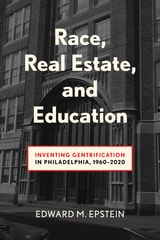
Race, Real Estate and Education
Inventing Gentrification in Philadelphia, 1960-2020Edward M. Epstein
Temple University Press, 2025
Epstein outlines the citywide context for the plan to create “University City” in West Philadelphia. He recounts the attempts to correct the segregation, overcrowding, and authoritarian management that plagued Philadelphia’s public schools. As the West Philadelphia Corporation, the proxy for the universities and hospitals, initiated gentrification efforts, the local community resisted and protested, causing the project to fail. The effort was revived with spectacular success, however, with the launch of the well-funded Penn Alexander School in 2001.
Race, Real Estate, and Education shows how the pursuit of urbanist ideals sometimes deepens neighborhood injustice. Epstein’s exploration of whether Philadelphia’s overall approach was beneficial or misguided presents a cautionary tale.
In the series Urban Life, Landscape, and Policy
Regional Perspectives on Learning by Doing
Stories from Engaged Universities around the WorldLorlene Hoyt
Michigan State University Press, 2017
Service-Learning as a New Paradigm in Higher Education of China
Carol Ma Hok-ka
Michigan State University Press, 2018

The City as Campus
Urbanism and Higher Education in ChicagoSharon Haar
University of Minnesota Press, 2010
The City as Campus shows the strain of this integration, detailing historical accounts of battles over space as campus designers faced the challenge of weaving the social, spatial, and architectural conditions of the urban milieu into new forms to meet the changing needs of academia. Through a close analysis of the history of higher education in Chicago, The City as Campus explores how the university's missions of service, teaching, and research have metamorphosed over time, particularly in response to the unique opportunities-and restraints-the city provides. Illustrating how Chicago serves as a site of pedagogical transformation and a location for the larger purpose of the academic community, The City as Campus presents a social and design history of the urban campus as an architectural idea and form.
The Road Half Traveled
University Engagement at a CrossroadsRita Axelroth Hodges
Michigan State University Press, 2012
A growing number of universities are dedicating resources to support their surrounding communities, but much potential for advancement remains. A university’s mission as an “anchor institution,” as defined by the authors, is to consciously and strategically apply the institution’s long-term, place-based economic power, in combination with its human and intellectual resources, to better the welfare of the community in which it resides. Drawing on ten diverse universities as case studies, this eye-opening book explores practices and strategies that can be employed to improve conditions in low-income communities and emphasizes the critical roles of university leaders, philanthropy, and policy in this process. To date the most comprehensive account of the range of roles played by universities as anchors in their communities, The Road Half Traveled provides a forward-thinking perspective on new horizons in university and community partnership.