Results by title
5 books match the query 'Comparative History'
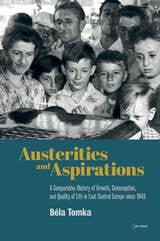
Austerities and Aspirations
A Comparative History of Growth, Consumption, and Quality of Life in East Central Europe since 1945Béla Tomka
Central European University Press, 2020
This monograph provides an analysis of the economic performance and living standard in Czechoslovakia and its successor states, Hungary, and Poland since 1945. The novelty of the book lies in its broad comparative perspective: it places East Central Europe in a wider European framework that underlines the themes of regional disparities and European commonalities. Going beyond the traditional growth paradigm, the author systematically studies the historical patterns of consumption, leisure, and quality of life—aspects that Tomka argues can best be considered in relation to one other. By adopting this “triple approach,” he undertakes a truly interdisciplinary research drawing from history, economics, sociology, and demography.
As a result of Tomka’s three-pillar comparative analysis, the book makes a major contribution to the debates on the dynamics of economic growth in communist and postcommunist East Central Europe, on the socialist consumer culture along with its transformation after 1990, and on how the accounts on East Central Europe can be integrated into the emerging field of historical quality of life research.
Imperial Designs, Postimperial Extremes
Studies in Interdisciplinary and Comparative History of Russia and Eastern EuropeAndrei Cusco
Central European University Press, 2023
Anchored in the Russian Empire, but not limited to it, the eight studies in this volume explore the nineteenth-century imperial responses to the challenge of modernity, the dramatic disruptions of World War I, the radical scenarios of the interwar period and post-communist endgames at the different edges of Eurasia. The book continues and amplifies the historiographic momentum created by Alfred J. Rieber’s long and fruitful scholarly career.
First, the volume addresses the attempts of Russian imperial rulers and elites to overcome the economic backwardness of the empire with respect to the West. The ensuing rivalry of several interest groups (entrepreneurs, engineers, economists) created new social forms in the subsequent rounds of modernization. The studies explore the dynamics of the metamorphoses of what Rieber famously conceptualized as a “sedimentary society” in the pre-revolutionary and early Soviet settings.
Second, the volume also expands and dwells on the concept of frontier zones as dynamic, mutable, shifting areas, characterized by multi-ethnicity, religious diversity, unstable loyalties, overlapping and contradictory models of governance, and an uneasy balance between peaceful co-existence and bloody military clashes. In this connection, studies pay special attention to forced and spontaneous migrations, and population politics in modern Eurasia.
The Rise of Comparative History
Balázs Trencsényi
Central European University Press, 2021

Tropical Multiculturalism
A Comparative History of Race in Brazilian Cinema and CultureRobert Stam
Duke University Press, 1997
Stam examines the broad historical and cultural links that connect Brazil and the United States before considering multicultural imagery in Brazilian film as it has changed from the silent era to the present. His analysis moves through the comic chanchadas of the 1930s and 1940s, to the Hollywood-style films from Sao Paulo in the 1950s, and the diverse phases of Cinema Novo beginning in the 1960s. He explores a wealth of subjects, including the submerged "blackness" of Carmen Miranda, the anti-racist agenda of Orson Welles’s never-released Brazilian film It’s All True, the international background behind Black Orpheus, the career of Grande Otelo (Brazil’s greatest black film star), the allegorical "cannibalistic" films like How Tasty Was My Frenchman, and "indigenous media"—the attempt by Brazilian "indians" to use camcorders and VCRs for their own cultural and political purposes. Tropical Multiculturalism is simultaneously a history of Brazilian cinema from the standpoint of race, a history of Brazil itself through its cinematic representations, a comparative study of racial formations in Brazil and the United States, and a theorized analysis of racialized representations.
Under Eastern Eyes
A Comparative History of East European Travel Writing on EuropeAlex Drace-Francis
Central European University Press, 2008