Results by title
21 books match the query 'Comparative government'
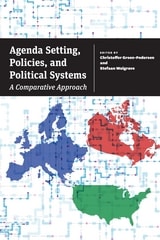
Agenda Setting, Policies, and Political Systems
A Comparative ApproachEdited by Christoffer Green-Pedersen and Stefaan Walgrave
University of Chicago Press, 2014
Agenda Setting and Political Attention brings together essays on eleven countries and two broad themes. Contributors to the first section analyze the extent to which party and electoral changes and shifts in the partisan composition of government have led—or not led—to policy changes in the United States, the United Kingdom, the Netherlands, Denmark, Switzerland, and France. The second section turns the focus on changing institutional structures in Germany, Italy, Belgium, Spain, and Canada, including the German reunification and the collapse of the Italian party system. Together, the essays make clear the efficacy of the agenda-setting approach for understanding not only how policies evolve, but also how political systems function.
Comparing Public Bureaucracies
Problems of Theory and MethodB. Guy Peters
University of Alabama Press, 1988
A foundational guide to understanding how bureaucracies differ—and why those differences matter.
The comparative study of public policy once promised to make major contributions to our understanding of government. Much of that promise now appears unfulfilled. What accounts for this decline in intellectual fortunes and change in intellectual fashion? Comparing Public Bureaucracies seeks to understand why. One of the principal answers is that there is no readily accepted and dependent variable that would allow comparative public administration to conform to the usual canons of social research. In contrast, comparative public policy has a ready-made dependent variable in public expenditure.
Peters discusses four possible dependent variables for comparative public administration. The first is personnel—the number and type of people who work for government. Second, the number and type of organizations that form government can suggest a great deal about the structure of government. Third, the behavior of members is obviously important for understanding what actually happens in government—such as the extents to which bureaucracies approximate the budget-maximizing behavior posited by economists. Ginally, the relative power of civil servants in the policymaking process is a major factor in institutional politics in contemporary industrial societies.

Culture Troubles
Politics and the Interpretation of MeaningPatrick Chabal and Jean-Pascal Daloz
University of Chicago Press, 2005
Culture Troubles is a systematic reevaluation of the role of culture in political analysis. Here, Patrick Chabal and Jean-Pascal Daloz contend that it is unwise to compare different societies without taking into account culture, which in their interpretation is not a system of values, but rather a system of inherited meanings and symbols. This cultural approach, they argue, can attribute meaning to political comparison, and they outline the shape of that approach, one that draws from an eclectic range of sources. Illustrating the sharpness and acuity of their methods, they proceed with a comparative study of the state and political representation in three very different nations—France, Nigeria, and Sweden—to untangle the many ways that culture informs our understanding of political events. As a result, Culture Troubles offers a rational starting point from which we may begin to understand foreign politics.

Dangerous Counsel
Accountability and Advice in Ancient GreeceMatthew Landauer
University of Chicago Press, 2019
With Dangerous Counsel, Matthew Landauer analyzes the sometimes ferocious and unpredictable politics of accountability in ancient Greece and offers novel readings of ancient history, philosophy, rhetoric, and drama. In comparing the demos to a tyrant, thinkers such as Herodotus, Plato, Isocrates, and Aristophanes were attempting to work out a theory of the badness of unaccountable power; to understand the basic logic of accountability and why it is difficult to get right; and to explore the ways in which political discourse is profoundly shaped by institutions and power relationships. In the process they created strikingly portable theories of counsel and accountability that traveled across political regime types and remain relevant to our contemporary political dilemmas.
Designing Democratic Government
Making Institutions WorkMargaret Levi
Russell Sage Foundation, 2008
Dynamic Partisanship
How and Why Voter Loyalties ChangeKen Kollman and John E. Jackson
University of Chicago Press, 2021
Federalism and Social Policy
Patterns of Redistribution in 11 DemocraciesEdited by Scott L. Greer and Heather Elliott
University of Michigan Press, 2019
Legislatures
Comparative Perspectives on Representative AssembliesGerhard Loewenberg, Peverill Squire, and D. Roderick Kiewiet, Editors
University of Michigan Press, 2002
Consisting of fourteen essays, this volume incorporates major areas of legislative research, including studies of recruitment of legislators and an overview of their careers, the evolution of legislatures, and the electoral systems by which legislatures are chosen. Each contributor reviews the principal research findings and emphasizes those concepts and methods that facilitate comparative research. The book assesses the state of knowledge in regard to U.S., European, Asian, and Latin American legislatures. The introductory chapter by the editors identifies how to comparatively test research findings while taking into account data availability and questions of conceptual equivalence. Each chapter provides an extensive bibliography, making the book an excellent guide to literature on legislative research. The contributors are David T. Canon, John M. Carey, Gary W. Cox, Frantisek Formanek, John R. Hibbing, Ewa Karpowicz, Junko Kato, Sadafumi Kawato, Michael Laver, Gary F. Moncrief, Chan Wook Park, Werner J. Patzelt, Bjorn Erik Rasch, Kenneth A. Shepsle, Steven S. Smith, and Rick K. Wilson.
This book is designed for faculty and graduate students in political science and will also be of interest to members of legislative research staffs in this country and overseas, and to specialists on legislatures in history and law.
Gerhard Loewenberg is University of Iowa Foundation Distinguished Professor of Political Science. D. Roderick Kiewiet is Dean of Graduate Studies and Professor of Political Science, California Institute of Technology, Pasadena. Peverill Squire is Professor of Political Science, University of Iowa.

Locating the Proper Authorities
The Interaction of Domestic and International InstitutionsDaniel W. Drezner, Editor
University of Michigan Press, 2002

Paradigms and Sand Castles
Theory Building and Research Design in Comparative PoliticsBarbara Geddes
University of Michigan Press, 2003
Barbara Geddes is Professor of Political Science at the University of California, Los Angeles.
Parliaments in the Modern World
Changing InstitutionsGary Copeland and Samuel C. Patterson, Editors
University of Michigan Press, 1994
The editors frame the book in the theoretical questions of how institutionalized bodies accomplish change. They explain the nature of the institutionalizing process and show that as the ability for an organization to fulfill its mission changes (or as the mission itself changes), corresponding adaptation becomes necessary if the institution is to remain viable. The individual case studies amply illustrate how modifications in the governing ideology, the party, the electoral systems, or the character of membership have precipitated change at various times and in various parliaments. Parliaments in the Modern World ultimately demonstrates that it is precisely this ability to change that has kept these organizations vital, responsive, and long-lived.
Participation and Political Equality
A Seven-Nation ComparisonSidney Verba
University of Chicago Press, 1987

Parties under Pressure
The Politics of Factions and Party AdaptationMatthias Dilling
University of Chicago Press, 2024
An illuminating investigation into why some parties evolve with their times while others fall behind.
Around the world, established political parties face mounting pressures: insurgents on the Left and Right, altered media environments, new policy challenges, and the erosion of traditional strongholds, to name just a few. Yet parties have differed enormously in their ability to move with the times and update their offers to voters. This variation matters. While adaptation does not guarantee a party’s electoral success, the failure to modernize can spell its decline, even collapse, and create openings for radical and populist parties that may threaten the future of liberal democracy.
Parties under Pressure examines why some parties adapt meaningfully to social, economic, and political transformations while others flounder, focusing especially on the fate of Western Europe’s Christian democratic parties. Matthias Dilling reveals the under-appreciated importance of party factions. While very high levels of factionalism are counter-productive and create paralysis, more moderate levels of factionalism help parties to adapt by giving visibility to fresh groups and ideas. Dilling draws on extensive archival research in Germany, Italy, and Austria, as well as evidence from France, Japan, and beyond. Taking a comparative-historical approach, Parties under Pressure sheds new light on parties’ varying records of adaptive reforms over more than seventy-five years.
Party Mandates and Democracy
Making, Breaking, and Keeping Election Pledges in Twelve CountriesElin Naurin, Terry J. Royed, and Robert Thomson, Editors
University of Michigan Press, 2019
The fulfillment of parties’ election pledges is an essential part of the democratic process. This book is the first major, genuinely comparative study of promises across a broad range of countries and elections, including the United States, Canada, nine Western European countries, and Bulgaria. The book thus adds to the body of literature on the variety of outcomes stemming from alternative democratic institutions.

Power-Sharing
Institutional and Social Reform in Divided SocietiesIan O'Flynn & David Russell, Editors
Pluto Press, 2005
Power-Sharing seeks to explore the unintended consequences of power-sharing for the communities themselves, their individual members, and for others in society. More specifically, it is distinctive in questioning explicitly whether power sharing: perpetuates inter-communal conflict by institutionalising difference at the political level; inhibits conflict resolution by encouraging extremism; stifles internal diversity; and fails to leave sufficient space for individual autonomy.
This book not only provides a theoretical exploration and critique of these questions, but comprehensively examines specific test cases where power-sharing institutions have been established, including in Northern Ireland, Belgium, Bosnia-Herzegovina, Macedonia and Lebanon. It also explores such issues as the role of political leaders, human rights
instruments, the position of women, and the prospects for reconciliation within such societies.
Furthermore it provides a detailed set of policy recommendations to meet the challenges of transition in deeply-divided societies.
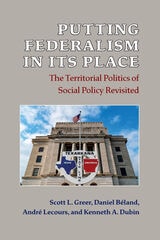
Putting Federalism in Its Place
The Territorial Politics of Social Policy RevisitedScott L. Greer, Daniel Béland, André Lecours, and Kenneth A. Dubin
University of Michigan Press, 2023
What does federalism do to welfare states? This question arises in scholarly debates about policy design as well as in discussions about the right political institutions for a country. It has frustrated many, with federalism seeming to matter in all sorts of combinations with all sorts of issues, from nationalism to racism to intergovernmental competition. The diffuse federalism literature has not come to compelling answers for very basic questions.
Scott L. Greer, Daniel Béland, André Lecours, and Kenneth A. Dubin argue for a new approach—one methodologically focused on configurations of variables within cases rather than a fruitless attempt to isolate “the” effect of federalism; and one that is substantively engaged with identifying key elements in configurations as well as with when and how their interactions matter. Born out of their work on a multi-year, eleven-country project (published as Federalism and Social Policy: Patterns of Redistribution in Eleven Countries, University of Michigan Press, 2019), this book comprises a methodological and substantive agenda. Methodologically, the authors shift to studies that embraced and understood the complexity within which federal political institutions operate. Substantively, they make an argument for the importance of plurinationalism, changing economic interests, and institutional legacies.
REFORMING PARLIAMENTARY COMMITTEES
ISRAEL IN COMPARATIVE PERSPECTIVEREUVEN Y. HAZAN
The Ohio State University Press, 2001

SENATES
BICAMERALISM IN THE CONTEMPORARY WORLDEdited by Samuel C. Patterson & Anthony Mughan
The Ohio State University Press, 1999

The Madisonian Turn
Political Parties and Parliamentary Democracy in Nordic EuropeTorbjörn Bergman and Kaare Strøm, editors
University of Michigan Press, 2013
"The Madisonian Turn is an outstanding assessment of the functioning of democratic institutions in the Nordic countries. If democracy is in trouble in Scandinavia, then it is surely facing problems everywhere, so the book will be read carefully by those concerned about contemporary governance in all modern democracies."
---Michael Gallagher, Trinity College, Dublin
"This welcome and timely re-evaluation of Nordic politics constitutes a major contribution to comparative government, and is likely to stand as the definitive treatment of politics in the region for many years to come."
---Peter Mair, European University Institute
"This book is unique in its comparative scope and the wealth of information on the state of parliamentary democracy in the Nordic countries. It is particularly useful for the comparativists who do not come from these countries, because the original literature which it covers in detail is often not accessible for the English-speaking audience."
---Hanspeter Kriesi, University of Zurich
"The strength of The Madisonian Turn is to interface detailed empirical evidence on the dynamics of democratic politics in Scandinavia with an elaboration and test of rival theories of change in the politics of postindustrial democracies. This book is an inspiration for students of Northern Europe, but also for scholars of comparative legislatures and political parties more generally."
---Herbert Kitschelt, Duke University
Parliamentary democracy is the most common regime type in the contemporary political world, but the quality of governance depends on effective parliamentary oversight and strong political parties. Denmark, Finland, Iceland, Norway, and Sweden have traditionally been strongholds of parliamentary democracy. In recent years, however, critics have suggested that new challenges such as weakened popular attachment, the advent of cartel parties, the judicialization of politics, and European integration have threatened the institutions of parliamentary democracy in the Nordic region.
This volume examines these claims and their implications. The authors find that the Nordic states have moved away from their previous resemblance to a Westminster model toward a form of parliamentary democracy with more separation-of-powers features---a Madisonian model. These features are evident both in vertical power relations (e.g., relations with the European Union) and horizontal ones (e.g., increasingly independent courts and central banks). Yet these developments are far from uniform and demonstrate that there may be different responses to the political challenges faced by contemporary Western democracies.
Torbjörn Bergman is Professor of Political Science at Umeå University, Sweden.
Kaare Strøm is Professor of Political Science at the University of California, San Diego.
Jacket Credit: Heidi Hobde Dailey

The Politics of Social Protest
Comparative Perspectives on States and Social MovementsJ. Craig Jenkins and Bert Klandermans, Editors
University of Minnesota Press, 1995
The Politics of Social Protest was first published in 1995. Minnesota Archive Editions uses digital technology to make long-unavailable books once again accessible, and are published unaltered from the original University of Minnesota Press editions.
Bringing together celebrated scholars from diverse traditions and backgrounds, The Politics of Social Protest focuses on the reciprocal relationships among social movements, states, and political parties. The volume is organized around three key questions: Why do citizens resort to the often risky and demanding strategy of using disruptive protest when other channels of political intervention appear to be available? What is the relationship between social protest movements and systems of political representation? And what is the impact of the structure and development of the state on social movements themselves?
Contributors include Ronald Aminzade, University of Minnesota; Paul Burstein, University of Washington; Russell J. Dalton, University of California, Irvine; Donatella della Porta, University of Florence; Henry Dietz, University of Texas, Austin; Rachel L. Einwohner, University of Washington; Steven E. Finkel, University of Virginia; Jerrold D. Green, University of Arizona; Jocelyn Hollander, University of Washington; Hanspeter Kriesi, University of Geneva; Diarmuid Maguire, University of Sydney; Bronislaw Misztal, Indiana University, Fort Wayne; Edward N. Muller, University of Arizona; Michael Nollert, University of Trier; Karl-Dieter Opp, University of Hamburg; Dieter Rucht, Wissenschaftszentrum Berlin; Michael Wallace, Indiana University; and Gadi Wolfsfeld, Hebrew University of Jerusalem.
J. Craig Jenkins is professor of sociology at The Ohio State University. He is the author of The Politics of Insurgency: The Farm Worker Movement of the 1960's (1985).
Bert Klandermans is professor of applied social psychology at Free University in Amsterdam, the Netherlands. He has published widely on social movements in journals such as the American Sociological Review, Sociological Forum, and the European Journal of Social Psychology. He is the editor of the Social Movements, Protest, and Contention series for the University of Minnesota Press.
Copublished with UCL Press, London.
The Three Ages of Government
From the Person, to the Group, to the WorldJos C.N. Raadschelders
University of Michigan Press, 2020