Results by title
19 books match the query 'Comparative studies'
Agape Love
Tradition In Eight World ReligionsSir John Templeton
Templeton Press, 1999
The tradition of agape, or unconditional love, is not exclusive to any religion. It is a primary underlying principle found in religions worldwide. The concept of altruistic love challenges the spiritual person to "love your enemies" or to "love without thought of return." It is a love that flows out to others through compassion, kindness, tenderness, and charitable giving.
Buddhists have a path of compassion, where caring for others becomes the motivating force behind existence. Hindus have a branch of yoga, the heart-centered path, that leads to enlightenment through an overwhelming love for God that takes the form of loving all humanity. Eastern religions, such as Taoism and Confucianism, see transcendent love as essential to true wisdom.
Love is a universal theme of love found in all religious traditions, Buddhist, Christian, Islam, or others. As we realize that all religions have this spiritual principle of love at their core, we can develop a sense of shared humanity. The religious tradition of agape love examined in this book will inspire those who are learning to grow in compassion and love for all people.
Comparative Studies in Special Education
Kaz Mazurek
Gallaudet University Press, 1994
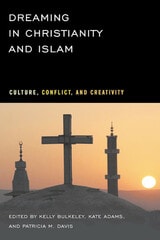
Dreaming in Christianity and Islam
Culture, Conflict, and CreativityEdited and with an Introduction by Kelly Bulkeley, Kate Adams, and Patricia M. Davis
Rutgers University Press, 2009
Dreaming in Christianity and Islam, the first book to explore dreaming in these religions through original essays, fills this void. The editors reach a plateau by focusing on how studying dreams reveals new aspects of social and political reality. International scholars document the impact of dreams on sacred texts, mystical experiences, therapeutic practices, and doctrinal controversies.
Elites and Economic Development
Comparative Studies on the Political Economy of Latin American CitiesBy John Walton
University of Texas Press, 1977
This book is a detailed comparative analysis of development politics in four urban regions of Latin America, two in Mexico and two in Colombia. John Walton has based his studies on the assumption that the problems of economic growth are essentially political, that is, are problems of choice, decision-making, and the exercise of power. His fundamental purpose has been to discover how elites of different kinds are more and less successful in the promotion of economic development, which he defines as a process in the organization of a society leading not only to higher levels of efficient output but also to a more equitable distribution of benefits.
At the time, the four cities compared were the second- and third-largest metropolitan areas in each country, Guadalajara and Monterrey in Mexico, Medellín and Cali in Colombia. This selection allows the author to pair, across countries, cases of early and large-scale industrialization (Monterrey and Medellín) with cases of more recent industrial growth in agricultural-commercial centers (Guadalajara and Cali). Walton presents historical introductions to each of the regions and integrates these with original fieldwork and interviews with more than three hundred members of the political and economic elites.
The findings are extensive, but in general they demonstrate that where political and economic power is more broadly distributed, where elites are more open and accessible, and where organizational life is more active and coordinated, regions tend to develop qualitatively as well as quantitatively, showing increases both in productivity and in such benefits as public services, housing, education, and a more balanced distribution of income. If these characteristics are absent, regions may be industrialized but do not provide a broad sharing of the benefits. Walton places a good deal of emphasis on the role of foreign investments, demonstrating that the more penetrated regions are also the less developed.
Finally, the results of these studies are used to evaluate and advance theories of underdevelopment and particularly of economic dependency.
Fundamentalisms Observed
Edited by Martin E. Marty and R. Scott Appleby
University of Chicago Press, 1991
The contributors include sociologists, cultural anthropologists, and historians, some of whom have been participant-observers in the groups under consideration. As an analysis of the global resurgence of religion, Fundamentalisms Observed sheds new light on current religious movements and cultures from North America to the Far East.
Fundamentalisms and Society
Reclaiming the Sciences, the Family, and EducationEdited by Martin E. Marty and R. Scott Appleby
University of Chicago Press, 1993
Edited by Martin E. Marty and R. Scott Appleby
Around the world, fundamentalist movements are profoundly
affecting the way we live. Misinformation and misperception
about fundamentalism exacerbate conflicts at home and abroad.
Yet policymakers, journalists, students, and others have
lacked any comprehensive resource on the explosive phenomenon
of fundamentalism. Now the Fundamentalism Project has
assembled an international team of scholars for a multivolume
assessment of the history, scope, sources, character, and
impact of fundamentalist movements within the world's major
religious traditions.
Fundamentalisms and Society shows how fundamentalist
movements have influenced human relations, education, women's
rights, and scientific research in over a dozen nations and
within the traditions of Islam, Judaism, Christianity,
Buddhism, and Hinduism. Drawn from the fields of
anthropology, sociology, history of religion, and history of
science, the contributors cover topics such as the
educational structures of Hindu revivalism, women in
fundamentalist Iran and Pakistan, and the creationist cosmos
of Protestant fundamentalism. In a concluding essay, William
H. McNeill situates contemporary fundamentalisms within a
world historical context.
The Fundamentalism Project, Volume 2
Martin E. Marty and R. Scott Appleby direct the
Fundamentalism Project. Marty, the Fairfax M. Cone
Distinguished Service Professor of the History of Modern
Christianity at the University of Chicago, is the senior
editor of the Christian Century and the author of
numerous books, including the multivolume Modern American
Religion, also published by the University of
Chicago Press. Appleby, a research associate at the
University of Chicago, is the author of “Church and
Age Unite!” The Modernist Impulse in American
Catholicism.
Fundamentalisms and the State
Remaking Polities, Economies, and MilitanceEdited by Martin E. Marty and R. Scott Appleby
University of Chicago Press, 1996
successful have they been in remaking political structures?
To answer this question, the contributors to this volume—
political scientists, historians of religion,
anthropologists, and sociologists—discuss the anti-
abortion movement, Operation Rescue in the United States, the
Islamic war of resistance in Afghanistan, Shi'ite
jurisprudence in Iran, and other issues. The volume
considers the effect that antisecular religious movements
have had over the past twenty-five years on national
economies, political parties, constitutional issues, and
international relations on five continents and within the
traditions of Islam, Christianity, Judaism, Buddhism,
Hinduism, and Sikhism. Marty and Appleby conclude with a
synthetic statement on the fundamentalist impact on polities,
economies, and state security.
The Fundamentalism Project, Volume 3
Martin E. Marty and R. Scott Appleby direct the
Fundamentalism Project. Marty, the Fairfax M. Cone
Distinguished Service Professor of the History of Modern
Christianity at the University of Chicago, is the senior
editor of the Christian Century and the author of
numerous books, including the multivolume Modern American
Religion, also published by the University of
Chicago Press. Appleby, a research associate at the
University of Chicago, is the author of “Church and
Age Unite!” The Modernist Impulse in American
Catholicism.
Global Hermeneutics. Reflections and Consequences
Knut Holter
SBL Press, 2010
A collection of essays from the International Cooperation Initiative of the Society of Biblical Literature
This first volume in the International Voices in Biblical Studies series stimulates and facilitates a global hermeneutic in which centers and margins fade. The collection explores the global context within which biblical studies and interpretation take place, includes three case studies from different regions, and reflections on the consequences of global hermeneutics on biblical interpretation and on translation.Features
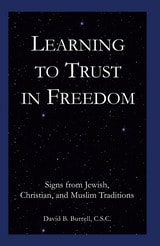
Learning to Trust in Freedom
Signs from Jewish, Christian, and Muslim TraditionsDavid B. Burrell, C.S.C.
University of Scranton Press, 2010
True religious faith cannot be confirmed by any external proofs. Rather, it is founded on a basic act of trust—and the common root of that trust, for Jewish, Christian, and Islamic traditions, is a belief in the divine creation of the universe. But with Learning to Trust in Freedom, David B. Burrell asks the provocative question: How do we reach that belief, and what is it about the universe that could possibly testify to its divine origins? Even St. Augustine, he points out, could only find faith after a harrowing journey through the lures of desire—and it is that very desire that Burrell seizes on as a tool with which to explore the origin and purpose of the world. Delving deep into the intertwinings of desire and faith, and drawing on St. John of the Cross, Edith Stein, and Charles Taylor, Burrell offers a new understanding of free will, trust, and perception.
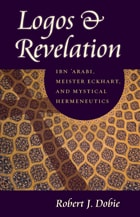
Logos and Revelation
Ibn 'Arabi, Meister Eckhart, and Mystical HermeneuticsRobert J. Dobie
Catholic University of America Press, 2010
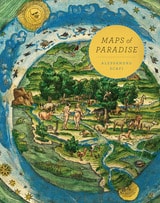
Maps of Paradise
Alessandro Scafi
University of Chicago Press, 2013
Maps of Paradise charts the diverse ways in which scholars and mapmakers from the eighth to the twenty-first century rose to the challenge of identifying the location of paradise on a map, despite the certain knowledge that it was beyond human reach. Over one hundred illustrations celebrate this history of a paradox: the mapping of the unmappable. It is also a mirror to the universal dream of perfection and happiness, and the yearning to discover heaven on earth.
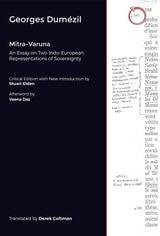
Mitra-Varuna
An Essay on Two Indo-European Representations of SovereigntyGeorges Dumézil
HAU, 2023
Georges Dumézil’s fascination with the myths and histories of India, Rome, Scandinavia, and the Celts yielded an idea that became his most influential scholarly legacy: the tripartite hypothesis, which divides Indo-European societal functions into three classes: the sacred sovereign, the warrior, and the producer. Mitra-Varuna, originally published in 1940, concentrates on the first function, that of sovereignty. Dumézil identifies two types of rulers, the first judicial and worldly, the second divine and supernatural. These figures, both priestly, are oppositional but complementary. The title nods to these roles, referring to the gods Mitra, a rational mediator, and Varuna, an awesome religious figure.
Stuart Elden’s critical edition, based on the 1988 English translation by Derek Coltman, identifies variations between the first and second French editions and completes—and in places corrects—Dumézil’s references. The editor’s detailed introduction situates Mitra-Varuna within Dumézil’s career, outlines how his treatment of its themes developed over time, and relates the book to the political controversy around his ideas. Two new appendices contain passages that did not appear in the second French edition.
Protestant and Roman Catholic Ethics
Prospects for RapprochementJames M. Gustafson
University of Chicago Press, 1978
Religious Imaginations
How Narratives of Faith are Shaping Today’s WorldEdited by James Walters
Gingko, 2018
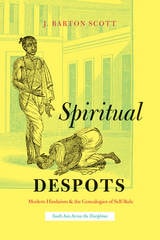
Spiritual Despots
Modern Hinduism and the Genealogies of Self-RuleJ. Barton Scott
University of Chicago Press, 2016
Through this alternative genealogy of the self-ruling subject, Spiritual Despots demonstrates that Hindu reform movements cannot be understood solely within the precolonial tradition, but rather need to be read alongside other movements of their period. The book’s focus moves fluidly between Britain and India—engaging thinkers such as James Mill, Keshub Chunder Sen, Max Weber, Karsandas Mulji, Helena Blavatsky, M. K. Gandhi, and others—to show how colonial Hinduism shaped major modern discourses about the self. Throughout, Scott sheds much-needed light how the rhetoric of priestcraft and practices of worldly asceticism played a crucial role in creating a new moral and political order for twentieth-century India and demonstrates the importance of viewing the emergence of secularism through the colonial encounter.
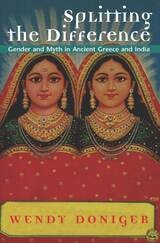
Splitting the Difference
Gender and Myth in Ancient Greece and IndiaWendy Doniger
University of Chicago Press, 1999
Myth, Doniger argues, responds to the complexities of the human condition by multiplying or splitting its characters into unequal parts, and these sloughed and cloven selves animate mythology's prodigious plots of sexuality and mortality. Doniger's comparisons show that ultimately differences in gender are more significant than differences in culture; Greek and Indian stories of doubled women resemble each other more than they do tales of doubled men in the same culture. In casting Hindu and Greek mythologies as shadows of each other, Doniger shows that culture is sometimes but the shadow of gender.

The Bedtrick
Tales of Sex and MasqueradeWendy Doniger
University of Chicago Press, 2000
The Bedtrick brings together hundreds of stories from all over the world, from the earliest recorded Hindu and Hebrew texts to the latest item in the Weekly World News, to show the hilariously convoluted sexual scrapes that people manage to get themselves into and out of. Here you will find wives who accidentally commit adultery with their own husbands. You will read Lincoln's truly terrible poem about a bedtrick. You will learn that in Hong Kong the film The Crying Game was retitled Oh No! My Girlfriend Has a Penis. And that President Clinton was not the first man to be identified by an idiosyncratic organ.
At the bottom of these wonderful stories, ancient myths, and historical anecdotes lie the dynamics of sex and gender, power and identity. Why can't people tell the difference in the dark? Can love always tell the difference between one lover and another? And what kind of truth does sex tell? Funny, sexy, and engaging, The Bedtrick is a masterful work of energetic storytelling and dazzling scholarship. Give it to your spouse and your lover.
The Wayfarer's End
Bonaventure and Aquinas on Divine Rewards in Scripture and Sacred DoctrineShawn M. Colberg
Catholic University of America Press, 2020
What Has Athens to Do with Jerusalem?
Timaeus and Genesis in CounterpointJaroslav Pelikan
University of Michigan Press, 1997