Results by title
9 books match the query 'Confession'
Confession
Susan Hahn
University of Chicago Press, 1996
"Phoenix Poets is the most distinguished university press series going."—Alfred Corn
"Compressed, controlled, circumscribed by the artist's discipline, the poems in Susan Hahn's Confession do not spill over; each is like a steadily held cup containing its pain."—Alicia Ostriker
"Hahn's voice is unique and unforgettable . . . . Hahn's self-revelation is so startling, and her details so extraordinary, that she virtually detonates her poems with energy. . . . Plath, Ai, Sexton—Hahn brings to mind those vivid, violent poets, but her voice is clearly her own, strong and without either shrillness or shame."—Patricia Monaghan, Booklist
"In her third book of poems, Confession, Susan Hahn continues to refine her amazing capacity to disquiet, disgust and fascinate. This may not sound like a recommendation, but it is. . . . The precision of Hahn's language stands out even more clearly when compared to the looser, baggier free verse that dominates so much contemporary poetry."—Maureen McLane, Chicago Tribune

Confession of a Serial Killer
The Untold Story of Dennis Rader, the BTK KillerKatherine Ramsland
University Press of New England, 2017

Isadore's Secret
Sin, Murder, and Confession in a Northern Michigan TownMardi Link
University of Michigan Press, 2010
"In Isadore's Secret, Mardi Link shines a journalist's lamp on this dark, quiet corner of Michigan's history, assuring that the tragic story of Sister Janina is not forgotten. Link's telling is fascinating and thorough, making a story you will not soon forget."
---Steve Lehto, author of Death's Door
A gripping account of the mysterious 1907 disappearance of a young nun in a northern Michigan town and the national controversy that followed when she turned up dead and buried in the basement of her own church.
Swinging planks of lantern light shine through the musty air and onto the dirt floor of the church basement. The oddly glowing rectangles syncopate over the damp ground and illuminate even the darkest, stooped-down corners of the space beyond. The only sound is the ragged breathing of two men, a young parish priest and a much older laborer. Aboveground these men belong completely to this place, in both body and soul. A glimpse of their faces anywhere in the sanctuary, the rectory, the school, the barn, or the gardens would be a welcome sight. But here below, these men of Isadore are interlopers. Only trespassers would sneak silently into the church's sloped underbelly without witness to carry out such a sinful and secret errand as this one. Despite their tools, and their lantern, and their resolve, neither is equipped for the task at hand or for what is to come.
Mardi Link, a former crime reporter, was named Antioch's Betty Crumrine Scholar for Creative Nonfiction in 2007. Her first book, When Evil Came to Good Hart, also published by the University of Michigan Press, spent four months on the Heartland Indie Bestseller List.
This true story was the basis for the Broadway play The Runner Stumbles and the film of the same name.
Front cover: Photograph of cemetery © John L. Russell, Great Lakes Images; image of face ©iStockphoto.com/duncan1890.
Paganism - Christianity - Judaism
A Confession of FaithMax Brod, translated by William Wolfe, introduction by Eric Gottgetreu
University of Alabama Press, 1970
Now remembered primarily as Franz Kafta's friend and literary executor, Max Brod was an accomplishered thinker and writer in his own right. In this volume, he considers the nature and differences between Judaism and Christianity, addressing some of the most perplexing questions at the heart of human existence.
“One of the most famous and widely discussed books of the 1920’s, Max Brod’s Paganism—Christianity—Judaism, has at last found its way into English translation to confront a new generation of readers. Max Brod is best remembered today as the literary editor and friend of Franz Kafka. In his day, however, he was the more famous of the two by far. A major novelist, playwright, poet, essayist, and composer, he was also, as this book demonstrates, a serious thinker on the perennial questions that are at the heart of human existence. . . .Some of his judgments are open to question. Still, with all its limitations, this is a forthright and passionate proclamation of the uniqueness of Judaism. Paganism—Christianity—Judaism was an intellectual and spiritual event when it was first published and it remains a valuable document even now.” —Rabbi Jack Riemer, Hadassah
Sin and Confession in Colonial Peru
Spanish-Quechua Penitential Texts, 1560-1650By Regina Harrison
University of Texas Press, 2014
A central tenet of Catholic religious practice, confession relies upon the use of language between the penitent and his or her confessor. In the sixteenth and seventeenth centuries, as Spain colonized the Quechua-speaking Andean world, the communication of religious beliefs and practices—especially the practice of confession—to the native population became a primary concern, and as a result, expansive bodies of Spanish ecclesiastic literature were translated into Quechua. In this fascinating study of the semantic changes evident in translations of Catholic catechisms, sermons, and manuals, Regina Harrison demonstrates how the translated texts often retained traces of ancient Andean modes of thought, despite the didactic lessons they contained.
In Sin and Confession in Colonial Peru, Harrison draws directly from confession manuals to demonstrate how sin was newly defined in Quechua lexemes, how the role of women was circumscribed to fit Old World patterns, and how new monetized perspectives on labor and trade were taught to the subjugated indigenous peoples of the Andes by means of the Ten Commandments. Although outwardly confession appears to be an instrument of oppression, the reformer Bartolomé de Las Casas influenced priests working in the Andes; through their agency, confessional practice ultimately became a political weapon to compel Spanish restitution of Incan lands and wealth. Bringing together an unprecedented study (and translation) of Quechua religious texts with an expansive history of Andean and Spanish transculturation, Harrison uses the lens of confession to understand the vast and telling ways in which language changed at the intersection of culture and religion.
The Inquisitor's Tongue
A NovelAlan Singer
University of Alabama Press, 2012
Alan Singer’s riveting new novel, The Inquisitor’s Tongue, reimagines the Spanish Inquisition as a world in which spiritual horrors and acts of violence are the birth pangs of otherwise unimaginable identities.
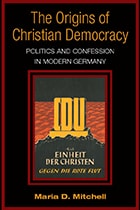
The Origins of Christian Democracy
Politics and Confession in Modern GermanyMaria D. Mitchell
University of Michigan Press, 2012
This book is a pioneering contribution to the history of the founding of the West German political system after the Second World War. The political cooperation between Catholics and Protestants that resulted in the formation of the Christian Democratic Union (CDU) in occupied and early West Germany represented a significant change from a long history of hostility in confessional relations. Given that the CDU went on to dominate politics in West Germany well into the 1960s, Maria D. Mitchell argues that an understanding of what made this interconfessional party possible is crucial to an exploration of German history in the postwar period. She examines the political history of party formation as well as the religious beliefs and motivations that shaped the party's philosophy and positions. She provides an authoritative guide to the complex processes of maneuvering and negotiation that produced the CDU during 1945-46. The full range of political possibilities is discussed, including the suppressed alternatives to the Adenauer/Erhard axis that eventually defined the party's trajectory during the 1950s and the abortive Christian Socialism associated with Jacob Kaiser.
The Pursuit of Harmony
Kepler on Cosmos, Confession, and CommunityAviva Rothman
University of Chicago Press, 2017
Harmony, Rothman shows, was both the intellectual bedrock for and the primary goal of Kepler’s disparate endeavors. But it was also an elusive goal amid the deteriorating conditions of his world, as the political order crumbled and religious war raged. In the face of that devastation, Kepler’s hopes for his theories changed: whereas he had originally looked for a unifying approach to truth, he began instead to emphasize harmony as the peaceful coexistence of different views, one that could be fueled by the fundamentally nonpartisan discipline of mathematics.
Troubling Confessions
Speaking Guilt in Law and LiteraturePeter Brooks
University of Chicago Press, 2000
In Troubling Confessions, Peter Brooks juxtaposes cases from law and literature to explore the kinds of truth we associate with confessions, and why we both rely on them and regard them with suspicion. For centuries the law has considered confession to be "the queen of proofs," yet it has also seen a need to regulate confessions and the circumstances under which they are made, as evidenced in the continuing debate over the Miranda decision. Western culture has made confessional speech a prime measure of authenticity, seeing it as an expression of selfhood that bears witness to personal truth. Yet the urge to confess may be motivated by inextricable layers of shame, guilt, self-loathing, the desire to propitiate figures of authority. Literature has often understood the problematic nature of confession better than the law, as Brooks demonstrates in perceptive readings of legal cases set against works by Rousseau, Dostoevsky, Joyce, and Camus, among others.
Mitya in The Brothers Karamazov captures the trouble with confessional speech eloquently when he offers his confession with the anguished plea: this is a confession; handle with care. By questioning the truths of confession, Peter Brooks challenges us to reconsider how we demand confessions and what we do with them.