Results by title
6 books match the query 'Confucianism'
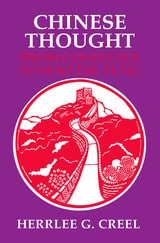
Chinese Thought from Confucius to Mao Tse-tung
Herrlee Glessner Creel
University of Chicago Press, 1971
"Chinese philosophy before our Christian era is emphasized in this nontechnical summary of Chinese thought. Professor Creel also deals with Confucianism, the ideas of Mo-tsu and Mencius, Taoism, Legalism, and their variations and adaptations. As an introduction for the general reader, this book stands among the best."—China: A Resource and Curriculum Guide
"There exists nowhere else such a well-written presentation of the main trends in Chinese thought in so brief a space. The text is not cluttered with Chinese names and the pages are not weighed down with footnotes—but the references are there for those who want them, with suggestions for further readings. This is a book which can be understood by those who have never read anything else about China."—The New York Times Book Review
"There exists nowhere else such a well-written presentation of the main trends in Chinese thought in so brief a space. The text is not cluttered with Chinese names and the pages are not weighed down with footnotes—but the references are there for those who want them, with suggestions for further readings. This is a book which can be understood by those who have never read anything else about China."—The New York Times Book Review
[more]
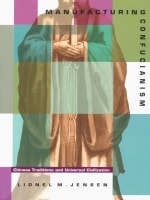
Manufacturing Confucianism
Chinese Traditions and Universal CivilizationLionel M. Jensen
Duke University Press, 1998
Could it be that the familiar and beloved figure of Confucius was invented by Jesuit priests? In Manufacturing Confucianism, Lionel M. Jensen reveals this very fact, demonstrating how sixteenth- and seventeenth-century Western missionaries used translations of the ancient ru tradition to invent the presumably historical figure who has since been globally celebrated as philosopher, prophet, statesman, wise man, and saint.
Tracing the history of the Jesuits’ invention of Confucius and of themselves as native defenders of Confucius’s teaching, Jensen reconstructs the cultural consequences of the encounter between the West and China. For the West, a principal outcome of this encounter was the reconciliation of empirical investigation and theology on the eve of the scientific revolution. Jensen also explains how Chinese intellectuals in the early twentieth century fashioned a new cosmopolitan Chinese culture through reliance on the Jesuits’ Confucius and Confucianism. Challenging both previous scholarship and widespread belief, Jensen uses European letters and memoirs, Christian histories and catechisms written in Chinese, translations and commentaries on the Sishu, and a Latin summary of Chinese culture known as the Confucius Sinarum Philosophus to argue that the national self-consciousness of Europe and China was bred from a cultural ecumenism wherein both were equal contributors.
Tracing the history of the Jesuits’ invention of Confucius and of themselves as native defenders of Confucius’s teaching, Jensen reconstructs the cultural consequences of the encounter between the West and China. For the West, a principal outcome of this encounter was the reconciliation of empirical investigation and theology on the eve of the scientific revolution. Jensen also explains how Chinese intellectuals in the early twentieth century fashioned a new cosmopolitan Chinese culture through reliance on the Jesuits’ Confucius and Confucianism. Challenging both previous scholarship and widespread belief, Jensen uses European letters and memoirs, Christian histories and catechisms written in Chinese, translations and commentaries on the Sishu, and a Latin summary of Chinese culture known as the Confucius Sinarum Philosophus to argue that the national self-consciousness of Europe and China was bred from a cultural ecumenism wherein both were equal contributors.
[more]
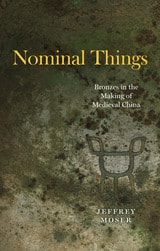
Nominal Things
Bronzes in the Making of Medieval ChinaJeffrey Moser
University of Chicago Press, 2023
How the medieval study of ancient bronzes influenced the production of knowledge and the making of things in East Asia.
This book opens in eleventh-century China, where scholars were the first in world history to systematically illustrate and document ancient artifacts. As Jeffrey Moser argues, the visual, technical, and conceptual mechanisms they developed to record these objects laid the foundations for methods of visualizing knowledge that scholars throughout early modern East Asia would use to make sense of the world around them.
Of the artifacts these scholars studied, the most celebrated were bronze ritual vessels that had been cast nearly two thousand years earlier. While working to make sense of the relationship between the bronzes’ complex shapes and their inscribed glyphs, they came to realize that the objects were “nominal things”—objects inscribed with names that identified their own categories and uses. Eleventh-century scholars knew the meaning of these glyphs from hallowed Confucian writings that had been passed down through centuries, but they found shocking disconnects between the names and the bronzes on which they were inscribed. Nominal Things traces the process by which a distinctive system of empiricism was nurtured by discrepancies between the complex materiality of the bronzes and their inscriptions. By revealing the connections between the new empiricism and older ways of knowing, the book explains how scholars refashioned the words of the Confucian classics into material reality.
[more]
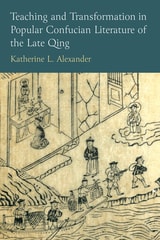
Teaching and Transformation in Popular Confucian Literature of the Late Qing
Katherine L. Alexander
University of Michigan Press, 2025
The Taiping Civil War (1851–1864) was one of the most destructive wars in Chinese history, with the death toll estimated between twenty and thirty million. What visions did survivors have for restoring their fractured society once the war ended? Katherine L. Alexander’s Teaching and Transformation in Popular Confucian Literature of the Late Qing approaches these questions through literature by examining the works of evangelical Confucian teacher Yu Zhi (1809-1874), who gave a voice to the zealous side of conservative Confucian reform efforts before, during, and after the Taiping War. His works offer radical visions of a world that could be restored through collective effort and goodness, while also revealing the shifting nature of power and the cracks in Qing society.
Yu’s works complicate the picture of socio-moral reform, particularly the Confucian mission of jiaohua (teaching and transformation). Though he viewed the disasters of the late Qing as the natural consequence of jiaohua’s failure to compete against socially disruptive media, such as vernacular fiction and theatrical productions, he also wanted reformers to engage closely with these genres. Yu became a vocal advocate of teaching with moral vernacular literature that he believed met commoners at their level. He emphasized the hope that by writing, printing, and performing such texts, every member of his audience could be transformed into teachers themselves, restoring society from the bottom up.
Yu’s works complicate the picture of socio-moral reform, particularly the Confucian mission of jiaohua (teaching and transformation). Though he viewed the disasters of the late Qing as the natural consequence of jiaohua’s failure to compete against socially disruptive media, such as vernacular fiction and theatrical productions, he also wanted reformers to engage closely with these genres. Yu became a vocal advocate of teaching with moral vernacular literature that he believed met commoners at their level. He emphasized the hope that by writing, printing, and performing such texts, every member of his audience could be transformed into teachers themselves, restoring society from the bottom up.
[more]
The Culture of Korean Industry
An Ethnography of Poongsan CorporationChoong Soon Kim
University of Arizona Press, 1992
As Americans become more conscious of trade competition from Japan, Korea looms large as another source of high-quality goods. What accounts for Korea's ability to compete in foreign markets, and what distinguishes it from its island neighbor? Anthropologist Kim sheds light on this question through an ethnography of a South Korean manufacturer, showing how Korean values, ethics, and other cultural traits such as kinship networks are translated into organizational structure and economic life.
[more]
Women, the Family, and Peasant Revolution in China
Kay Ann Johnson
University of Chicago Press, 1983
Kay Ann Johnson provides much-needed information about women and gender equality under Communist leadership. She contends that, although the Chinese Communist Party has always ostensibly favored women's rights and family reform, it has rarely pushed for such reforms. In reality, its policies often have reinforced the traditional role of women to further the Party's predominant economic and military aims.
Johnson's primary focus is on reforms of marriage and family because traditional marriage, family, and kinship practices have had the greatest influence in defining and shaping women's place in Chinese society. Conversant with current theory in political science, anthropology, and Marxist and feminist analysis, Johnson writes with clarity and discernment free of dogma. Her discussions of family reform ultimately provide insights into the Chinese government's concern with decreasing the national birth rate, which has become a top priority. Johnson's predictions of a coming crisis in population control are borne out by the recent increase in female infanticide and the government abortion campaign.
Johnson's primary focus is on reforms of marriage and family because traditional marriage, family, and kinship practices have had the greatest influence in defining and shaping women's place in Chinese society. Conversant with current theory in political science, anthropology, and Marxist and feminist analysis, Johnson writes with clarity and discernment free of dogma. Her discussions of family reform ultimately provide insights into the Chinese government's concern with decreasing the national birth rate, which has become a top priority. Johnson's predictions of a coming crisis in population control are borne out by the recent increase in female infanticide and the government abortion campaign.
[more]