Results by title
11 books match the query 'Conley, Tom'
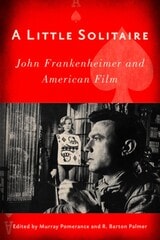
A Little Solitaire
John Frankenheimer and American FilmPomerance, Murray
Rutgers University Press, 2011
Think about some commercially successful film masterpieces--The Manchurian Candidate. Seven Days in May. Seconds. Then consider some lesser known, yet equally compelling cinematic achievements--The Fixer. The Gypsy Moths. Path to War. These triumphs are the work of the best known and most highly regarded Hollywood director to emerge from live TV drama in the 1950s--five-time Emmy-award-winner John Frankenheimer.
Although Frankenheimer was a pioneer in the genre of political thrillers who embraced the antimodernist critique of contemporary society, some of his later films did not receive the attention they deserved. Many claimed that at a midpoint in his career he had lost his touch. World-renowned film scholars put this myth to rest in A Little Solitaire, which offers the only multidisciplinary critical account of Frankenheimer's oeuvre. Especially emphasized is his deep and passionate engagement with national politics and the irrepressible need of human beings to assert their rights and individuality in the face of organizations that would reduce them to silence and anonymity.

An Errant Eye
Poetry and Topography in Early Modern FranceTom Conley
University of Minnesota Press, 2010
This tension, Conley demonstrates, cuts through literature and graphic matter of various shapes and forms-hybrid genres that include the comic novel, the emblem-book, the eclogue, sonnets, and the personal essay. An Errant Eye differs from historical treatments of spatial invention through Conley's argument that the topographic sensibility is one in which the ocular faculty, vital to the description of locale, is endowed with tact and touch.
Detailed close readings of Apian, Rabelais, Montaigne, and others empower the reader with a lively sense of the topographical impulse, deriving from Conley's own "errant eye," which is singularly discerning in attentiveness to the ambiguities of charted territory, the contours of woodcut images, and the complex combinations of word and figure in French Renaissance poetry, emblem, and politics.
Cartographic Cinema
Tom Conley
University of Minnesota Press, 2006
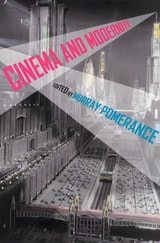
Cinema and Modernity
Pomerance, Murray
Rutgers University Press, 2006
The modern impulse gave us captivating technology and dark anxiety, rampant mobility and a world filled with strangers, the futuristic city and a fragmentation of experience. Motion pictures––the quintessence of modernism––entered into this cultural, technical, and philosophical richness with a vast public appeal and a jarring new vision of what life could be.
In Cinema and Modernity, Murray Pomerance brings together new essays by seventeen leading scholars to explore the complexity of the essential connection between film and modernity. Among the many films considered are Detour, Shock Corridor, The Last Laugh, Experiment in Terror, The Great Dictator, Leave Her to Heaven, The Talented Mr. Ripley, Eyes Wide Shut, Sunrise, The Crowd, The Shape of Things to Come, The War of the Worlds, The Day the Earth Stood Still, Scarlet Street, Shadow of a Doubt, Stella Dallas, The Blue Angel, Sullivan’s Travels, and Catch Me If You Can.
Distributions of the Sensible
Rancière, between Aesthetics and PoliticsEdited by Scott Durham and Dilip Gaonkar With an afterword by Jacques Rancière
Northwestern University Press, 2019
Jacques Rancière’s work is increasingly central to several debates across the humanities. Distributions of the Sensible confronts a question at the heart of his thought: How should we conceive the relationship between the “politics of aesthetics” and the “aesthetics of politics”? Specifically, the book explores the implications of Rancière’s rethinking of the relationship of aesthetic to political democracy from a wide range of critical perspectives.
Distributions of the Sensible contains original essays by leading scholars on topics such as Rancière’s relation to political theory, critical theory, philosophical aesthetics, and film. The book concludes with a new essay by Rancière himself that reconsiders the practice of theory between aesthetics and politics.
Film Hieroglyphs
Tom Conley
University of Minnesota Press, 2006
Identity Papers
Contested Nationhood in Twentieth-Century FranceSteven Ungar and Tom Conley, Editors
University of Minnesota Press, 1996
Identity Papers was first published in 1996. Minnesota Archive Editions uses digital technology to make long-unavailable books once again accessible, and are published unaltered from the original University of Minnesota Press editions.
What does citizenship mean? What is the process of "naturalization" one goes through in becoming a citizen, and what is its connection to assimilation? How do the issues of identity raised by this process manifest themselves in culture? These questions, and the way they arise in contemporary France, are the focus of this diverse collection.
The essays in this volume range in subject from fiction and essay to architecture and film. Among the topics discussed are the 1937 Exposition Universelle; films dealing with Vichy France; François Truffaut's Histoire d'Adèle H.; the war of Algerian independence; and nation building under François Mitterrand.
Contributors: Anne Donadey, Elizabeth Ezra, Richard J. Golsan, Lynn A. Higgins, T. Jefferson Kline, Panivong Norindr, Shanny Peer, Rosemarie Scullion, David H. Slavin, Philip H. Solomon; Florianne Wild, .
Steven Ungar is professor of cinema and comparative literature at the University of Iowa and author of Scandal and Aftereffect: Blanchot and France since 1930 (Minnesota, 1995). Tom Conley is professor of French at Harvard University.
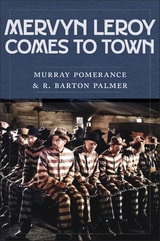
Mervyn LeRoy Comes to Town
Murray Pomerance
Rutgers University Press, 2025
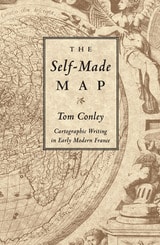
The Self-Made Map
Cartographic Writing in Early Modern FranceTom Conley
University of Minnesota Press, 2011
Conley traces the explosion of interest in mapmaking that occurred with the discovery of the New World, and discusses the commensurate rise of what he defines as cartographic writing-writing that "holds, penetrates, delineates, and explores space." Considering the works of such writers as Rabelais, Montaigne, and Descartes, Conley provides a "navigation" through the printed page, revealing the emerging values of Renaissance France. In his examination of the placing of words, letters, and graphic elements in books, he exposes the playful and sometimes enigmatic relation between spatial organization and text.
Conley also exposes the ideological exercise inherent in mapmaking, arguing that Renaissance cartography is inseparably bound up with the politics of the era. He undertakes close readings of maps and illustrations, discussing the necessity of viewing Renaissance maps in the context of their typographic layout, graphic reproduction, and literary and ideological import.
Richly illustrated throughout, The Self-Made Map combines studies of art, geography, history, literature, and printing to show a clear historical transformation, along the way linking geographical discoveries, printing processes, and political awareness. Conley's provocative analysis discloses how early modern printed literature and cartography worked together to crystallize broader issues engaging the then emergent status of cultural identity, nation, and individuality.
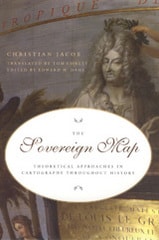
The Sovereign Map
Theoretical Approaches in Cartography throughout HistoryChristian Jacob
University of Chicago Press, 2006
Beginning with a historical overview of maps and their creation—from those traced in the dirt by primitive hands to the monumental Dutch atlases and ornate maps on Italian palace walls—Jacob goes on to consider the visual components of cartography: the decorative periphery, geometric grid, topographical lines, dots, details of iconographic figures, and many other aspects. Considering text on maps—titles, toponyms, legends, and keys—Jacob proposes that writing can both clarify and interfere with a map's visual presentation. Finally Jacob examines the role of the viewer in decoding a map's meaning and the role of society in defining the power of maps as authoritative depictions of space.
Innovative in its philosophical motivation and its interdisciplinary approach to looking at and writing about maps, The Sovereign Map is eagerly awaited by scholars from many different fields.
Thinking in the Dark
Cinema, Theory, PracticePomerance, Murray
Rutgers University Press, 2015
Thinking in the Dark introduces readers to twenty-one key theorists whose work has made a great impact on film scholarship today, including Rudolf Arnheim, Sergei Eisenstein, Michel Foucault, Siegfried Kracauer, and Judith Butler. Rather than just discussing each theorist’s ideas in the abstract, the book shows how those concepts might be applied when interpreting specific films by including an analysis of both a classic film and a contemporary one. It thus demonstrates how theory can help us better appreciate films from all eras and genres: from Hugo to Vertigo, from City Lights to Sunset Blvd., and from Young Mr. Lincoln to A.I. and Wall-E.
The volume’s contributors are all experts on their chosen theorist’s work and, furthermore, are skilled at explaining that thinker’s key ideas and terms to readers who are not yet familiar with them. Thinking in the Dark is not only a valuable resource for teachers and students of film, it’s also a fun read, one that teaches us all how to view familiar films through new eyes.
Theorists examined in this volume are: Rudolf Arnheim, Béla Balázs, Roland Barthes, André Bazin, Walter Benjamin, Judith Butler, Stanley Cavell, Michel Chion, Gilles Deleuze, Jean Douchet, Sergei Eisenstein, Jean Epstein, Michel Foucault, Siegfried Kracauer, Jacques Lacan, Vachel Lindsay, Christian Metz, Hugo Münsterberg, V. F. Perkins, Jacques Rancière, and Jean Rouch.