Results by title
10 books match the query 'Conscientious objectors'
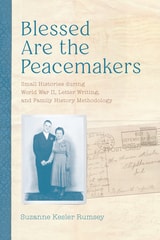
Blessed Are the Peacemakers
Small Histories during World War II, Letter Writing, and Family History MethodologySuzanne Kesler Rumsey
University of Alabama Press, 2021
Where family letters become history, and ordinary lives reveal the untold story of World War II.
In the summer of 2013, Suzanne Kesler Rumsey discovered hundreds of letters exchanged between her late grandparents, Miriam and Benjamin Kesler. The letters, written between 1941 and 1946, were filled with typical wartime sentiments: love and longing, anguish at being apart, uncertainty about the war and the country’s future, and attempts at humor to keep their spirits up. What is unusual about their story is that Ben Kesler was not writing from a theater of war. Instead, Ben, a member of the Dunkard Brethren Church, was a conscientious objector. He, along with about 12,000 other men, opted to join the Civilian Public Service (CPS) and contribute to “work of national importance” at one of the 218 CPS camps around the country.
In Blessed Are the Peacemakers: Small Histories during World War II, Letter Writing, and Family History Methodology, Rumsey has mined not only her grandparents’ letters but also archival research on CPS camps and historical data from several Mennonite and Brethren archives to recapture the narrative of Ben’s service at two different camps and of Miriam’s struggle to support herself and her husband financially at the young age of seventeen. Ben and Miriam’s life during the war was extraordinarily ordinary, spanning six years of unrecognized and humble work for their country. Ben was not compensated for his work in the camps, and Miriam stayed home and worked as a day laborer, as a live-in maid, as a farmhand, and in the family butcher shop in order to earn enough money to support them both. Small histories like that of her grandparents, Rumsey argues, provide a unique perspective on significant political and historical moments.
Blessed Are the Peacemakers also explores the rhetorical functions of letter writing as well as the methodology of family history writing. Ben and Miriam’s letters provide an apt backdrop to examine the genre, a relatively understudied mode of literacy. Rumsey situates the young couple’s correspondence within ars dictaminis, the art of letter writing, granting new insights into the genre and how personal accounts shape our understanding of historical events.
Constructing Peace
Conscientious Objectors and the Boundaries of State Power in East Germany in the 1960sDavid Doellinger
Central European University Press, 2026

Duty to Serve, Duty to Conscience
The Story of Two Conscientious Objector Combat Medics during the Vietnam WarJames C. Kearney
University of North Texas Press, 2023
Free to Die for Their Country
The Story of the Japanese American Draft Resisters in World War IIEric L. Muller
University of Chicago Press, 2001
In the spring of 1942, the federal government forced West Coast Japanese Americans into detainment camps on suspicion of disloyalty. Two years later, the government demanded even more, drafting them into the same military that had been guarding them as subversives. Most of these Americans complied, but Free to Die for Their Country is the first book to tell the powerful story of those who refused. Based on years of research and personal interviews, Eric L. Muller re-creates the emotions and events that followed the arrival of those draft notices, revealing a dark and complex chapter of America's history.
General Lewis B. Hershey and Conscientious Objection during World War II
Nicholas A. Krehbiel
University of Missouri Press, 2012
Seeking to correct these omissions in history, Nicholas A. Krehbiel provides the most comprehensive and well-rounded examination to date of General Hershey’s work as the developer and protector of alternative service programs for conscientious objectors. Hershey, whose Selective Service career spanned three major wars and six presidential administrations, came from a background with a tolerance for pacifism. He served in the National Guard and later served in both World War I and the interwar army. A lifelong military professional, he believed in the concept of the citizen soldier—the civilian who responded to the duty of service when called upon. Yet embedded in that idea was his intrinsic belief in the American right to religious freedom and his notion that religious minorities must be protected.
What to do with conscientious objectors has puzzled the United States throughout its history, and prior to World War II, there was no unified system for conscientious objectors. The Selective Service Act of 1917 only allowed conscientious objection from specific peace sects, and it had no provisions for public service. In action, this translated to poor treatment of conscientious objectors in military prisons and camps during World War I. In response to demands by the Historic Peace Churches (the Brethren, Mennonites, and the Society of Friends) and other pacifist groups, the government altered language in the Selective Service Act of 1940, stating that conscientious objectors should be assigned to noncombatant service in the military but, if opposed to that, would be assigned to “work of national importance under civilian direction.”
Under the direction of President Franklin D. Roosevelt and with the cooperation of the Historic Peace Churches, Hershey helped to develop Civilian Public Service in 1941, a program that placed conscientious objectors in soil conservation and forestry work camps, with the option of moving into detached services as farm laborers, scientific test subjects, and caregivers, janitors, and cooks at mental hospitals. Although the Civilian Public Service program only lasted until 1947, alternative service was required for all conscientious objectors until the end of the draft in 1973.
Krehbiel delves into the issues of minority rights versus mandatory military service and presents General Hershey’s pivotal role in the history of conscientious objection and conscription in American history. Archival research from both Historic Peace Churches and the Selective Service makes General Lewis B. Hershey and Conscientious Objection during World War II the definitive book on this subject.
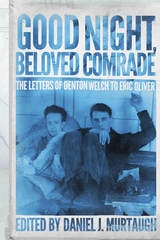
Good Night, Beloved Comrade
The Letters of Denton Welch to Eric OliverEdited and with an introduction by Daniel J. Murtaugh
University of Wisconsin Press, 2017
Though German bombs were ravaging Britain, Welch wrote in his published work about the idyllic landscapes and local people he observed in Kent. There, in 1943, he met and fell in love with Eric Oliver, a handsome, intelligent, but rather insecure "landboy"—an agricultural worker with the wartime Land Army. Oliver would become a companion, comrade, lover, and caretaker during the last six years of Welch's life. All fifty-one letters that Welch wrote to Oliver are collected and annotated here for the first time. They offer a historical record of life amidst the hardship, deprivation, and fear of World War II, and also are a timeless testament of one young man's tender and intimate emotions, his immense courage in adversity, and his continual struggle for love and creative existence.
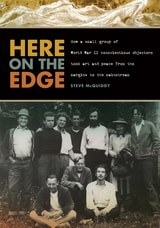
Here on the Edge
How a Small Group of World War II Conscientious Objectors Took Art and Peace from the Margins to the MainstreamSteve McQuiddy
Oregon State University Press, 2013
They worked six days a week—planting trees, crushing rock, building roads, and fighting forest fires—in exchange for only room and board. At night, they published books under the imprint of the Untide Press. They produced plays, art, and music—all during their limited non-work hours, with little money and few resources. This influential group included poet William Everson, later known as Brother Antoninus, “the Beat Friar”; violinist Broadus Erle, founder of the New Music Quartet; fine arts printer Adrian Wilson; Kermit Sheets, co-founder of San Francisco’s Interplayers theater group; architect Kemper Nomland, Jr.; and internationally renowned sculptor Clayton James.
After the war, camp members went on to participate in the San Francisco Poetry Renaissance of the 1950s, which heavily influenced the Beat Generation of Jack Kerouac, Allen Ginsberg, and Gary Snyder—who in turn inspired Ken Kesey and his Merry Pranksters, leading the way to the 1960s upheavals epitomized by San Francisco’s Summer of Love.
As camp members engaged in creative acts, they were plowing ground for the next generation, when a new set of young people, facing a war of their own in Vietnam, would populate the massive peace movements of the 1960s.
Twenty years in the making and packed with original research, Here on the Edge is the definitive history of the Fine Arts Group at Waldport, documenting how their actions resonated far beyond the borders of the camp. It will appeal to readers interested in peace studies, World War II history, influences on the 1960s generation, and in the rich social and cultural history of the West Coast.
Prison Etiquette
The Convict's Compendium of Useful InformationEdited by Holley Cantine and Dachine Rainer. Foreword by Philip Metres.
Southern Illinois University Press, 2001
Of the fifty thousand Americans who declared themselves conscientious objectors during World War II, nearly six thousand went to prison, many serving multiyear sentences in federal lockups. Some conscientious objectors, notably Robert Lowell, William Everson, and William Stafford, went on to become important figures in the literary life of their country, while others were participants and teachers in the civil rights and antiwar movements of the 1950s, 1960s, and 1970s. This long out-of-print book, reprinted from the rare original 1951 edition, collects firsthand accounts by conscientious objectors who were imprisoned for their beliefs.
Prison Etiquette is illustrated with eleven line drawings by Lowell Naeve.
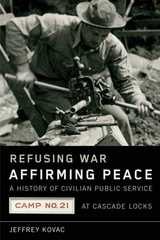
Refusing War, Affirming Peace
The History of Civilian Public Service Camp #21 at Cascade LocksJeffrey Kovac
Oregon State University Press, 2009
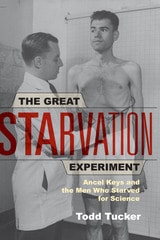
The Great Starvation Experiment
Ancel Keys and the Men Who Starved for ScienceTodd Tucker
University of Minnesota Press, 2007
“The Great Starvation Experiment is wide-ranging, weaving progress in the war into the day-to-day suffering of the hungry volunteers.” —Saint Paul Pioneer Press
“Fascinating . . .” —Minneapolis Star Tribune
Near the end of World War II, thirty-six conscientious objectors volunteered to be systematically starved for renowned scientist Ancel Keys’s study at the University of Minnesota in the basement of Memorial Stadium. Aimed to benefit relief efforts in war-ravaged Europe and Asia, the study sought the best way to rehabilitate starving citizens. Tucker captures a lost moment in American history—a time when stanch idealism and a deep willingness to sacrifice trumped even basic human needs.
“Tucker provides a fascinating and moving history of the experiment, centering on the lives and experiences of the volunteers and the formidable obstacles they overcame. Tucker tells the story with verve and economy. . . . Keys, his experiment and his 36 starving men form a compelling combination.” —Publishers Weekly
Todd Tucker is the author of several books, including Notre Dame vs. the Klan: How the Fighting Irish Defeated the Ku Klux Klan (2004). He served on the legendary Navy submarine USS Alabama before moving to Valparaiso, Indiana.