Results by title

9 books match the query 'Consciousness in literature'
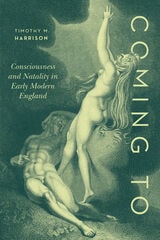
cover of Coming To: Consciousness and Natality in Early Modern England

Coming To

Consciousness and Natality in Early Modern England

Timothy M. Harrison

University of Chicago Press, 2020
In Coming To, Timothy M. Harrison uncovers the forgotten role of poetry in the history of the idea of consciousness. Drawing our attention to a sea change in the English seventeenth century, when, over the course of a half century, “conscience” made a sudden shift to “consciousness,” he traces a line that leads from the philosophy of René Descartes to the poetry of John Milton, from the prenatal memories of theologian Thomas Traherne to the unresolved perspective on natality, consciousness, and ethics in the philosophy of John Locke. Each of these figures responded to the first-person perspective by turning to the origins of how human thought began. Taken together, as Harrison shows, this unlikely group of thinkers sheds new light on the emergence of the concept of consciousness and the significance of human natality to central questions in the fields of literature, philosophy, and the history of science.
 
[more]
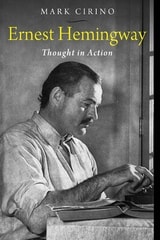
cover of Ernest Hemingway: Thought in Action

Ernest Hemingway

Thought in Action

Mark Cirino

University of Wisconsin Press, 2012

Ernest Hemingway’s groundbreaking prose style and examination of timeless themes made him one of the most important American writers of the twentieth century. Yet in Ernest Hemingway: Thought in Action, Mark Cirino observes, “Literary criticism has accused Hemingway of many things but thinking too deeply is not one of them.” Although much has been written about the author’s love of action—hunting, fishing, drinking, bullfighting, boxing, travel, and the moveable feast—Cirino looks at Hemingway’s focus on the modern mind, paralleling the interest in consciousness of such predecessors and contemporaries as Proust, Joyce, Woolf, Faulkner, and Henry James. Hemingway, Cirino demonstrates, probes the ways his character’s minds respond when placed in urgent situations or when damaged by past traumas.
    In Cirino’s analysis of Hemingway’s work through this lens—including such celebrated classics as A Farewell to Arms, The Old Man and the Sea, and “Big Two-Hearted River” and less-appreciated works including Islands in the Stream and “Because I Think Deeper”—an entirely different Hemingway hero emerges: intelligent, introspective, and ruminative.
[more]
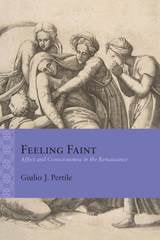
cover of Feeling Faint: Affect and Consciousness in the Renaissance

Feeling Faint

Affect and Consciousness in the Renaissance

Giulio J. Pertile

Northwestern University Press, 2019

Feeling Faint is a book about human consciousness in its most basic sense: the awareness, at any given moment, that we live and feel. Such awareness, it argues, is distinct from the categories of selfhood  to which it is often assimilated, and can only be uncovered at the margins of first-person experience. What would it mean to be conscious without being a first person—to be conscious in the absence of a self? 

Such a phenomenon, subsequently obscured by the Enlightenment identification of consciousness and personal identity, is what we discover in scenes of swooning from the Renaissance: consciousness without self, consciousness reconceived as what Fredric Jameson calls "a registering apparatus for transformed states of being." Where the early modern period has often been seen in terms of the rise of self-aware subjectivity, Feeling Faint argues that swoons, faints, and trances allow us to conceive of Renaissance subjectivity in a different guise: as the capacity of the senses and passions to experience, regulate, and respond to their own activity without the intervention of first-person awareness. 

In readings of Renaissance authors ranging from Montaigne to Shakespeare, Pertile shows how self-loss affords embodied consciousness an experience of itself in a moment of intimate vitality which precedes awareness of specific objects or thoughts—an experience with which we are all familiar, and yet which is tantalizingly difficult to pin down.

 
[more]
cover of Fictions of Consciousness: Mill, Newman, and the Reading of Victorian Prose

Fictions of Consciousness

Mill, Newman, and the Reading of Victorian Prose

Jonathan Loesberg

Rutgers University Press, 1986

Mill, Newman, and the Reading of Victorian Prose
[more]
cover of I KNOW THAT YOU KNOW THAT I KNOW: NARRATING SUBJECTS FROM MOLL FLANDERS TO MARNIE

I KNOW THAT YOU KNOW THAT I KNOW

NARRATING SUBJECTS FROM MOLL FLANDERS TO MARNIE

George Butte

The Ohio State University Press, 2004

In I Know That You Know That I Know, Butte explores how stories narrate human consciousness. Butte locates a historical shift in the representation of webs of consciousnesses in narrative—what he calls “deep intersubjectivity”—and examines the effect this shift has since had on Western literature and culture. The author studies narrative practices in two ways: one pairing eighteenth-and nineteenth-century British novels (Moll Flanders and Great Expectations, for example), and the other studying genre practices—comedy, anti-comedy and masquerade—in written and film narratives (Jane Austen and His Girl Friday, for example, and Hitchcock’s Cary Grant films).

Butte’s second major claim argues for new ways to read representations of human consciousness, whether or not they take the form of deep intersubjectivity. Phenomenological criticism has lost its credibility in recent years, but this book identifies better reading strategies arising out of what the author calls poststructuralist phenomenology, grounded largely in the work of the French philosopher Merleau-Ponty. Butte criticizes the extreme of transcendental idealism (first-wave phenomenological criticism) and cultural materialism (when it rules out the study of consciousness). He also criticizes the dominant Lacanian framework of much academic film criticism.
[more]
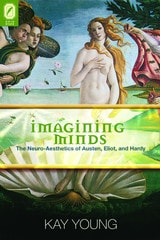
cover of Imagining Minds: The Neuro-Aesthetics of Austen, Eliot, and Hardy

Imagining Minds

The Neuro-Aesthetics of Austen, Eliot, and Hardy

Kay Young

The Ohio State University Press, 2010
Jane Austen, George Eliot, and Thomas Hardy—three great masters of the English novel—are three remarkable imagining minds. As readers of their novels, we feel ourselves to be in contact with their authorial minds and conjure the minds they create spread across the pages of their narrative worlds. In the way that we believe in and hold in mind the idea that other human beings have minds of their own do we as readers of the novel believe we are in the presence of these other minds. But how?
 
Imagining Minds explores how the novels of Austen, Eliot, and Hardy create the felt-quality of their authoring minds and of the minds they author by bringing their writing in relation to cognitive neuroscience accounts of the mind-brain, especially of William James and Antonio Damasio. It is in that relational space between the novels and theories of mind-brain that Kay Young works through her fundamental claim: the novel writes about the nature of mind, narrates it at work, and stimulates us to know deepened experiences of consciousness in its touching of our reading minds. 
 
While, in addition to James and Damasio, Young draws on a range of theories of mind-brain generated by current research in philosophy, neuroscience, cognitive science, psychology, psychiatry, and psychoanalysis to help her understand the novel’s imagining of mind, her claim is that those disciplines cannot themselves perform the more fully integrated because embodied and emotionally stimulating mind work of thenovel—mind work that prompts us as their readers to better know our own minds.
[more]
cover of Saying I No More: Subjectivity and Consciousness in the Prose of Samuel Beckett

Saying I No More

Subjectivity and Consciousness in the Prose of Samuel Beckett

Daniel Katz

Northwestern University Press, 1999
In recent criticism, Samuel Beckett's prose has been increasingly described as a labor of refusal: not only of what traditionally has made possible narrative and the novel but also of the major conventional suppositions concerning the primacy of consciousness, subjectivity, and expression for the artistic act. Beginning from the premise that Beckett never betrays his belief in "the impossibility to express," Saying I No More explores the Beckettian refusal. Katz posits that the expression of voicelessness in Beckett is not silence, that the negativity and negation so evident in the great writer's work are not simply affirmed, but that the valorization of abnegation, emptiness, impotence, or the "no" can all too easily become itself an affirmation of power or an inverted imposition of force.
[more]
cover of Staging Consciousness: Theater and the Materialization of Mind

Staging Consciousness

Theater and the Materialization of Mind

William W. Demastes

University of Michigan Press, 2002

Staging Consciousness argues that theater is a living invalidation of the Western dualism of mind and body, activating human consciousness through its embodiment of thought in performance. While consciousness theory has begun to find ways to bridge dualist gaps, Staging Consciousness suggests that theater has anticipated these advances, given the ways in which the physical theater promotes nonphysical thought, connecting the two realms in unique and ingenious ways.
William W. Demastes makes use of the writings of such varied theater practitioners as Antonin Artaud, Jerzy Grotowski, Samuel Beckett, Tony Kushner, Sam Shepard, Spalding Gray, Peter Shaffer, and others, illuminating theater as proof that mind is an extension of body. The living stage incubates and materializes thought in a way that highlights the processes of daily existence outside the theater. This book offers a new way for theater practitioners to look at the unique value of the theater and an invitation for philosophers and scientists to search for new paradigms in theater, the oldest of art forms.
William W. Demastes is Professor of English, Louisiana State University. His previous books include Theatre of Chaos: Beyond Absurdism, into Disorderly Order.
[more]
cover of Thinking in Henry James

Thinking in Henry James

Sharon Cameron

University of Chicago Press, 1989

Thinking in Henry James identifies what is genuinely strange and radical about James's concept of consciousness—first, the idea that it may not always be situated within this or that person but rather exists outside or "between," in some transpersonal place; and second, the idea that consciousness may have power over things and people outside the person who thinks. Examining these and other counterintuitive representations of consciousness, Cameron asks, "How do we make sense of these conceptions of thinking?"
[more]