Results by title
19 books match the query 'Conspiracy theories'

A Conspiratorial Life
Robert Welch, the John Birch Society, and the Revolution of American ConservatismEdward H. Miller
University of Chicago Press, 2021
Though you may not know his name, Robert Welch (1899-1985)—founder of the John Birch Society—is easily one of the most significant architects of our current political moment. In A Conspiratorial Life, the first full-scale biography of Welch, Edward H. Miller delves deep into the life of an overlooked figure whose ideas nevertheless reshaped the American right.
A child prodigy who entered college at age 12, Welch became an unlikely candy magnate, founding the company that created Sugar Daddies, Junior Mints, and other famed confections. In 1958, he funneled his wealth into establishing the organization that would define his legacy and change the face of American politics: the John Birch Society. Though the group’s paranoiac right-wing nativism was dismissed by conservative thinkers like William F. Buckley, its ideas gradually moved from the far-right fringe into the mainstream. By exploring the development of Welch’s political worldview, A Conspiratorial Life shows how the John Birch Society’s rabid libertarianism—and its highly effective grassroots networking—became a profound, yet often ignored or derided influence on the modern Republican Party. Miller convincingly connects the accusatory conservatism of the midcentury John Birch Society to the inflammatory rhetoric of the Tea Party, the Trump administration, Q, and more. As this book makes clear, whether or not you know his name or what he accomplished, it’s hard to deny that we’re living in Robert Welch’s America.

Awful Archives
Conspiracy Theory, Rhetoric, and Acts of EvidenceJenny Rice
The Ohio State University Press, 2020
After sketching a broader framework for understanding what evidence is, Awful Archives then asks how we can practice more ethical and productive forms of debate, especially when we’re faced with arguments that feel like a dead end. Thorough, engaging, and deeply insightful, Awful Archives:Conspiracy Theory, Rhetoric, and Acts of Evidence introduces an entirely new perspective on evidence—one that will impact the field for years to come.
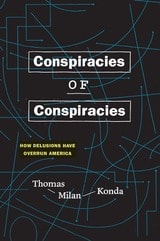
Conspiracies of Conspiracies
How Delusions Have Overrun AmericaThomas Milan Konda
University of Chicago Press, 2019
In this sweeping book, Thomas Milan Konda traces the country’s obsession with conspiratorial thought from the early days of the republic to our own anxious moment. Conspiracies of Conspiracies details centuries of sinister speculations—from antisemitism and anti-Catholicism to UFOs and reptilian humanoids—and their often incendiary outcomes. Rather than simply rehashing the surface eccentricities of such theories, Konda draws from his unprecedented assemblage of conspiratorial writing to crack open the mindsets that lead people toward these self-sealing worlds of denial. What is distinctively American about these theories, he argues, is not simply our country’s homegrown obsession with them but their ongoing prevalence and virulence. Konda proves that conspiracy theories are no harmless sideshow. They are instead the dark and secret heart of American political history—one that is poisoning the bloodstream of an increasingly sick body politic.

Conspiracy Narratives from Postcolonial Africa
Freemasonry, Homosexuality, and Illicit EnrichmentRogers Orock and Peter Geschiere
University of Chicago Press, 2024
In this book, anthropologists Rogers Orock and Peter Geschiere examine the moral panic over a perceived rise in homosexuality that engulfed Cameroon and Gabon beginning in the early twenty-first century. As they uncover the origins of the conspiratorial narratives that fed this obsession, they argue that the public’s fears were grounded in historically situated assumptions about the entanglement of same-sex practices, Freemasonry, and illicit enrichment.
This specific panic in postcolonial Central Africa fixated on high-ranking Masonic figures thought to lure younger men into sex in exchange for professional advancement. The authors’ thorough account shows how attacks on elites as homosexual predators corrupting the nation became a powerful outlet for mounting populist anger against the excesses and corruption of the national regimes. Unraveling these tensions, Orock and Geschiere present a genealogy of Freemasonry, taking readers from London through Paris to francophone Africa and revealing along the way how the colonial past shapes present-day anxieties linking same-sex practices to enrichment.

Conspiracy Theories and the Failure of Intellectual Critique
Kurtis Hagen
University of Michigan Press, 2022
Conspiracy Theories and the Failure of Intellectual Critique argues that conspiracy theories, including those that conflict with official accounts and suggest that prominent people in Western democracies have engaged in appalling behavior, should be taken seriously and judged on their merits and problems on a case-by-case basis. It builds on the philosophical work on this topic that has developed over the past quarter century, challenging some of it, but affirming the emerging consensus: each conspiracy theory ought to be judged on its particular merits and faults.
The philosophical consensus contrasts starkly with what one finds in the social science literature. Kurtis Hagen argues that significant aspects of that literature, especially the psychological study of conspiracy theorists, has turned out to be flawed and misleading. Those flaws are not randomly directed; rather, they consistently serve to disparage conspiracy theorists unfairly. This suggests that there may be a bias against conspiracy theorists in the academy, skewing “scientific” results. Conspiracy Theories and the Failure of Intellectual Critique argues that social scientists who study conspiracy theories and/or conspiracy theorists would do well to better absorb the implications of the philosophical literature.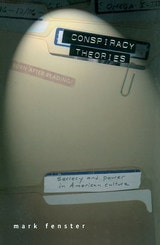
Conspiracy Theories
Secrecy and Power in American CultureMark Fenster
University of Minnesota Press, 2001
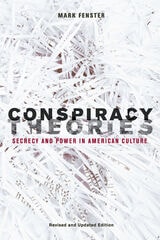
Conspiracy Theories
Secrecy and Power in American CultureMark Fenster
University of Minnesota Press, 2008
In this new edition of the landmark work, and the first in-depth look at the conspiracy communities that formed to debunk the 9/11 Commission Report, Fenster shows that conspiracy theories play an important role in U.S. democracy. Examining how and why they circulate through mass culture, he contends, helps us better understand society as a whole. Ranging from The Da Vinci Codeto the intellectual history of Richard Hofstadter, he argues that dismissing conspiracy theories as pathological or marginal flattens contemporary politics and culture because they are—contrary to popular portrayal—an intense articulation of populism and, at their essence, are strident calls for a better, more transparent government. Fenster has demonstrated once again that the people who claim someone’s after us are, at least, worth hearing.
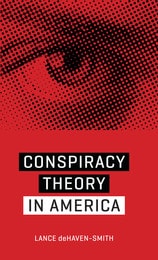
Conspiracy Theory in America
By Lance deHaven-Smith
University of Texas Press, 2013
Ever since the Warren Commission concluded that a lone gunman assassinated President John F. Kennedy, people who doubt that finding have been widely dismissed as conspiracy theorists, despite credible evidence that right-wing elements in the CIA, FBI, and Secret Service—and possibly even senior government officials—were also involved. Why has suspicion of criminal wrongdoing at the highest levels of government been rejected out-of-hand as paranoid thinking akin to superstition?
Conspiracy Theory in America investigates how the Founders’ hard-nosed realism about the likelihood of elite political misconduct—articulated in the Declaration of Independence—has been replaced by today’s blanket condemnation of conspiracy beliefs as ludicrous by definition. Lance deHaven-Smith reveals that the term “conspiracy theory” entered the American lexicon of political speech to deflect criticism of the Warren Commission and traces it back to a CIA propaganda campaign to discredit doubters of the commission’s report. He asks tough questions and connects the dots among five decades’ worth of suspicious events, including the assassinations of John and Robert Kennedy, the attempted assassinations of George Wallace and Ronald Reagan, the crimes of Watergate, the Iran-Contra arms-for-hostages deal, the disputed presidential elections of 2000 and 2004, the major defense failure of 9/11, and the subsequent anthrax letter attacks.
Sure to spark intense debate about the truthfulness and trustworthiness of our government, Conspiracy Theory in America offers a powerful reminder that a suspicious, even radically suspicious, attitude toward government is crucial to maintaining our democracy.

Conspiracy Theory in Latin Literature
By Victoria Emma Pagán
University of Texas Press, 2012
Conspiracy theory as a theoretical framework has emerged only in the last twenty years; commentators are finding it a productive way to explain the actions and thoughts of individuals and societies. In this compelling exploration of Latin literature, Pagán uses conspiracy theory to illuminate the ways that elite Romans invoked conspiracy as they navigated the hierarchies, divisions, and inequalities in their society. By seeming to uncover conspiracy everywhere, Romans could find the need to crush slave revolts, punish rivals with death or exile, dismiss women, denigrate foreigners, or view their emperors with deep suspicion. Expanding on her earlier Conspiracy Narratives in Roman History, Pagán here interprets the works of poets, satirists, historians, and orators—Juvenal, Tacitus, Suetonius, Terence, and Cicero, among others—to reveal how each writer gave voice to fictional or real actors who were engaged in intrigue and motivated by a calculating worldview.
Delving into multiple genres, Pagán offers a powerful critique of how conspiracy and conspiracy theory can take hold and thrive when rumor, fear, and secrecy become routine methods of interpreting (and often distorting) past and current events. In Roman society, where knowledge about others was often lacking and stereotypes dominated, conspiracy theory explained how the world worked. The persistence of conspiracy theory, from antiquity to the present day, attests to its potency as a mechanism for confronting the frailties of the human condition.
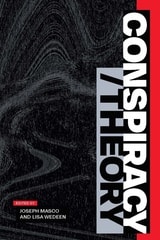
Conspiracy/Theory
Joseph Masco and Lisa Wedeen, editors
Duke University Press, 2024
Contributors. Nadia Abu El-Haj, Hussein Ali Agrama, Kathleen Belew, Elizabeth Anne Davis, Joseph Dumit, Faith Hillis, Lochlann Jain, Demetra Kasimis, Susan Lepselter, Darryl Li, Louisa Lombard, Joseph Masco, Robert Meister, Timothy Melley, Rosalind C. Morris, George Shulman, Lisa Wedeen

Global Narratives of Russian Disinformation
Edited by Muriel Fischer, Sandra Frimmel, Nanina Graf, Iryna Herasimovich, Sylvia Sasse
Diaphanes, 2026
Disinformation, conspiracy narratives, and propaganda are not only manipulative forms of communication with the intention to deceive, but also a field of global collective narratives. Russia is an important player in this field. From the Cold War to the present day, we can observe how (pro-)Russian narratives are regionally tailored, internationally disseminated, and appropriated by various political, economic, or cultural actors for their own purposes.
While some narratives might originate from literary fantasy, science fiction, or national myths, others draw on historical narratives and reproduce them. Russia often claims an anti-imperialist, anti-fascist, or postcolonial intention in order to conceal its own imperialism and fascism.
The contributions in this book document these narratives in their respective geographical and historical contexts. They examine narrative practices and their history, the interplay of global address, and local appropriation as well as affects and effects within political discourse.
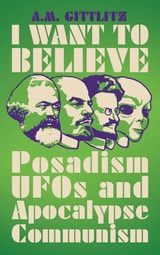
I Want to Believe
Posadism, UFOs and Apocalypse CommunismA.M. Gittlitz
Pluto Press, 2020
Advocating nuclear war, attempting communication with dolphins, and taking an interest in the paranormal and UFOs, there is perhaps no greater (or stranger) cautionary tale for the Left than that of Posadism. Named after the Argentine Trotskyist J. Posadas, the movement’s journey through the fractious and sectarian world of mid-20th century revolutionary socialism was unique. This book is a “dumpster dive” into the weird and wonderful world of the Posadists.
Although at times significant, Posadas' movement was ultimately a failure. As it disintegrated, it increasingly grew to resemble a bizarre cult, detached from the working class it sought to liberate. The renewed interest in Posadism today, especially for its more outlandish fixations, speaks to both a cynicism towards the past and nostalgia for the earnest belief that a better world is possible. Chapters include:
*Revolutionary Youth or Patriotic Youth
*The Death Throes of Capitalism
*The Origins of Posadism
*Flying Saucers, the Process of Matter and Energy, Science, the Revolutionary and Working-Class Stuggle, and the Socialist Future of Mankind
*What Exists Cannot be True
*Why Don’t Extraterrestrials Make Public Contact
*UFOs to the People
In the Introduction, A.M. Gittlitz writes, “Insurrection or first contact could come any day, Marxists and ufologists both tell us, but both are far more likely if we desire them, embracing a sentiment enigmatically expressed in a meme come before its time, a poster on the wall of rouge FBI agent Fox Mulder in the ‘90s sci-fi noir The X-Files: hovering alongside a granny image of a comically unconvincingly flying saucer and the words I WANT TO BELIEVE".
Drawing on considerable archival research, and numerous interviews with ex- and current Posadists, I Want to Believe tells the fascinating story of this most unusual socialist movement and considers why it continues to capture the imaginations of leftists today.
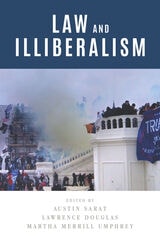
Law and Illiberalism
Edited by Austin Sarat, Lawrence Douglas, and Martha Merrill Umphrey
University of Massachusetts Press, 2022
Does the law shield citizens from authoritarian regimes? Are the core beliefs of classical liberalism—namely the rights of all individuals and constraints on state power—still protected by law? Liberalism and its expansion of rights could not exist without the legal system, and unsurprisingly, many scholars have explored the relationship between law and liberalism. However, the study of law and illiberalism is a relatively recent undertaking, a project that takes on urgency in light of the rise of authoritarian powers, among them Donald Trump’s administration, Viktor Orban’s Hungary, Recep Erdogan’s Turkey, and Jair Bolsanoro’s Brazil.
In this volume, six penetrating essays explore the dynamics of the law and illiberal quests for power, examining the anti-liberalism of neoliberalism; the weaponization of “free speech”; the role of the administrative state in current crises of liberal democracy; the broad and unstoppable assault on facts, truth, and reality; and the rise of conspiracism leading up to the Capitol insurrection. In addition to the editors, contributors include Sharon Krause, Elizabeth Anker, Jeremy Kessler, Lee McIntyre, and Nancy Rosenblum.
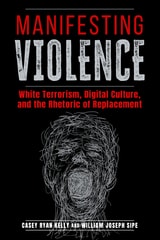
Manifesting Violence
White Terrorism, Digital Culture, and the Rhetoric of ReplacementCasey Ryan Kelly and William Joseph Sipe
University of Alabama Press, 2025
When communication becomes the engine of white supremacist violence.
Manifesting Violence: White Terrorism, Digital Culture, and the Rhetoric of Replacement by Casey Ryan Kelly and William Joseph Sipe is a compelling exploration of how the digital world has become a fertile ground for white supremacist ideology. Through an in-depth analysis of white supremacist manifestos, online rhetoric, and the myth of “white genocide,” Kelly and Sipe uncover the disturbing ways in which digital culture facilitates the spread of racist ideology and the radicalization of individuals. By examining the language of white nationalism—calls to defend the white race, family, and children—Kelly and Sipe reveal how these messages, often disguised as entertainment or humor, gradually transform passive consumers into active participants in a dangerous ideology.
Manifesting Violence sheds light on the alarming shift from organized white supremacist groups to a decentralized digital arena where hate speech is disguised as humor and online conversations foster a culture of violence. Kelly and Sipe’s thorough investigation of this growing digital ecosystem offers a chilling glimpse into the dark underbelly of online extremism. A must-read for anyone seeking to understand the growing threat of hate-motivated violence and the urgent need to address its roots in digital culture, Kelly and Sipe offer rich insights to readers, researchers, academics, and policymakers concerned about extremism, online radicalization, and white supremacy.
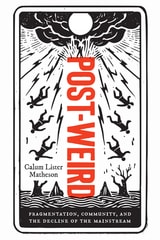
Post-Weird
Fragmentation, Community, and the Decline of the MainstreamCalum Lister Matheson
Rutgers University Press, 2026
An ambitious look at rhetoric and psychosis that explores how communities form when society collapses
American society seems to have fractured. Common touchpoints of authority have receded in recent decades and beliefs that were once taboo are now openly shared, from neo-Nazism to occultism to conspiracy thinking. In this book, Calum Lister Matheson goes beyond the fraying of contemporary American culture to ask how splinter communities form in our current media environment, what keeps them together, and what they build from the ruins of shared language.
In his stirring exploration of how people communicate when old forms of authority and meaning collapse, Matheson examines far-flung groups that have departed the mainstream—Sandy Hook deniers, Appalachian serpent handlers, pro-anorexia bloggers, incels, transvestigators, pseudoscientific reactionaries, and more—and finds unexpected similarities among their many differences. Key among their parallels is the insistence that the symbols shared by each community represent a hidden truth that cannot be questioned or interpreted but is revealed through signs—words, images, videos, and texts. By documenting American fringe cultures, extremism, and the social functions of language, this book rethinks concepts like irony, psychosis, propriety, and what it means to be normal in weird times.
Radicalizing Men
Fascist Desires, Great Replacement Propaganda, and Political ViolenceJessica Johnson
Duke University Press, 2026

The Jesuit and the Incas
The Extraordinary Life of Padre Blas Valera, S.J.Sabine Hyland
University of Michigan Press, 2004
This is the tale of Father Blas Valera, the child of a native Incan woman and Spanish father, caught between the ancient world of the Incas and the conquistadors of Spain. Valera, a Jesuit in sixteenth-century Peru, believed in what to his superiors was pure heresy: that the Incan culture, religion, and language were equal to their Christian counterparts.
As punishment for his beliefs he was imprisoned, beaten, and, finally, exiled to Spain, where he died at the hands of English pirates in 1597.
Four centuries later, this Incan chronicler had been all but forgotten, until an Italian anthropologist discovered some startling documents in a private Neapolitan collection. The documents claimed, among other things, that Valera's death had been faked by the Jesuits; that he had returned to Peru; and, intriguingly, while there had taught his followers that the Incas used a secret phonetic quipu-a record-keeping device of the Inca empire-to record history.
Far from settling anything, the documents created an international sensation among scholars and led to bitter disputes over how they should be assessed. Are they forgeries, authentic documents, or something in between? If genuine, they will radically reform our view of Inca culture and Valera. The author insightfully examines the evidence, showing how fact and fiction intertwine, and brings the dimly understood history of this author-priest to light.
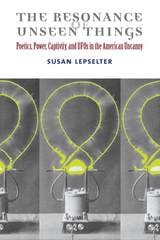
The Resonance of Unseen Things
Poetics, Power, Captivity, and UFOs in the American UncannySusan Lepselter
University of Michigan Press, 2016
“We really don’t have anything like this in terms of a focused, sympathetic, open-minded ethnographic study of UFO experiencers. . . . The author’s semiotic approach to the paranormal is immensely productive, positive, and, above all, resonant with what actually happens in history.”
—Jeffrey J. Kripal, J. Newton Rayzor Professor of Religion, Rice University
“Lepselter relates a weave of intimate alien sensibilities in out-off-the-way places which are surprisingly, profoundly, close to home. Readers can expect to share her experience of contact with complex logics of feeling, and to do so in a contemporary America they may have thought they understood.”
—Debbora Battaglia, Mount Holyoke College
“An original and beautifully written study of contemporary American cultural poetics. . . . The book convincingly brings into relief the anxieties of those at the margins of American economic and civic life, their perceptions of state power, and the narrative continuities that bond them to histories of violence and expansion in the American West.”
—Deirdre de la Cruz, University of Michigan
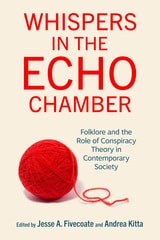
Whispers in the Echo Chamber
Folklore and the Role of Conspiracy Theory in Contemporary SocietyEdited by Jesse A. Fivecoate and Andrea Kitta
University of Wisconsin Press, 2025
This timely volume complements studies from political science, sociology, psychology, history, and more, while also crucially calling for the field of folklore studies to engage more assertively with conspiracy theories as a genre. Focusing on modern iterations of sometimes quite ancient conspiracy motifs and themes, the editors and contributors forcibly illustrate the crucial relevance of this prevalent and influential form of folklore in today’s interconnected world.
Contributors: Matthew D. Atkinson, John Bodner, Ian Brodie, Darin DeWitt, Bill Ellis, Jesse A. Fivecoate, Sandra Grady, David Guignion, Pavan Holur, Andrea Kitta, Afsane Rezaei, Vwani Roychowdhury, Lisa M. Ruch, Shadi Shahsavari, Timothy R. Tangherlini, Jeannie Banks Thomas, Anika Wilson