Results by title
22 books match the query 'Constructing'
Britain and World Power since 1945
Constructing a Nation's Role in International PoliticsDavid M. McCourt
University of Michigan Press, 2014
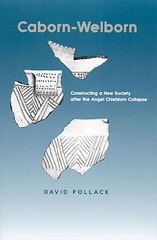
Caborn-Welborn
Constructing a New Society after the Angel Chiefdom CollapseDavid Pollack
University of Alabama Press, 2004
Caborn-Welborn, a late Mississippian (A.D. 1400-1700) farming society centered at the confluence of the Ohio and Wabash Rivers (in what is now southwestern Indiana, southeastern Illinois, and northwestern Kentucky), developed following the collapse of the Angel chiefdom (A.D. 1000-1400). Using ceramic and settlement data, David Pollack examines the ways in which that new society reconstructed social, political, and economic relationships from the remnants of the Angel chiefdom. Unlike most instances of the demise of a complex society led by elites, the Caborn-Welborn population did not become more inward-looking, as indicated by an increase in extraregional interaction, nor did they disperse to smaller more widely scattered settlements, as evidenced by a continuation of a hierarchy that included large villages.
This book makes available for the first time detailed, well-illustrated descriptions of Caborn-Welborn ceramics, identifies ceramic types and attributes that reflect Caborn-Welborn interaction with Oneota tribal groups and central Mississippi valley Mississippian groups, and offers an internal regional chronology. Based on intraregional differences in ceramic decoration, the types of vessels interred with the dead, and cemetery location, Pollack suggests that in addition to the former Angel population, Caborn-Welborn society may have included households that relocated to the Ohio/Wabash confluence from nearby collapsing polities, and that Caborn-Welborn’s sociopolitical organization could be better considered as a riverine confederacy.
Constructing a Black Curriculum
The Origins of Race-Conscious Education in AmericaAmato Nocera
Rutgers University Press, 2027
Constructing a Black Curriculum reframes how we understand Black Americans’ intellectual and political engagement with education during the first half of the twentieth century. It traces the powerful, diffuse movement created by Black Americans to build what Nocera calls a “Black Curriculum:" a communal effort to represent Black identity, guide racial consciousness, and rebut claims of inferiority. This curriculum first developed as a public educational project in Black learned societies and during the Harlem Renaissance before making its way into schools. The struggle for a Black curriculum was not only a fight against white supremacy, but also an internal debate among Black advocates over the very nature of how race should be represented and taught. This book illuminates this struggle through the work of Black intellectuals (Alexander Crummell, Carter G. Woodson, Hubert Harrison, and Alain Locke) and the intellectual contributions of African American educators (Nannie Burroughs, Jane Dabney Shackelford, and Julia Davis). This essential history provides vital context for contemporary debates over curriculum reform, racial knowledge, and the enduring quest for educational equity.
Constructing a Democracy
The History, Law, and Politics of Redistricting in OregonNorman R. Williams
Oregon State University Press, 2023
In Constructing a Democracy, legal scholar Norman Williams presents a comprehensive history of legislative and congressional redistricting in Oregon. Because redistricting impacts the representativeness of the ensuing legislative body, Oregon’s constitutional framers, legislators, and courts alike have understandably focused on developing legal rules to constrain the redistricting process. Williams is primarily interested in identifying and understanding the scope of those rules: What legal constraints have existed over time? How aggressively have the courts enforced those restraints? How have political actors undertaken the redistricting task in light of the various rules and the judicial pronouncements regarding those constraints?
The redistricting process in Oregon has not drawn national attention the way it has in states like North Carolina and Pennsylvania. But the process in Oregon is notable in several ways, including an early attention to malapportionment, the use of the initiative to reform the process, and and the impact of women leaders on the redistricting process. The Oregon process, however, has also notably lagged behind other states, particularly in considering issues of race and minority representation and preventing gerrymandering.

Constructing and Deconstructing Power in Psalms 107-150
W. Dennis Tucker Jr.
SBL Press, 2014
Essential research on the relationship between the Persian empire and the the formation of the book of Psalms
In this latest entry in the Ancient Israel and Its Literature series, W. Dennis Tucker, Jr. examines the role of Persian imperial ideology in the creation of psalms in Book 5 of the Psalter and in the shaping of the book of Psalms as a whole. Although much research has been conducted on the relationship between the Persian empire and the creation of biblical texts, the book of Psalms has been largely absent from this discussion. Tucker seeks to rectify this omission by illustrating that Book 5 constructed a subtle anti-imperial ideology in response to the threats imposed from all empires both past and present.
Features:
- Close study of the psalms portrayal of human power to that of Yahweh
- Comparison of Achaemenid propaganda to the ideology found in the psalms
- Evidence drawn from Persian iconography and inscriptions
Constructing the Black Masculine
Identity and Ideality in African American Men’s Literature and Culture, 1775–1995Maurice O. Wallace
Duke University Press, 2002
Highlighting their chronic objectification under the gaze of white eyes, Wallace argues that black men suffer a social and representational crisis in being at once seen and unseen, fetish and phantasm, spectacle and shadow in the American racial imagination. Invisible and disregarded on one hand, black men, perceived as potential threats to society, simultaneously face the reality of hypervisibility and perpetual surveillance. Paying significant attention to the sociotechnologies of vision and image production over two centuries, Wallace shows how African American men—as soldiers, Freemasons, and romantic heroes—have sought both to realize the ideal image of the American masculine subject and to deconstruct it in expressive mediums like modern dance, photography, and theatre. Throughout, he draws on the experiences and theories of such notable figures as Frederick Douglass, W. E. B. Du Bois, Booker T. Washington, and James Baldwin.
Constructing the Enemy
Empathy/Antipathy in U.S. Literature and LawRajini Srikanth
Temple University Press, 2011
In her engaging book, Constructing the Enemy, Rajini Srikanth probes the concept of empathy, attempting to understand its different types and how it is—or isn't—generated and maintained in specific circumstances.
Using literary texts to illuminate issues of power and discussions of law, Srikanth focuses on two case studies— the internment of Japanese citizens and Japanese Americans in World War II, after the bombing of Pearl Harbor, and the detainment of Muslim Americans and individuals from various nations in the U.S. prison at Guantanamo Bay.
Through primary documents and interviews that reveal why and how lawyers become involved in defending those who have been designated “enemies,” Srikanth explores the complex conditions under which engaged citizenship emerges. Constructing the Enemy probes the seductive promise of legal discourse and analyzes the emergence and manifestation of empathy in lawyers and other concerned citizens and the wider consequences of this empathy on the institutions that regulate our lives.
Constructing the Image of the Mexican Revolution
Cinema and the ArchiveBy Zuzana M. Pick
University of Texas Press, 2009
Katherine Singer Kovács Book Award, Society for Cinema and Media Studies, 2011
With a cast ranging from Pancho Villa to Dolores del Río and Tina Modotti, Constructing the Image of the Mexican Revolution demonstrates the crucial role played by Mexican and foreign visual artists in revolutionizing Mexico's twentieth-century national iconography. Investigating the convergence of cinema, photography, painting, and other graphic arts in this process, Zuzana Pick illuminates how the Mexican Revolution's timeline (1910–1917) corresponds with the emergence of media culture and modernity.
Drawing on twelve foundational films from Que Viva Mexico! (1931–1932) to And Starring Pancho Villa as Himself (2003), Pick proposes that cinematic images reflect the image repertoire produced during the revolution, often playing on existing nationalist themes or on folkloric motifs designed for export. Ultimately illustrating the ways in which modernism reinvented existing signifiers of national identity, Constructing the Image of the Mexican Revolution unites historicity, aesthetics, and narrative to enrich our understanding of Mexicanidad.
Constructing the Little House
Gender, Culture, and Laura Ingalls WilderAnn Romines
University of Massachusetts Press, 1997
Ann Romines interweaves personal observation with scholarly analysis to address these questions. Writing from a feminist perspective and drawing on resources of gender studies, cultural studies, and new historicist reading, she examines both the content of the novels and the process of their creation. She explores the relationship between mother and daughter working as collaborative authors and calls into question our assumptions about plot, juvenile fiction, and constructions of gender on the nineteenth-century frontier and in the Depression years when the Little House books were written.
This is a book that will appeal both to scholars and to general readers who might welcome an engaging and accessible companion volume to the Little House novels.
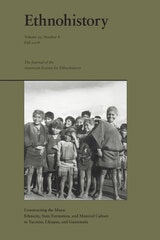
Constructing the Maya
Ethnicity, State Formation, and Material Culture in Yucatán, Chiapas, and Guatemala, Volume 55Paul K. Eiss, special issue editor
Duke University Press, 0
Contributors: David Carey Jr., Paul K. Eiss, Ben Fallaw, Stephen E. Lewis, Walter E. Little, John M. Watanabe
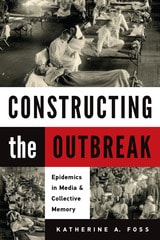
Constructing the Outbreak
Epidemics in Media and Collective MemoryKatherine A. Foss
University of Massachusetts Press, 2020
Constructing the Outbreak demonstrates how news reporting on epidemics communicates more than just information about pathogens; rather, prejudices, political agendas, religious beliefs, and theories of disease also shape the message. Analyzing seven epidemics spanning more than two hundred years—from Boston's smallpox epidemic and Philadelphia's yellow fever epidemic in the eighteenth century to outbreaks of diphtheria, influenza, and typhoid in the early twentieth century—Katherine A. Foss discusses how shifts in journalism and medicine influenced the coverage, preservation, and fictionalization of different disease outbreaks. Each case study highlights facets of this interplay, delving into topics such as colonization, tourism, war, and politics. Through this investigation into what has been preserved and forgotten in the collective memory of disease, Foss sheds light on current health care debates, like vaccine hesitancy.
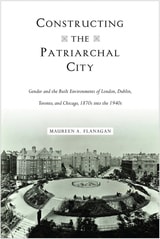
Constructing the Patriarchal City
Gender and the Built Environments of London, Dublin, Toronto, and Chicago, 1870s into the 1940sMaureen A. Flanagan
Temple University Press, 2018
In the Anglo-Atlantic world of the late nineteenth century, groups of urban residents struggled to reconstruct their cities in the wake of industrialization and to create the modern city. New professional men wanted an orderly city that functioned for economic development. Women’s vision challenged the men’s right to reconstruct the city and resisted the prevailing male idea that women in public caused the city’s disorder.
Constructing the Patriarchal City compares the ideas and activities of men and women in four English-speaking cities that shared similar ideological, professional, and political contexts. Historian Maureen Flanagan investigates how ideas about gender shaped the patriarchal city as men used their expertise in architecture, engineering, and planning to fashion a built environment for male economic enterprise and to confine women in the private home. Women consistently challenged men to produce a more equitable social infrastructure that included housing that would keep people inside the city, public toilets for women as well as men, housing for single, working women, and public spaces that were open and safe for all residents.
Constructing the Pluriverse
The Geopolitics of KnowledgeBernd Reiter, editor
Duke University Press, 2018
Contributors. Zaid Ahmad, Manuela Boatcă, Hans-Jürgen Burchardt, Raewyn Connell, Arturo Escobar, Sandra Harding, Ehsan Kashfi, Venu Mehta, Walter D. Mignolo, Ulrich Oslender, Issiaka Ouattara, Bernd Reiter, Manu Samnotra, Catherine E. Walsh, Aram Ziai
Constructing the Political Spectacle
Murray Edelman
University of Chicago Press, 1988

Fields of Play
Constructing an Academic LifeRichardson, Laurel
Rutgers University Press, 1997
Deeply engaging, movingly written with grace, elegance, and clarity, the book stimulates readers to situate their own writing in personal, social, and political contexts.
Hispanic Nation
Culture, Politics, and the Constructing of IdentityGeoffrey Fox
University of Arizona Press, 1997
Identity Technologies
Constructing the Self OnlineEdited by Anna Poletti and Julie Rak
University of Wisconsin Press, 2013

Sexual Borderlands
Constructing an American Sexual PastEdited by Kathleen Kennedy and Sharon Ullman
The Ohio State University Press, 2003

Subalternity, Antagonism, Autonomy
Constructing the Political SubjectMassimo Modonesi
Pluto Press, 2013
In this bold and innovative book, Massimo Modonesi weaves together theory and political practice by relating the concepts of subalternity, antagonism and autonomy to contemporary movements in Latin America and elsewhere.
In a sophisticated account, Modonesi reconstructs the debates between Marxist authors and schools of thought in order to sketch out informed strategies of resistance. He reviews the works of Gramsci, Negri, Castoriadis and Lefort, and engages with the arguments made by E. P. Thompson, Spivak, Laclau and Mouffe.
Subalternity, Antagonism, Autonomy firmly roots key theoretical arguments from a range of critical thinkers within specific political movements in order to recover these concepts as analytical instruments which can help to guide contemporary struggles.

The History of Modern Japanese Education
Constructing the National School System, 1872-1890Duke, Benjamin
Rutgers University Press, 2014

Voices of Crime
Constructing and Contesting Social Control in Modern Latin AmericaEdited by Luz E. Huertas, Bonnie A. Lucero, and Gregory J. Swedberg
University of Arizona Press, 2016
Voices of Crime examines these official and unofficial perceptions of deviancy, justice, and social control in modern Latin America. As a collection of essays exploring histories of crime and justice, the book focuses on both cultural and social history and the interactions among state institutions, the press, and a variety of elite and non-elite social groups. Arguing that crime in Latin America is best understood as a product of ongoing negotiation between “top-down” and “bottom up” ideas (not just as the exercise of power from the state), the authors seek to document and illustrate the everyday experiences of crime in particular settings, emphasizing underresearched historical actors such as criminals, victims, and police officers.
The book examines how these social groups constructed, contested, navigated, and negotiated notions of crime, criminality, and justice. This reorientation—in contrast to much of the existing historical literature that focuses on elite and state actors—prompts the authors to critically examine the very definition of crime and its perpetrators, suggesting that “not only the actions of the poor and racial others but also the state can be termed as criminal.”
Who Deserves to Die?
Constructing the Executable SubjectAustin Sarat
University of Massachusetts Press, 2011
How do we select those who will be subject to capital punishment? How do we identify the worst of the worst and decide who among them can and should be executed? Today these questions are more pressing than they have ever been. As the number of people sentenced to death and executed declines in the United States, those who are executed stand out as distinctive kinds of criminals, distinctive kinds of people. Does a death sentence affirm or deny their humanity? Is such a sentence an act of revenge or a carefully calculated act of justice?
These are more than questions for policy and law. They are one way of getting a handle on how our culture understands what makes life worth preserving and of delving into its complex calculus of punishment and retribution. Who Deserves to Die? brings together a distinguished group of death penalty scholars to assess the forms of legal subjectivity and legal community that are supported and constructed by the doctrines and practices of punishment by death in the United States. They help us understand what we do and who we become when we decide who is fit for execution.
In addition to the editors, contributors include Vanessa Barker, Thomas L. Dumm, Daniel Markel, Linda Meyer, Ruth A. Miller, Ravit Reichman, Susan R. Schmeiser, Mateo Taussig-Rubbo, and Robert Weisberg.