Results by title
15 books match the query 'Consumers'
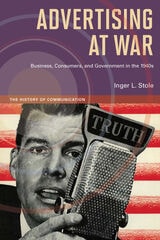
Advertising at War
Business, Consumers, and Government in the 1940sInger L. Stole
University of Illinois Press, 2012
Using archival sources, newspapers accounts, and trade publications, Stole demonstrates that the war elevated and magnified the seeming contradictions of advertising and allowed critics of these practices one final opportunity to corral and regulate the institution of advertising. Exploring how New Dealers and consumer advocates such as the Consumers Union battled the advertising industry, Advertising at War traces the debate over two basic policy questions: whether advertising should continue to be a tax-deductible business expense during the war, and whether the government should require effective standards and labeling for consumer products, which would render most advertising irrelevant. Ultimately the postwar climate of political intolerance and reverence for free enterprise quashed critical investigations into the advertising industry. While advertising could be criticized or lampooned, the institution itself became inviolable.

Brand Islam
The Marketing and Commodification of PietyBy Faegheh Shirazi
University of Texas Press, 2016
From food products to fashions and cosmetics to children’s toys, a wide range of commodities today are being marketed as “halal” (permitted, lawful) or “Islamic” to Muslim consumers both in the West and in Muslim-majority nations. However, many of these products are not authentically Islamic or halal, and their producers have not necessarily created them to honor religious practice or sentiment. Instead, most “halal” commodities are profit-driven, and they exploit the rise of a new Islamic economic paradigm, “Brand Islam,” as a clever marketing tool.
Brand Islam investigates the rise of this highly lucrative marketing strategy and the resulting growth in consumer loyalty to goods and services identified as Islamic. Faegheh Shirazi explores the reasons why consumers buy Islam-branded products, including conspicuous piety or a longing to identify with a larger Muslim community, especially for those Muslims who live in Western countries, and how this phenomenon is affecting the religious, cultural, and economic lives of Muslim consumers. She demonstrates that Brand Islam has actually enabled a new type of global networking, joining product and service sectors together in a huge conglomerate that some are referring to as the Interland. A timely and original contribution to Muslim cultural studies, Brand Islam reveals how and why the growth of consumerism, global communications, and the Westernization of many Islamic countries are all driving the commercialization of Islam.

Buyers Beware
Insurgency and Consumption in Caribbean Popular CulturePatricia Joan Saunders
Rutgers University Press, 2022
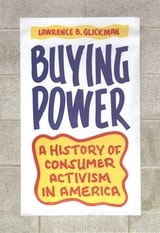
Buying Power
A History of Consumer Activism in AmericaLawrence B. Glickman
University of Chicago Press, 2009
A definitive history of consumer activism, Buying Power traces the lineage of this political tradition back to our nation’s founding, revealing that Americans used purchasing power to support causes and punish enemies long before the word boycott even entered our lexicon. Taking the Boston Tea Party as his starting point, Lawrence Glickman argues that the rejection of British imports by revolutionary patriots inaugurated a continuous series of consumer boycotts, campaigns for safe and ethical consumption, and efforts to make goods more broadly accessible. He explores abolitionist-led efforts to eschew slave-made goods, African American consumer campaigns against Jim Crow, a 1930s refusal of silk from fascist Japan, and emerging contemporary movements like slow food. Uncovering previously unknown episodes and analyzing famous events from a fresh perspective, Glickman illuminates moments when consumer activism intersected with political and civil rights movements. He also sheds new light on activists’ relationship with the consumer movement, which gave rise to lobbies like the National Consumers League and Consumers Union as well as ill-fated legislation to create a federal Consumer Protection Agency.

Consumers And Citizens
Globalization and Multicultural ConflictsNestor Garcia Canclini
University of Minnesota Press, 2001
An essential analysis of the ways consumerism and globalization intersect with political power.
In Consumers and Citizens, Néstor García Canclini, the best-known and most innovative cultural studies scholar in Latin America, maps the critical effects of urban sprawl and global media and commodity markets on citizens-and shows at the same time that the complex results mean not only a shrinkage of certain traditional rights (particularly those of the welfare or client state) but also new openings for expanding citizenship.
García Canclini focuses on the diverse ways in which democratic societies recognize markets of citizen opinions, however heterogeneous and dissonant, as in the fashion and entertainment industries. He shows how identity issues, brought to the fore by the aligning of citizenship and consumption, can no longer be understood strictly within the purview of territory or nation. Rather, the postmodern citizen-consumer inhabits a transterritorial and multilingual space, structured more along the lines of markets than states. Defining this space, García Canclini seeks to formulate a participatory and critical approach to consumption in which national culture, far from being extinguished, is reconstituted in transnational, cultural interactions.

Engineered to Sell
European Émigrés and the Making of Consumer CapitalismJan L. Logemann
University of Chicago Press, 2019

Favored Flowers
Culture and Economy in a Global SystemCatherine Ziegler
Duke University Press, 2007
Ziegler interviewed more than 250 people as she followed flowers along the full length of the commodity chain, from cuttings in Europe and Latin America to vases in and around New York. She examines the daily experiences of flower growers in the Netherlands and Ecuador, two leading exporters of flowers to the United States. Primary focus, though, is on others in the commodity chain: exporters, importers, wholesalers, and retailers. She follows their activities as they respond to changing competition, supply, and consumer behavior in a market characterized by risk, volatility, and imperfect knowledge. By tracing changes in the wholesale and retail systems, she shows the recent development of two complementary commodity chains in New York and the United States generally. One leads to a high-end luxury market served by specialty florists and designers, and the other to a lower-priced mass market served by chain groceries, corner delis, and retail superstores.

Market Encounters
Consumer Cultures in Twentieth-Century GhanaBianca Murillo
Ohio University Press, 2017
In Market Encounters, Bianca Murillo explores the shifting social terrains that made the buying and selling of goods in modern Ghana possible. Fusing economic and business history with social and cultural history, she traces the evolution of consumerism in the colonial Gold Coast and independent Ghana from the late nineteenth century through to the political turmoil of the 1970s.
Murillo brings sales clerks, market women, and everyday consumers in Ghana to the center of a story that is all too often told in sweeping metanarratives about what happens when African businesses are incorporated into global markets. By emphasizing the centrality of human relationships to Ghana’s economic past, Murillo introduces a radical rethinking of consumption studies from an Africa-centered perspective. The result is a keen look at colonial capitalism in all of its intricacies, legacies, and contradictions, including its entanglement with gender and race.
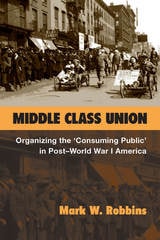
Middle Class Union
Organizing the ‘Consuming Public’ in Post-World War I AmericaMark W. Robbins
University of Michigan Press, 2017
Combining social history with interdisciplinary approaches to the study of consumption and symbolic space, Middle Class Union illustrates how acts of consumption, representations of the middle class in literary, journalistic, and artistic discourses, and ground-level organizing combined to enable white-collar activists to establish themselves as both the middle class and the backbone of the nation. This book contributes to labor history by examining the nexus of class and consumption to show how many white-collar workers drew on their consumer identity to express an anti-labor politics, later facilitating the struggles of unions throughout the post–World War I years. It also contributes to political history by emphasizing how these middle-class activists laid important groundwork for both 1920s business conservatism and New Deal liberalism. They exerted their political influence well before the post–World War II period, when a self-interested and powerful middle-class consumer identity is more widely acknowledged to have taken hold.
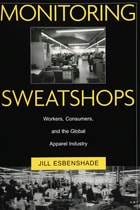
Monitoring Sweatshops
Workers, Consumers, And TheJill Esbenshade
Temple University Press, 2004

My Life with Things
The Consumer DiariesElizabeth Chin
Duke University Press, 2016

Redeeming Objects
A West German MythologyNatalie Scholz
University of Wisconsin Press, 2023
Postwar advertising, film, and print culture sought to divest mass-produced goods—such as the Volkswagen and modern interiors—of their fascist legacies. But Scholz demonstrates that postwar representations were saturated with unacknowledged references to the Nazi past. Drawing on a vast array of popular and highbrow publications and films, Redeeming Objects adds a new perspective to debates about postwar reconstruction, memory, and consumerism.

Scripted Affects, Branded Selves
Television, Subjectivity, and Capitalism in 1990s JapanGabriella Lukács
Duke University Press, 2010
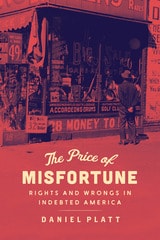
The Price of Misfortune
Rights and Wrongs in Indebted AmericaDaniel Platt
University of Chicago Press, 2023
What can be taken from someone who has borrowed money and cannot repay? What do the victims of misfortune owe to their lenders, and what can they keep for themselves? The answers to those questions, immensely important for debtors, creditors, and society at large, have changed over time. The Price of Misfortune examines the cause of debtors’ rights in the modern United States and the struggles of reformers who fought to establish financial freedoms in law.
Daniel Platt shows how, in the wake of the Civil War, a range of advocates drew potent analogies between slavery, imprisonment for debt, and the experiences of wage garnishment and property foreclosure. He traces the ways those analogies were used to campaign for bold new protections for debtors, keeping them secure in their labor, property, and personhood. Yet, as Platt demonstrates, those reforms tended to assume as their ideal borrower someone who was white, propertied, and male. In subsequent decades, the emancipatory promise of debtors’ rights would be tested as women, wage earners, and African Americans seized on their language to challenge other structural inequalities: the dependency of marriage, the exploitation of industrial capitalism, and the oppression of Jim Crow. By reconstructing these forgotten developments—and recovering the experiences of indebted farmwives, sharecroppers, and wage workers—The Price of Misfortune narrates a new history of inequality, coercion, and law amid the early financialization of American capitalism.
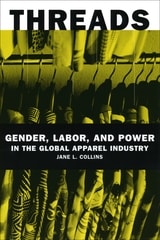
Threads
Gender, Labor, and Power in the Global Apparel IndustryJane L. Collins
University of Chicago Press, 2003
To dispel these misunderstandings, Jane L. Collins visited two very different apparel firms and their factories in the United States and Mexico. Moving from corporate headquarters to factory floors, her study traces the diverse ties that link First and Third World workers and managers, producers and consumers. Collins examines how the transnational economics of the apparel industry allow firms to relocate or subcontract their work anywhere in the world, making it much harder for garment workers in the United States or any other country to demand fair pay and humane working conditions.
Putting a human face on globalization, Threads shows not only how international trade affects local communities but also how workers can organize in this new environment to more effectively demand better treatment from their distant corporate employers.