Results by title

8 books match the query 'Contemporary Japan'

cover of Aging and Loss: Mourning and Maturity in Contemporary Japan

Aging and Loss

Mourning and Maturity in Contemporary Japan

Danely, Jason

Rutgers University Press, 2015

By 2030, over 30% of the Japanese population will be 65 or older, foreshadowing the demographic changes occurring elsewhere in Asia and around the world.  What can we learn from a study of the aging population of Japan and how can these findings inform a path forward for the elderly, their families, and for policy makers?

Based on nearly a decade of research, Aging and Loss examines how the landscape of aging is felt, understood, and embodied by older adults themselves. In detailed portraits, anthropologist Jason Danely delves into the everyday lives of older Japanese adults as they construct narratives through acts of reminiscence, social engagement and ritual practice, and reveals the pervasive cultural aesthetic of loss and of being a burden.

 
Through first-hand accounts of rituals in homes, cemeteries, and religious centers, Danely argues that what he calls the self-in-suspense can lead to the emergence of creative participation in an economy of care. In everyday rituals for the spirits, older adults exercise agency and reinterpret concerns of social abandonment within a meaningful cultural narrative and, by reimagining themselves and their place in the family through these rituals, older adults in Japan challenge popular attitudes about eldercare. Danely’s discussion of health and long-term care policy, and community welfare organizations, reveal a complex picture of Japan’s aging society. 
[more]
cover of Dyeing with the Earth: Textiles, Tradition, and Sustainability in Contemporary Japan

Dyeing with the Earth

Textiles, Tradition, and Sustainability in Contemporary Japan

Charlotte Linton

Duke University Press, 2025
In Dyeing with the Earth, Charlotte Linton explores the intersection of small-scale traditional craft production with contemporary sustainability practices. Focusing on natural textile dyeing on the southern Japanese island of Amami Ōshima, Linton details the complex relationship between preservation practices, resource extraction, and land access in the production of Oshima tsumugi kimono cloth, which uses the indigenous technique of dorozome (or mud-dyeing). As global interest in sustainable fashion grows, textile manufacturers on Amami have expanded from kimono production to dyeing garments and textiles for high-profile designers. While traditional craft may appear at odds with the large-scale global textile industry, Linton reveals how Amamian and global producers face similar social, economic, and environmental pressures. Ethical production in fashion, Linton contends, should focus on understanding local everyday practices that sustain direct relationships between people, place, and environment rather than rely on short-term solutions via new processes or materials. Weaving together ethnography, photography, and illustration, Linton underscores the continued relevance of traditional craft and material cultures amid ongoing climate change and biodiversity loss.
[more]
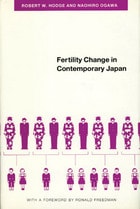
cover of Fertility Change in Contemporary Japan

Fertility Change in Contemporary Japan

Robert W. Hodge and Naohiro Ogawa

University of Chicago Press, 1992

The authors examine the striking decline in Japan's birthrate in light of the rapid urbanization, industrialization, and socioeconomic development experienced by the nation since World War II.
[more]
cover of Intimate Disconnections: Divorce and the Romance of Independence in Contemporary Japan

Intimate Disconnections

Divorce and the Romance of Independence in Contemporary Japan

Allison Alexy

University of Chicago Press, 2020

In many ways, divorce is a quintessentially personal decision—the choice to leave a marriage that causes harm or feels unfulfilling to the two people involved. But anyone who has gone through a divorce knows the additional public dimensions of breaking up, from intense shame and societal criticism to friends’ and relatives’ unsolicited advice. In Intimate Disconnections, Allison Alexy tells the fascinating story of the changing norms surrounding divorce in Japan in the early 2000s, when sudden demographic and social changes made it a newly visible and viable option. Not only will one of three Japanese marriages today end in divorce, but divorces are suddenly much more likely to be initiated by women who cite new standards for intimacy as their motivation. As people across Japan now consider divorcing their spouses, or work to avoid separation, they face complicated questions about the risks and possibilities marriage brings: How can couples be intimate without becoming suffocatingly close? How should they build loving relationships when older models are no longer feasible? What do you do, both legally and socially, when you just can’t take it anymore?
 
Relating the intensely personal stories from people experiencing different stages of divorce, Alexy provides a rich ethnography of Japan while also speaking more broadly to contemporary visions of love and marriage during an era in which neoliberal values are prompting wide-ranging transformations in homes across the globe.
[more]
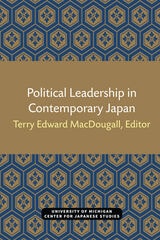
cover of Political Leadership in Contemporary Japan

Political Leadership in Contemporary Japan

Terry Edward MacDougall, Editor

University of Michigan Press, 1982
Those who do not read Japanese seldom have access to analytic studies of the fascinating and surprisingly diverse world of contemporary Japanese political leadership. This volume constitutes a step toward bringing to the English reader some sense of the norms, beliefs, styles, and modes of exercising power of Japanese political leaders and the organizational and political contexts which are changing leadership role expectations. The second volume in this series concentrates more explicitly on leadership recruitment, although the subject is also addressed here.
All of the essays in this volume highlight specific politicians, while attempting to develop analytic categories to understand the broader significance of these types of leaders. Included are the following: a Liberal Democratic Party prime minister and faction leader (Fukuda Takeo) who rose "almost effortlessly" to the pinnacle of power on the basis of an elitist educational and bureaucratic career background and another (Tanaka Kakuei) who took advantage of the chaotic wartime and immediate postwar period to overcome the limitations of his commoner background by developing an entrepreneurial style that makes him even today "the most powerful in Japan"; a younger conservative leader (Kono Yohei) who, with certain others of his generation, found life within the restrictive but predictable career paths of ruling Liberal Democrats less attractive than the risky option of forming his own New Liberal Club; an unconventional Socialist chairman (Asukata Ichio) who bucks the pull toward coalition making among the opposition parties in favor of his belief that this major but perpetual opposition party must first reconstruct itself and structure a new popular consensus that can legitimize a coalitional alternative to the Liberal Democrats; parliamentary leaders (like lower-house speaker Maeo Shigesaburo, directors of the House Management Committee, and heads of the Diet policy committees of the various parties) who are projected into increasingly influential roles by changing electoral trends and popular expectations; an innovative and dynamic mayor (Suzuki Heizaburo) who, taking advantage of the considerable authority afforded by Japan's "presidential" system of local chief executives, pursues his own priorities, mobilizing the requisite support despite the lack of national guidance and the oppositions of former backers; and the "power behind the throne" (Matsunaga Yasuzaemon and Komori Takeshi) whose visions move prime ministers and governors as well as their own followers in powerful public and private bureaucracies. [intro]
[more]
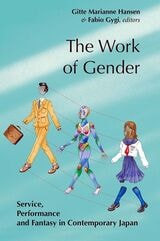
cover of The Work of Gender: Service, Performance and Fantasy in Contemporary Japan

The Work of Gender

Service, Performance and Fantasy in Contemporary Japan

Edited by Gitte Marianne Hansen and Fabio Gygi

National University of Singapore Press, 2022
This engaging volume brings new perspectives to the much-studied field of gender in Japan by focusing on the ways in which gender presentation is turned into a commodified experience. It highlights the deliberate work that goes into the creation of gendered forms of intimacy in a broad range of settings: among female fans of pornography, cross-dressing escorts, gay bar service staff, street musicians in Tokyo and transgender people in Kyoto. Engaging with theories of gender presentation, performance and emotional labour, the chapters pay careful attention to the lived realities of gender, showcasing the strength of ethnographic methods. They allow readers to understand not only how gender is constructed and commodified in contemporary Japan but also what fantasies feed this process. Mainly written by early-career scholars, the volume addresses questions of sexuality and gender that are of interest to scholars and students at all levels, whether in Japan-related fields or beyond.
[more]
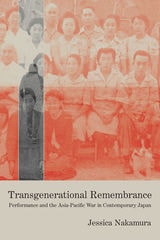
cover of Transgenerational Remembrance: Performance and the Asia-Pacific War in Contemporary Japan

Transgenerational Remembrance

Performance and the Asia-Pacific War in Contemporary Japan

Jessica Nakamura

Northwestern University Press, 2020

In Transgenerational Remembrance, Jessica Nakamura investigates the role of artistic production in the commemoration and memorialization of the Asia-Pacific War (1931–1945) in Japan since 1989. During this time, survivors of Japanese aggression and imperialism, previously silent about their experiences, have sparked contentious public debates about the form and content of war memories.

The book opens with an analysis of the performance of space at Yasukuni Shinto Shrine, which continues to promote an anachronistic veneration of the war. After identifying the centrality of performance in long-standing dominant narratives, Transgenerational Remembrance offers close readings of artistic performances that tackle subject matter largely obscured before 1989: the kamikaze pilot, Japanese imperialism, comfort women, the Battle of Okinawa, and Japanese American internment. These case studies range from Hirata Oriza’s play series about Japanese colonial settlers in Korea and Shimada Yoshiko’s durational performance about comfort women to Kondo Aisuke’s videos and gallery installations about Japanese American internment.

Working from theoretical frameworks of haunting and ethics, Nakamura develops an analytical lens based on the Noh theater ghost. Noh emphasizes the agency of the ghost and the dialogue between the dead and the living. Integrating her Noh-inflected analysis into ethical and transnational feminist queries, Nakamura shows that performances move remembrance beyond current evidentiary and historiographical debates.

 
[more]
cover of When Death Falls Apart: Making and Unmaking the Necromaterial Traditions of Contemporary Japan

When Death Falls Apart

Making and Unmaking the Necromaterial Traditions of Contemporary Japan

Hannah Gould

University of Chicago Press, 2023

Through an ethnographic study inside Japan’s Buddhist goods industry, this book establishes a method for understanding change in death ritual through attention to the dynamic lifecourse of necromaterials.
 
Deep in the Fukuyama mountainside, “the grave of the graves” (o-haka no haka) houses acres of unwanted headstones—the material remains of Japan’s discarded death rites. In the past, the Japanese dead became venerated ancestors through sustained ritual offerings at graves and at butsudan, Buddhist altars installed inside the home. But in twenty-first-century Japan, this intergenerational system of care is rapidly collapsing.

In noisy carpentry studios, flashy funeral-goods showrooms, neglected cemeteries, and cramped kitchens where women prepare memorial feasts, Hannah Gould analyzes the lifecycle of butsudan, illuminating how they are made, circulate through religious and funerary economies, mediate intimate exchanges between the living and the dead, and—as the population ages, families disperse, and fewer homes have space for large lacquer cabinets—eventually fall into disuse. What happens, she asks, when a funerary technology becomes obsolete? And what will take its place? Gould examines new products better suited to urban apartments: miniature urns and sleek altars inspired by Scandinavian design, even reliquary jewelry. She visits an automated columbarium and considers new ritual practices that embrace impermanence. At an industry expo, she takes on the role of “demonstration corpse.” Throughout, Gould invites us to rethink memorialization and describes a distinct form of Japanese necrosociality, one based on material exchanges that seek to both nurture the dead and disentangle them from the world of the living.
[more]