Results by title
6 books match the query 'Content'
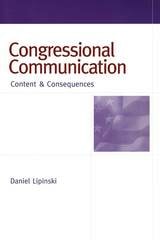
Congressional Communication
Content and ConsequencesDaniel Lipinski
University of Michigan Press, 2004
--Bruce Oppenheimer, Vanderbilt University
"The communication between representatives and their constituents is where election strategy and policy explanations are merged and, until now, we have had only anecdotal evidence. Lipinski's book sheds light on this important part of American political life."
--David Brady, Stanford University
Congressional Communication challenges the notion that legislators "run against Congress" by routinely denigrating the institution. Using a unique, systematic analysis of the communication from members of Congress to their constituents over a five-year period, Daniel Lipinski challenges this notion, demonstrating key partisan differences in representatives' portrayals of congressional activities. While members of the majority party tend to report that the institution-and, hence, their party-is performing well, members of the minority party are more likely to accuse Congress of doing a poor job.
The findings in Congressional Communication offer the first strong empirical evidence from the electoral arena in support of controversial party government theories. Moving beyond previous studies that look only at legislators' messages, Lipinski's research also reveals the effects of these politically strategic claims on voters, whose interpretations don't necessarily bear out the legislators' intended effects.
Daniel Lipinski is Assistant Professor of Political Science at the University of Tennessee.
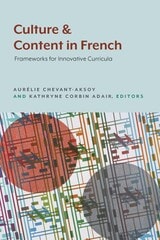
Culture and Content in French
Frameworks for Innovative CurriculaAurélie Chevant-Aksoy
Lever Press, 2022

Personology
Method and Content in Personality Assessment and PsychobiographyIrving E. Alexander
Duke University Press, 1990
This work by a highly respected senior psychologist is an effort to answer these questions. Irving E. Alexander presents a case for considering the personal narrative of a human life as the most compelling aspect of that life to be decoded and understood. In part a critique of an exclusive reliance on general theories about the development of personality and ways of knowing based primarily on comparison with others, Personology is illustrated with material drawn from the lives, personal writings, and theories of Freud, Jung, and Sullivan. Alexander develops new insights into the lives of these men and offers methods and guidelines for investigating and teaching personology and psychobiography.
Propositional Attitudes
The Role of Content in Logic, Language, and MindEdited by C. Anthony Anderson and Joseph Owens
CSLI, 1990
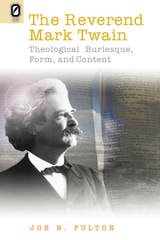
The REVEREND MARK TWAIN
THEOLOGICAL BURLESQUE, FORM, AND CONTENTJoe B. Fulton
The Ohio State University Press, 2006
Twain adopted such religious personae to burlesque the religious literary genres associated with those vocations. He wrote catechisms, prophecies, psalms, and creeds, all in the theological tradition, but with a comic twist. Twain even wrote a burlesque life of Christ that has the son of God sporting blue jeans and cowboy boots. With his distinctive comic genius, Twain entered the religious dialogue of his time, employing the genres of belief as his vehicle for criticizing church and society.
Twain’s burlesques of religious form and content reveal a writer fully engaged with the religious ferment of his day. Works like The Innocents Abroad, Adventures of Huckleberry Finn, Personal Recollections of Joan of Arc, Roughing It, and What Is Man? are the productions of a writer skilled at adopting and adapting established literary and religious forms for his own purposes. Twain is sometimes viewed as a haphazard writer, but in The Reverend Mark Twain, Fulton demonstrates how carefully Twain studied established literary and theological genres to entertain—and criticize—his society.
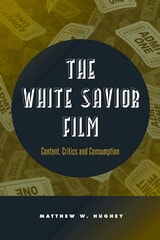
The White Savior Film
Content, Critics, and ConsumptionMatthew Hughey
Temple University Press, 2014
In The White Savior Film, Matthew Hughey provides a cogent, multipronged analysis of this subgenre of films to investigate the underpinnings of the Hollywood-constructed images of idealized (and often idealistic) white Americans.
Hughey considers the production, distribution, and consumption of white savior films to show how the dominant messages of sacrifice, suffering, and redemption are perceived by both critics and audiences. Examining the content of fifty films, nearly 3,000 reviews, and interviews with viewer focus groups, he accounts for the popularity of this subgenre and its portrayal of "racial progress."
The White Savior Film shows how we as a society create and understand these films and how they reflect the political and cultural contexts of their time.