Results by title
6 books match the query 'Contingency'

Contingency in Madagascar
Text by Stephen Muecke, Photographs by Max Pam
Intellect Books, 2012
As they set off for Madagascar in 2003, photographer Max Pam and writer Stephen Muecke adopted as their guiding principle the idea of contingency—central to which is the conscious embrace of risk and chance. In doing so, they established a new aesthetic in which image and text are inextricably linked to the notion of possibility. This stunning collection of photos and essays is the result of their vision, collectively illustrating the beauty and wisdom on offer in one of the world’s poorest nations. A contribution to the wave of new ethnography exemplified by Michael Taussig and Kathleen Stewart, these encounters with events, images, and experimental writing dramatize thoughts and feelings in the ongoing construction of place.
Contingency, Exploitation, and Solidarity
Labor and Action in English CompositionSeth Kahn
University Press of Colorado, 2017
Composition has been a microcosm of the corporatization of higher education for thirty years, with adjuncts often handling the hard work of writing instruction. We've learned enough to know that change is needed. Influenced by the efforts of organizations such as New Faculty Majority, Faculty Forward, PrecariCorps, and national faculty unions, this collection highlights action, describing efforts that have improved adjunct working conditions in English departments. The editors categorize these efforts into five threads: strategies for self-advocacy; organizing within and across ranks; professionalizing in complex contexts; working for local changes to workload, pay, and material conditions; and protecting gains.
Contributors to this collection include contingent and tenure-line faculty from private, public, and community colleges, as well as writing program administrators and writing center faculty. Their voices address contingency, exploitation, and solidarity in activist terms deriving from institutional realities and cases. Collectively, they offer creative and constructive responses that can enact labor justice and champion the disciplinary energies of all members of our collegial community.
Contributors: Janelle Adsit, Jacob Babb, Chris Blankenship, Rebekah Shultz Colby, Richard Colby, Anicca Cox, Sue Doe, Tracy Donhardt, Dawn Fels, Barbara Heifferon, Desirée M. Holter, Justin Jory, Jeffrey Klausman, Michelle LaFrance, Sarah Layden, Carol Lind, Maria Maisto, Amanda Martin, Mark McBeth, Tim McCormack, Joan Mullin, Dani Nier-Weber, Glenn Moomau, Michael Murphy, Anna K. Nardo, Rolf Norgaard, Courtney Adams Wooten, Lacey Wootton, Allison Laubach Wright
Gambling Life
DEALING IN CONTINGENCY IN A GREEK CITYThomas M. Malaby
University of Illinois Press, 2003
Backgammon cafés, card clubs, and hidden gambling rooms in the city of Chania provide the context for Thomas M. Malaby to examine the ways in which people confront uncertainty in their lives. He shows how the dynamics of gambling -- risk, fate, uncertainty, and luck -- are reflected in other aspects of gamblers’ lives from courtship and mortality to state bureaucracy and national identity.
By moving beyond risk and fate as unexamined analytical categories, Malaby presents a new model for research concerning indeterminacy, seeing it as arising from stochastic, performative, and other sources. Gambling Life questions the longstanding valorization of order and pattern in the social sciences.
Grace and Freedom in a Secular Age
Contingency, Vulnerability, and HospitalityPhilip J. Rossi
Catholic University of America Press, 2022
Necessity or Contingency
The Master ArgumentJules Vuillemin
CSLI, 1996
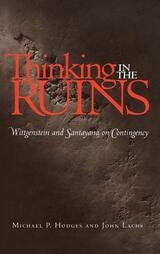
Thinking in the Ruins
Wittgenstein and Santayana on ContingencyMichael P. Hodges
Vanderbilt University Press, 2000
Santayana is often regarded as an aesthetician and metaphysician, but Wittgenstein's work is usually seen as antithetical to the philosophical approaches favored by Santayana. In this insightful new study, Michael Hodges and John Lachs argue that behind the striking differences in philosophical style and vocabulary there is a surprising agreement in position. The similarities have largely gone unnoticed because of their divergent styles, different metaphilosophies, and separate spheres of influence. Hodges and Lachs show that Santayana's and Wittgenstein's works express their philosophical responses to contingency. Surprisingly, both thinkers turn to the integrity of human practices to establish a viable philosophical understanding of the human condition.
Both of these important twentieth-century philosophers formed their mature views at a time when the comfortable certainties of Western civilization were crumbling all around them. What they say is similar at least in part because they wished to resist the spread of ruin by relying on the calm sanity of our linguistic and other practices. According to both, it is not living human knowledge but a mistaken philosophical tradition that demands foundations and thus creates intellectual homelessness and displacement. Both thought that, to get our house in order, we have to rethink our social, religious, philosophical, and moral practices outside the context of the search for certainty. This insight and the projects that flowed from it define their philosophical kinship.
Thinking in the Ruins will enhance our understanding of these monumental thinkers' intellectual accomplishments and show how each influenced subsequent American philosophers. The book also serves as a call to philosophers to look beyond traditional classifications to the substance of philosophical thought.