Results by title
25 books match the query 'Conversion'
Conversion
Miriam Bodian
Rutgers University Press, 2026
Conversion of a Continent
Contemporary Religious Change in Latin AmericaSteigenga, Timothy
Rutgers University Press, 2007
Conversion of a Continent brings together twelve original essays that document and explore competing explanations for how and why conversion has occurred. Contributors draw on various insights from social movement theory to religious studies to help outline its impact on national attitudes and activities, gender relations, identity politics, and reverse waves of missions from Latin America aimed at the American immigrant community.
Unlike other studies on religious conversion, this volume pays close attention to who converts, under what circumstances, the meaning of conversion to the individual, and how the change affects converts’ beliefs and actions. The thematic focus makes this volume important to students and scholars in both religious studies and Latin American studies.

Conversion to Modernism
The Early Work of Man RayFrancis M. Naumann
Rutgers University Press, 2003
Man Ray (1890–1976) has long been considered one of the most versatile and innovative artists of the twentieth century. As a painter, writer, sculptor, photographer, and filmmaker, he is best known for his intimate association with the French Surrealist group in Paris during the 1920s and 1930s, particularly for his highly inventive and unconventional photographic images. These remarkable accomplishments, however, have tended to overshadow the importance of his earlier work—significant not only for comprehending Man Ray’s future artistic development, but also for fleshing out our understanding of the visual arts in America during one of the most important and crucial phases of the evolution of modernism.
The book, and the exhibition for which this work will serve as the catalog, concentrate on Man Ray’s production from 1907 to 1917. Conversion to Modernism will be the first comprehensive, fully illustrated work to examine this artist’s seminal years. The show and the catalog begin with Man Ray’s high school years in Brooklyn, his studies at the Art Students League and the American Academy in New York, and the time he spent in life drawing classes at the more progressive Ferrer Center
From 1913 to 1915, Man Ray lived in a small artists’ colony in Grantwood, New Jersey. It was here, studying with Samuel Halpert (a former student of Matisse), that Man Ray began to become the artist we know today. The last section of the show and of the book include recently discovered photographs and other works that are influenced by a knowledge of the emergent Dada movement. Here is Man Ray in recognizable form just before he leaves the country for France in 1921.
This exhibit will first be on display at the Montclair Art Museum from January 26 through March 2003. It will then travel to museums in Athens, Georgia, Philadelphia, and Chicago.
Crisis and Conversion in Apuleius' Metamorphoses
Nancy Shumate
University of Michigan Press, 1996
Shumate draws on a wide range of literary and nonliterary representations of conversion in order to establish a useful theoretical framework. The Metamorphoses is exposed as a text anticipating later narratives in its concern with world-building, with the narrator's subjective reality, and with the invocation and critique of religious experience.
Crisis and Conversion in Apuleius' "Metamorphoses" will be of interest to classicists and scholars of Silver Latin and of the increasingly popular ancient novel, as well as to students of psychology and the sociology of religious experience.
Nancy Shumate is Associate Professor of Classical Languages and Literatures, Smith College.
Everyday Conversions
Islam, Domestic Work, and South Asian Migrant Women in KuwaitAttiya Ahmad
Duke University Press, 2017
Faction and Conversion in a Plural Society
Religious Alignments in the Hindu KushRobert Leroy Canfield
University of Michigan Press, 1973
Feeling Godly
Religious Affections and Christian Contact in Early North AmericaCaroline Wigginton
University of Massachusetts Press, 2021
Feeling Godly brings together well-known and highly regarded scholars of early American history and literature, Native American studies, African American history, and religious studies to investigate the shape, feel, look, theology, and influence of religious affections in early American sites of contact with and between Christians. While remaining focused on the question of religious affections, these essays span a wide range of early North American cultures, affiliations, practices, and devotions, and enable a comparative approach that draws together a history of emotions with a history of religion.
In addition to the volume editors, this collection includes essays from Joanna Brooks, Kathleen Donegan, Melissa Frost, Stephanie Kirk, Jon Sensbach, Scott Manning Stevens, and Mark Valeri, with an afterword by Barbara H. Rosenwein.
Figurative Inquisitions
Conversion, Torture, and Truth in the Luso-Hispanic AtlanticErin Graff Zivin
Northwestern University Press, 2014
Winner, 2015 LAJSA Best Book in Latin American Jewish Studies
The practices of interrogation, torture, and confession have resurfaced in public debates since the early 2000s following human rights abuses around the globe. Yet discussion of torture has remained restricted to three principal fields: the legal, the pragmatic, and the moral, eclipsing the less immediate but vital question of what torture does.Figurative Inquisitions seeks to correct this lacuna by approaching the question of torture from a literary vantage point.
This book investigates the uncanny presence of the Inquisition and marranismo (crypto-Judaism) in modern literature, theater, and film from Mexico, Brazil, and Portugal. Through a critique of fictional scenes of interrogation, it underscores the vital role of the literary in deconstructing the relation between torture and truth. Figurative Inquisitions traces the contours of a relationship among aesthetics, ethics, and politics in an account of the "Inquisitional logic" that continues to haunt contemporary political forms. In so doing, the book offers a unique humanistic perspective on current torture debates.
Figures of Conversion
“The Jewish Question” and English National IdentityMichael Ragussis
Duke University Press, 1995
—Daniel Defoe, The Farther Adventures of Robinson Crusoe (1719)
When the hero of Defoe’s novel listens skeptically to this anecdote related by a French Roman Catholic priest, he little suspects that in less than a century the conversion of the Jews would become nothing short of a national project—not in France but in England. In this book, Michael Ragussis explores the phenomenon of Jewish conversion—the subject of popular enthusiasm, public scandal, national debate, and dubbed "the English madness" by its critics—in Protestant England from the 1790s through the 1870s.
Moving beyond the familiar catalog of anti-Semitic stereotypes, Ragussis analyzes the rhetoric of conversion as it was reinvented by the English in sermons, stories for the young, histories of the Jews, memoirs by Jewish converts, and popular novels. Alongside these texts and the countertexts produced by English Jews, he situates such writers as Edgeworth, Scott, Disraeli, Arnold, Trollope, and Eliot within the debate over conversion and related issues of race, gender, and nation-formation. His work reveals how a powerful group of emergent cultural projects—including a revisionist tradition of the novel, the new science of ethnology, and the rewriting of European history—redefined English national identity in response to the ideology of conversion, the history of the Jews, and "the Jewish question."
Figures of Conversion offers an entirely new way of regarding Jewish identity in nineteenth-century British culture and will be of importance not only to literary scholars but also to scholars of Judaic and religious studies, history, and cultural studies.
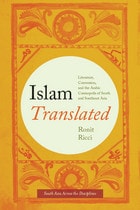
Islam Translated
Literature, Conversion, and the Arabic Cosmopolis of South and Southeast AsiaRonit Ricci
University of Chicago Press, 2011
In Islam Translated, Ronit Ricci uses the Book of One Thousand Questions—from its Arabic original to its adaptations into the Javanese, Malay, and Tamil languages between the sixteenth and twentieth centuries—as a means to consider connections that linked Muslims across divides of distance and culture. Examining the circulation of this Islamic text and its varied literary forms, Ricci explores how processes of literary translation and religious conversion were historically interconnected forms of globalization, mutually dependent, and creatively reformulated within societies making the transition to Islam.
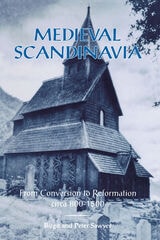
Medieval Scandinavia
From Conversion to Reformation, circa 800-1500Birgit Sawyer
University of Minnesota Press, 1993
Moving In and Out of Islam
By Karin van Nieuwkerk
University of Texas Press, 2018
Embracing a new religion, or leaving one’s faith, usually constitutes a significant milestone in a person’s life. While a number of scholars have examined the reasons why people convert to Islam, few have investigated why people leave the faith and what the consequences are for doing so. Taking a holistic approach to conversion and deconversion, Moving In and Out of Islam explores the experiences of people who have come into the faith along with those who have chosen to leave it—including some individuals who have both moved into and out of Islam over the course of their lives.
Sixteen empirical case studies trace the processes of moving in or out of Islam in Western and Central Europe, the United States, Canada, and the Middle East. Going beyond fixed notions of conversion or apostasy, the contributors focus on the ambiguity, doubts, and nonlinear trajectories of both moving in and out of Islam. They show how people shifting in either direction have to learn or unlearn habits and change their styles of clothing, dietary restrictions, and ways of interacting with their communities. They also look at how communities react to both converts to the religion and converts out of it, including controversies over the death penalty for apostates. The contributors cover the political aspects of conversion as well, including debates on radicalization in the era of the “war on terror” and the role of moderate Islam in conversions.
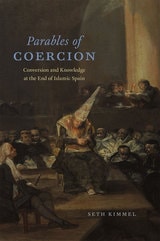
Parables of Coercion
Conversion and Knowledge at the End of Islamic SpainSeth Kimmel
University of Chicago Press, 2015
In its careful examination of how Spanish authors transformed the history of scholarship through debate about forced religious conversion, Parables of Coercion makes us rethink what we mean by tolerance and intolerance, and shows that debates about forced conversion and assimilation were also disputes over the methods and practices that demarcated one scholarly discipline from another.
Quiché Rebelde
Religious Conversion, Politics, and Ethnic Identity in GuatemalaBy Ricardo Falla
University of Texas Press, 2001
Since the arrival of the Spanish in the sixteenth century, the Maya population of Guatemala has been forced to adapt to extraordinary challenges. Under colonial rule, the Indians had to adapt enough to satisfy the Spanish while resisting those changes not necessary for survival, applying their understanding of the world to the realities they confronted daily. Despite the major changes wrought in their way of life by centuries of submission, the Maya have managed to regenerate, and thus maintain, their self-identity.
Among the major challenges they have faced has been the imposition of outside religions. Quiché Rebelde examines what happened when Acción Católica came into the Guatemalan municipio of San Antonio Ilotenango, Quiché, to convert its inhabitants.
Ricardo Falla, a Guatemalan Jesuit priest and anthropologist, analyzes the movement's origins and why some people became part of it while others resisted. He shows how religion was used as another tool to readapt to the changing environment—natural, economic, political, and social. His work is the first major empirical study of how change occurred in a Maya community with no serious loss of Maya identity—and how the process of conversion is related to more general processes of cultural change that actually strengthen ethnic identity.

Schneider on Schneider
The Conversion of the Jews and Other Anthropological StoriesDavid M. Schneider, as told to Richard Handler
Duke University Press, 1995
In this work, based on conversations with Richard Handler, Schneider tells the story of his days devoted to anthropology—as a student of Clyde Kluckhohn and Talcott Parsons and as a writer and teacher whose work on kinship and culture theory revolutionized the discipline. With a master’s sense of the telling anecdote, he describes his education at Cornell, Yale, and Harvard, his fieldwork on the Micronesian island of Yap and among the Mescalero Apache, and his years teaching at the London School of Economics, Berkeley, and the University of Chicago. Musing on the current state and the future of anthropology, Schneider’s cast of characters reads like a who’s who of postwar social science. His reflections on anthropological field research and academic politics address some of the most pressing ethical and epistemological issues facing scholars today, while yielding tales of unexpected amusement.
With its humor and irony, its wealth of information and searching questions about the state of anthropology, Schneider on Schneider not only provides an important resource for the history of twentieth-century social science, but also brings to life the entertaining voice of an engaging storyteller.
Slavery and Religious Conversion in Portugal's Indian Empire, 1500-1700
Stephanie Hassell
Ohio University Press, 2025
In the sixteenth and seventeenth centuries, enslaved Africans and Asians were part of the larger Portuguese project of building and maintaining a Catholic empire in the Indian Ocean. Both the Church and the Crown influenced the owner-slave relationship across households, the most basic organizational unit of power over the populace. Responsible for their enslaved dependents’ conversion to Catholicism, slaveholders became religious stewards whose spiritual duties toward their slaves helped expand the Christian population. This converted population was part of the imperial security apparatus, which conceptualized enslaved Catholics as loyal allies against neighboring Muslim states. They became members of the broader colonial community in which Catholicism also conveyed rights, enabled agency, and provoked household struggles between owners and slaves. Thus, the making of a Catholic empire was a contested process tied to the complex relationships between enslaved individuals, their enslavers, and the Church. The Portuguese Inquisition was a hybrid ecclesiastical and state institution, and its records detail the Crown’s commitment to the creation of a worldwide Catholic empire. Accordingly, inquisitorial encounters brought conversion, slavery, and empire into one field of vision. The Portuguese Inquisition had only one overseas tribunal, located in Goa, India. While most trial records of the Goa Tribunal were destroyed, author Stephanie Hassell has utilized extant sixteenth- and seventeenth-century cases featuring enslaved defendants and witnesses. Her use of thousands of case summaries provides a broader inquisitorial context by showing how prosecutorial trends reflected the anxieties of the Portuguese imperial state. Parish records, ecclesiastical council records, and municipal council records likewise emphasize the significance of religious conversion.
The Choice
Converts to Judaism Share Their StoriesArnine Cumsky Weiss and Carol Weiss Rubel
University of Scranton Press, 2010
In The Choice, Arnine Cumsky Weiss and Carol Weiss Rubel present the stories of forty-five converts to Judaism. These reflective narratives demonstrate that no two converts’ experiences are alike, yet most share some common characteristics: a spiritual uneasiness, fear, doubt, and a gradual development of spiritual and intellectual understanding and acceptance of conversion. The stories in The Choice will be a source of inspiration and affirmation for anyone who is struggling with a conversion decision or knows someone who is.
The Eucharistic Vision of Laudato Si
Praise, Conversion, and Integral EcologyLucas Briola
Catholic University of America Press, 2022
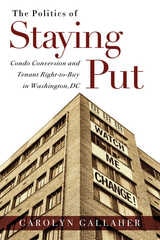
The Politics of Staying Put
Condo Conversion and Tenant Right-to-Buy in Washington, DCCarolyn Gallaher
Temple University Press, 2016
When cities gentrify, it can be hard for working-class and low-income residents to stay put. Rising rents and property taxes make buildings unaffordable, or landlords may sell buildings to investors interested in redeveloping them into luxury condos.
In her engaging study The Politics of Staying Put, Carolyn Gallaher focuses on a formal, city-sponsored initiative—The Tenant Opportunity to Purchase Act (TOPA)—that helps people keep their homes. This law, unique to the District of Columbia, allows tenants in apartment buildings contracted for sale the right to refuse the sale and purchase the building instead. In the hands of tenants, a process that would usually hurt them—conversion to a condominium or cooperative—can instead help them.
Taking a broad, city-wide assessment of TOPA, Gallaher follows seven buildings through the program’s process. She measures the law’s level of success and its constraints. Her findingshave relevance for debates in urban affairs about condo conversion, urban local autonomy, and displacement.
The Spectral Jew
Conversion and Embodiment in Medieval EuropeSteven F. Kruger
University of Minnesota Press, 2006
Looking closely at how medieval Jewish and Christian identities are distinguished from each other, yet intimately intertwined, Kruger demonstrates how Jews were often corporealized in ways that posited them as inferior to Christians—archaic and incapable of change—even as the two mutually shaped each other. But such attempts to differentiate Jews and Christians were inevitably haunted by the knowledge that Christianity had emerged out of Judaism and was, in its own self-understanding, a community of converts.
Examining the points of contact between Christian and Jewish communities, Kruger discloses the profound paradox of the Jew as different in all ways, yet capable of converting to fully Christian status. He draws from central medieval authors and texts such as Peter Damian, Guibert of Nogent, the Barcelona Disputation, and the Hebrew chronicles of the First Crusade, as well as lesser known writings such as the disputations of Ceuta, Majorca, and Tortosa and the immensely popular Dialogues of Peter Alfonsi.
By putting the conversion narrative at the center of this analysis, Kruger exposes it as a disruption of categories rather than a smooth passage and reveals the prominent role Judaism played in the medieval Christian imagination.
Steven F. Kruger is professor of English and medieval studies at Queens College and the Graduate Center, CUNY. He is author of several books and editor with Glenn Burger of Queering the Middle Ages (Minnesota, 2001).
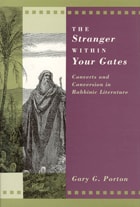
The Stranger within Your Gates
Converts and Conversion in Rabbinic LiteratureGary G. Porton
University of Chicago Press, 1994
The Stranger within Your Gates analyzes virtually every reference to converts in the full corpus of rabbinic literature. The intellectual dilemma that converts posed for classical Judaism played itself out in discussions of marriage, religious practice, inheritance of property, and much else. Reviewing the rabbinic literature text by text, Porton exposes the rabbis' frequently ambivalent and ambiguous views.
The Stranger within Your Gates is the only examination of conversion in rabbinic literature to draw upon the full scope of contemporary anthropological and sociological studies of conversion. It is also unique in its focus on the opinions of the community into which the convert enters, rather than on the testimony of the convert. By approaching data with new methods, Porton heightens our understanding of conversion and the nature of the People of Israel in rabbinic literature.
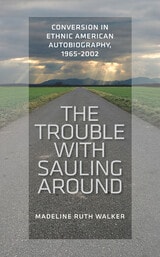
The Trouble with Sauling Around
Conversion in Ethnic American Autobiography, 1965-2002Madeline R. Walker
University of Iowa Press, 2011
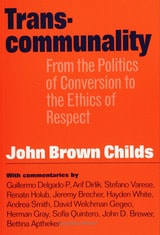
Transcommunality
From The Politics Of ConversionJohn Brown Childs
Temple University Press, 2003
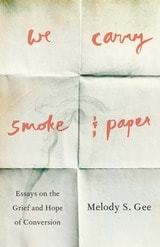
We Carry Smoke and Paper
Essays on the Grief and Hope of ConversionMelody S. Gee
University of Iowa Press, 2024
In essays that explore the parallels between conversion and language acquisition, isolated liturgies, cultural inheritances, stalled initiations, disrupted storytelling, and adoption, Gee examines conversion’s grief and hope, losses and gains, hauntings and promises. We Carry Smoke and Paper is a memoir about what we owe to those who sacrifice everything for us, and it is about the many conversions in a lifetime that turn our heads via whispers and shouts, calling us to ourselves.
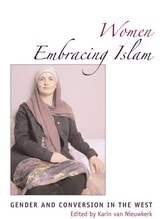
Women Embracing Islam
Gender and Conversion in the WestEdited by Karin van Nieuwkerk
University of Texas Press, 2006
Many Westerners view Islam as a religion that restricts and subordinates women in both private and public life. Yet a surprising number of women in Western Europe and America are converting to Islam. What attracts these women to a belief system that is markedly different from both Western Christianity and Western secularism? What benefits do they gain by converting, and what are the costs? How do Western women converts live their new Islamic faith, and how does their conversion affect their families and communities? How do women converts transmit Islamic values to their children? These are some of the questions that Women Embracing Islam seeks to answer.
In this vanguard study of gender and conversion to Islam, leading historians, sociologists, anthropologists, and theologians investigate why non-Muslim women in the United States, several European countries, and South Africa are converting to Islam. Drawing on extensive interviews with female converts, the authors explore the life experiences that lead Western women to adopt Islam, as well as the appeal that various forms of Islam, as well as the Nation of Islam, have for women. The authors find that while no single set of factors can explain why Western women are embracing Islamic faith traditions, some common motivations emerge. These include an attraction to Islam's high regard for family and community, its strict moral and ethical standards, and the rationality and spirituality of its theology, as well as a disillusionment with Christianity and with the unrestrained sexuality of so much of Western culture.