Results by title
7 books match the query 'Copper industry and trade'
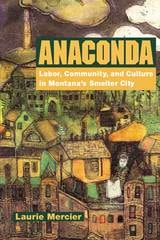
Anaconda
Labor, Community, and Culture in Montana's Smelter CityLaurie Mercier
University of Illinois Press, 2001
Laurie Mercier's look at "community unionism" examines the distinctive culture of cooperation and activism fostered by residents in Anaconda, Montana, home to the world's largest copper smelter and the namesake of the Anaconda Copper Mining Company.
Mercier depicts the vibrant life of the smelter city at full steam, incorporating the candid commentary of the locals ("the company furnished three pair of leather gloves . . . and all the arsenic [dust] you could eat"). During five decades of devoted unionism, locals embraced an "alternative Americanism" that championed improved living standards for working people as the best defense against communism. Mercier also explores how gender limits on women's political, economic, and social roles shaped the nature and outcome of labor struggles, and traces how union rivalries, environmental concerns, and the 1980 closing of the Anaconda smelter transformed the town.
A fascinating portrait of how community molds working class consciousness, Anaconda offers important insights about the changing nature of working class culture and collective action.
Colonel Greene and the Copper Skyrocket
The Spectacular Rise and Fall of William Cornell Greene: Copper King, Cattle Baron, and Promoter Extraordinary in Mexico, the American Southwest, and the New York Financial DistrictC. L. Sonnichsen
University of Arizona Press, 1974
"A solid account of a southwestern 'character' who has flitted in and out of frontier and economic history."—American Historical Review
"A creditable work on a fascinating individual. In delightful writing style he has reconstructed Greene's life, explaining the ambitions as well as the frailties of this extraordinary entrepreneur."—History
"A rewarding study of the later days of mining."—Arizona and the West
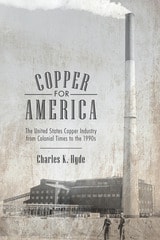
Copper for America
The United States Copper Industry from Colonial Times to the 1990sCharles K. Hyde
University of Arizona Press, 1998
An extensively documented chronicle of the rise and fall of individual mines, companies, and regions, Copper for America will prove an essential resource for economic and business historians, historians of technology and mining, and western historians.
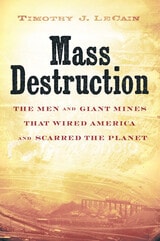
Mass Destruction
The Men and Giant Mines That Wired America and Scarred the PlanetTimothy J. LeCain
Rutgers University Press, 2009
Mass destruction mining soon spread around the nation and the globe, providing raw materials essential to the mass production and mass consumption that increasingly defined the emerging "American way of life." At the dawn of the last century, Jackling's open pit replaced immense but constricted underground mines that probed nearly a mile beneath the earth, to become the ultimate symbol of the modern faith that science and technology could overcome all natural limits. A new culture of mass destruction emerged that promised nearly infinite supplies not only of copper, but also of coal, timber, fish, and other natural resources.
But, what were the consequences? Timothy J. LeCain deftly analyzes how open-pit mining continues to affect the environment in its ongoing devastation of nature and commodification of the physical world. The nation's largest toxic Superfund site would be one effect, as well as other types of environmental dead zones around the globe. Yet today, as the world's population races toward American levels of resource consumption, truly viable alternatives to the technology of mass destruction have not yet emerged.

Red Gold of Africa
Copper in Precolonial History and CultureEugenia W. Herbert
University of Wisconsin Press, 1984
A finalist for the 1985 Herskovits Prize
First Paperback Edition
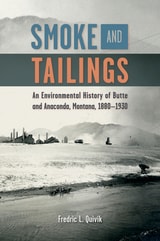
Smoke and Tailings
An Environmental History of Butte and Anaconda, Montana, 1880–1930Fredric L. Quivik
University of Nevada Press, 2026
Butte’s history, a long-standing subject of historical inquiry, gains new depth as Quivik examines the technological developments pioneered by local mining companies. He challenges the simplistic narrative of a powerful corporation imposing its will on helpless agricultural communities. Local communities mounted strong opposition to the industry’s polluting methods; Quivik acknowledges this dynamic while also revealing efforts by the Anaconda Copper Mining Company to address environmental issues. The company developed and implemented technical solutions to minimize resource waste and mitigate damage, driven by both economic interests and litigation pressures. While these advancements lessened some of the environmental harm, they were insufficient to prevent long-term consequences. The operations in Butte and Anaconda ultimately created the largest Superfund complex in the United States, requiring billions of dollars in remediation.
Quivik’s nuanced approach opens the “black box” of technology, showing how innovations both alleviated and exacerbated the environmental challenges of mining, milling, and smelting. In addition to contributing to the rich literature on smelter smoke, this book breaks new ground by examining the underexplored environmental impacts of tailings, offering a fresh perspective on the intersection of industry, technology, and environmental change. The cultural landscapes of Butte and Anaconda retain many features of the region’s history of both environmental degradation and remediation. Smoke and Tailings is an essential addition to the study of Butte’s industrial and ecological history.
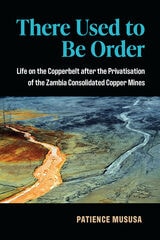
There Used to Be Order
Life on the Copperbelt after the Privatisation of the Zambia Consolidated Copper MinesPatience Mususa
University of Michigan Press, 2021