Results by title
22 books match the query 'Corporate'
CEO Leadership
Navigating the New Era in Corporate GovernanceThomas A. Cole
University of Chicago Press, 2019
Drawing on four decades of experience advising boards and CEOs on how to do just that, Thomas A. Cole offers in CEO Leadership a straightforward and accessible guide to navigating corporate governance today. He explores the recurring question of whose benefit a corporation should be governed for, along with related matters of corporate social responsibility, and he explains the role of laws, market forces, and politics and their influence on the governance of public companies. For corporate directors, he provides a comprehensive examination of the roles, responsibilities, and accountability the role entails, while also offering guidance on how to be as effective as possible in addressing both routine corporate matters and special situations such as mergers and acquisitions, succession, and corporate crises. In addition, he offers practical suggestions for CEOs on leadership and their interactions with boards and shareholders. Cole also mounts a compelling case that a corporate culture that celebrates diversity and inclusion and has zero tolerance for sexual misconduct is critical to long-term business success.
Filled with vignettes from Cole’s many years of experience in the board room and C-suite, CEO Leadership is an invaluable resource for current and prospective directors, CEOs, and other senior officers of public companies as well as the next generation of corporate leaders and their business and financial advisors.
Church State Corporation
Construing Religion in US LawWinnifred Fallers Sullivan
University of Chicago Press, 2020
Through readings of the opinions of the US Supreme Court and other legal texts, Sullivan shows how “the church” as a religious collective is granted special privilege in US law. In-depth analyses of Hosanna-Tabor v. EEOC and Burwell v. Hobby Lobby reveal that the law tends to honor the religious rights of the group—whether in the form of a church, as in Hosanna-Tabor, or in corporate form, as in Hobby Lobby—over the rights of the individual, offering corporate religious entities an autonomy denied to their respective members. In discussing the various communities that construct the “church-shaped space” in American law, Sullivan also delves into disputes over church property, the legal exploitation of the black church in the criminal justice system, and the recent case of Masterpiece Cakeshop v. Colorado Civil Rights Commission. Brimming with insight, Church State Corporation provocatively challenges our most basic beliefs about the ties between religion and law in ostensibly secular democracies.
Corporate Bodies and Guilty Minds
The Failure of Corporate Criminal LiabilityWilliam S. Laufer
University of Chicago Press, 2006
In this timely work, William S. Laufer argues that even with recent legal reforms, corporate criminal law continues to be ineffective. As evidence, Laufer considers the failure of courts and legislatures to fashion liability rules that fairly attribute blame for organizations. He analyzes the games that corporations play to deflect criminal responsibility. And he also demonstrates how the exchange of cooperation for prosecutorial leniency and amnesty belies true law enforcement. But none of these factors, according to Laufer, trumps the fact that there is no single constituency or interest group that strongly and consistently advocates the importance and priority of corporate criminal liability. In the absence of a new standard of corporate liability, the power of regulators to keep corporate abuses in check will remain insufficient.
Corporate Social Responsibility?
Human Rights in the New Global EconomyEdited by Charlotte Walker-Said and John D. Kelly
University of Chicago Press, 2015
The book examines the diverse approaches to CSR, with a particular focus on how those approaches are siloed within discrete disciplines such as business, law, the social sciences, and human rights. Bridging these disciplines and addressing and critiquing all the conceptual domains of CSR, the book also explores how CSR silos develop as a function of the competition between different interests. Ultimately, the contributors show that CSR actions across all arenas of power are interdependent, continually in dialogue, and mutually constituted. Organizing a diverse range of viewpoints, this book offers a much-needed synthesis of a crucial element of today’s globalized world and asks how businesses can, through their actions, make it better for everyone.
Corporate Sovereignty
Law and Government under CapitalismJoshua Barkan
University of Minnesota Press, 2013
Refinery explosions. Accounting scandals. Bank meltdowns. All of these catastrophes—and many more—might rightfully be blamed on corporations. In response, advocates have suggested reforms ranging from increased government regulation to corporate codes of conduct to stop corporate abuses. Joshua Barkan writes that these reactions, which view law as a limit on corporations, misunderstand the role of law in fostering corporate power.
In Corporate Sovereignty, Barkan argues that corporate power should be rethought as a mode of political sovereignty. Rather than treating the economic power of corporations as a threat to the political sovereignty of states, Barkan shows that the two are ontologically linked. Situating analysis of U.S., British, and international corporate law alongside careful readings in political and social theory, he demonstrates that the Anglo-American corporation and modern political sovereignty are founded in and bound together through a principle of legally sanctioned immunity from law. The problems that corporate-led globalization present for governments result not from regulatory failures as much as from corporate immunity that is being exported across the globe.
For Barkan, there is a paradox in that corporations, which are legal creations, are given such power that they undermine the sovereignty of states. He notes that while the relationship between states and corporations may appear adversarial, it is in fact a kind of doubling in which state sovereignty and corporate power are both conjoined and in conflict. Our refusal to grapple with the peculiar nature of this doubling means that some of our best efforts to control corporations unwittingly reinvest the sovereign powers they oppose.

Corruption in Corporate Culture, Volume 21
Randy Martin and Ella Shohat, eds.
Duke University Press, 0
Addressing several recent high-profile scandals, contributors examine both the short- and the long-term ramifications of corporate corruption: the means by which Martha Stewart has been used as an icon and a scapegoat in the ImClone case while broader critical issues have failed to receive the attention they demand; the divisive ways in which the antifeminist Independent Women’s Forum—along with other neocon organizations and pundits—has moved the debate regarding the deregulation of the financial services sector far to the right of the far right; the collapse of Enron and what it means for corporate governance; the global implications of U.S. corporate corruption; the confusion over public and private business transactions in Argentina; the moral panic ensuing from the random violence caused by the Washington, D.C. area snipers precisely as the U.S. was launching a war on Iraq because of its supposed weapons of mass destruction; and the emergence of a new business model and icon, the hiphop mogul.
Contributors. Peter Bratsis, David M. Brennan, Jane Marcus-Delgado, Randy Martin, Nancy Shaw, Ella Shohat, Christopher Holmes Smith, Barbara Spindel, Susan Willis
Eat What You Kill
The Fall of a Wall Street LawyerMilton C. Regan, Jr.
University of Michigan Press, 2005
-Nancy Rapoport, University of Houston Law Center
"Eat What You Kill is gripping and well written. . . . It weaves in academic commentary and understanding of professional ethics issues in a way that makes it accessible to everyone."
-Frank Partnoy, University of San Diego Law School
He had it all, and then he lost it. But why did he do it, risking everything-wealth, success, livelihood, freedom, and the security of family?
Eat What You Kill is the story of John Gellene, a rising star and bankruptcy partner at one of Wall Street's most venerable law firms. But when Gellene became entangled in a web of conflicting corporate and legal interests involving one of his clients, he was eventually charged with making false statements, indicted, found guilty of a federal crime, and sentenced to prison.
Milton C. Regan Jr. uses Gellene's case to prove that such conflicting interests are now disturbingly commonplace in the world of American corporate finance. Combining a journalist's eye with sharp psychological insight, Regan spins Gellene's story into a gripping drama of fundamental tensions in modern-day corporate practice and describes in perfect miniature the inexorable confluence of the interests of American corporations and their legal counselors.
This confluence may seem natural enough, but because these law firms serve many masters-corporations, venture capitalists, shareholder groups-it has paradoxically led to deep, pervasive conflicts of interest. Eat What You Kill gives us the story of a man trapped in this labyrinth, and reveals the individual and systemic factors that contributed to Gellene's demise.
Ensuring Corporate Misconduct
How Liability Insurance Undermines Shareholder LitigationTom Baker and Sean J. Griffith
University of Chicago Press, 2010
Shareholder litigation and class action suits play a key role in protecting investors and regulating big businesses. But Directors and Officers liability insurance shields corporations and their managers from the financial consequences of many illegal acts, as evidenced by the recent Enron scandal and many of last year’s corporate financial meltdowns. Ensuring Corporate Misconduct demonstrates for the first time how corporations use insurance to avoid responsibility for corporate misconduct, dangerously undermining the impact of securities laws.
As Tom Baker and Sean J. Griffith demonstrate, this need not be the case. Opening up the formerly closed world of corporate insurance, the authors interviewed people from every part of the industry in order to show the different instances where insurance companies could step in and play a constructive role in strengthening corporate governance—yet currently do not. Ensuring Corporate Misconduct concludes with a set of readily implementable reforms that could significantly rehabilitate the system.
International Taxation and Multinational Activity
Edited by James R. Hines Jr.
University of Chicago Press, 2001

Secret Manoeuvres in the Dark
Corporate and Police Spying on ActivistsEveline Lubbers
Pluto Press, 2012
The exposure of undercover policeman Mark Kennedy in the eco-activist movement revealed how the state monitors and undermines political activism. This book shows the other grave threat to our political freedoms - undercover activities by corporations.
Secret Manoeuvres in the Dark documents how corporations are halting legitimate action and investigation by activists. Using exclusive access to previously confidential sources, Eveline Lubbers shows how companies such as Nestlé, Shell and McDonalds use covert methods to evade accountability. She argues that corporate intelligence gathering has shifted from being reactive to pro-active, with important implications for democracy itself.
Secret Manoeuvres in the Dark will be vital reading for activists, investigative and citizen journalists, and all who care about freedom and democracy in the 21st century.
Shifting the Burden
The Struggle over Growth and Corporate TaxationCathie J. Martin
University of Chicago Press, 1991
Remarkably accessible and rich in historical evidence, Shifting the Burden is the most compelling explanation to date of how our nation's tax policy is formulated. Cathie J. Martin shows how presidents' cultivation of allies within the business community and struggles within that community itself combine to shape tax policy.
Studies in International Taxation
Edited by Alberto Giovannini, R. Glenn Hubbard, and Joel Slemrod
University of Chicago Press, 1993
The contributors examine the effects of taxation on decisions about international financial management, business investment, and international income shifting. They consider the influence of tax rules on dividend policy decisions within multinationals; the extent to which tax incentives affect the level and location of research and development across countries; and the fact that foreign-controlled companies operating in the United States pay lower taxes than do domestically controlled companies.
The contributors to this volume are Rosanne Altshuler, Alan J. Auerbach, Neil Bruce, Timothy Goodspeed, Roger H. Gordon, Harry Grubert, Bronwyn H. Hall, David Harris, Kevin Hassett, James R. Hines Jr., Roy D. Hogg, Joosung Jun, Jeffrey K. Mackie-Mason, Jack M. Mintz, Randall Morck, John Mutti, T. Scott Newlon, James M. Poterba, Joel Slemrod, Deborah Swenson, G. Peter Wilson, and Bernard Yeung.
Tax Policy and the Economy, Volume 37
Edited by Robert A. Moffitt
University of Chicago Press Journals, 2023
Tax Policy and the Economy publishes current academic research on taxation and government spending with both immediate bearing on policy debates and longer-term interest.
This volume of Tax Policy and the Economy presents new research on important issues concerning US taxation and transfers. First, Edward L. Glaeser, Caitlin S. Gorback, and James M. Poterba examine the distribution of burdens associated with taxes on transportation. Replacing the gasoline tax with a vehicle-miles-traveled (VMT) tax would increase the burden on higher-income households, who drive more fuel-efficient cars and are more likely to own electric vehicles. User charges for airports, subways, and commuter rail are progressive, while the burden of bus fees is larger for lower-income households than for their higher-income counterparts. Next, Katarzyna Bilicka, Michael Devereux, and Irem Güçeri investigate tax shifting by multinational companies (MNCs) and the implications of a potential Global Minimum Tax (GMT). They find that MNCs shift intellectual property to tax havens, and that a large share of patenting activity takes place in tax havens where little or no R&D occurs. Tax havens are particularly important for MNCs with large subsidiary networks; such firms would likely be subject to a GMT. Mark Duggan, Audrey Guo, and Andrew C. Johnston study the role of experience rating in the Unemployment Insurance (UI) system and find that the current structure stabilizes the labor market because it penalizes firms with high rates of UI-eligible layoffs. In the fourth paper, David Altig, Laurence J. Kotlikoff, and Victor Yifan Ye calculate how retiring at different ages will affect Social Security benefit amounts, taking into account taxation and other benefits. They find that virtually all individuals aged 45 to 62 should wait until age 65 or later to maximize their Social Security benefits. Indeed, 90 percent would benefit from waiting until age 70, but only 10 percent do so. Finally, Jonathan Meer and Joshua Witter examine the potential impact of the Earned Income Tax Credit on the labor force decisions of childless adults who are eligible for a small credit after they reach age 25. Comparing labor force attachment changes just before and after this age suggests that the EITC has little impact on the labor force participation of this group.
Tax Policy and the Economy, Volume 38
Edited by Robert A. Moffitt
University of Chicago Press Journals, 2024
Tax Policy and the Economy publishes current academic research on taxation and government spending with both immediate bearing on policy debates and longer-term interest.
This volume presents new research on taxation and public expenditure programs, with particular focus on how they affect economic behavior. John Guyton, Kara Leibel, Dayanand Manoli, Ankur Patel, Mark Payne, and Brenda Schafer study the disallowance of Earned Income Tax Credit (EITC) benefits as a result of IRS audits, and find that in post-audit years, audited taxpayers are less likely than similar non-audited taxpayers to claim EITC benefits. Janet Holtzblatt, Swati Joshi, Nora Cahill, and William Gale provide new empirical evidence on racial differences in the income tax penalty, or bonus, associated with a couple being married. Haichao Fan, Yu Liu, Nancy Qian, and Jaya Wen evaluate how computerizing value-added tax transactions in China affected the tax revenue collected from large manufacturing firms. Niels Johannesen, Daniel Reck, Max Risch, Joel Slemrod, John Guyton, and Patrick Langetieg study data on the ownership of foreign bank accounts and other financial accounts as reported on income tax returns. They find that many of these accounts are in tax havens, and they discuss the impact of the Foreign Account Tax Compliance Act on tax compliance and government revenue. Louis Kaplow integrates charitable giving into an optimal income tax framework, and shows that the externalities associated with such giving are key to determining its optimal tax treatment. Finally, Roger Gordon compares caps or quantity targets on emissions with carbon taxes and points out that which one dominates can be situation-specific and depend on a number of features of the economy.
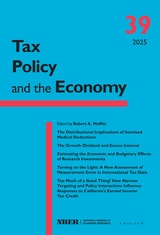
Tax Policy and the Economy, Volume 39
Edited by Robert A. Moffitt
University of Chicago Press Journals, 2025
Tax Policy and the Economy publishes current academic research on taxation and government spending with both immediate bearing on policy debates and longer-term interest. This volume highlights new insights on taxation, transfer programs, and related issues. First, analyzing the itemized medical deduction in the US federal income tax, Gopi Shah Goda, Ithai Lurie, Priyanka Parikh, and Chelsea Swete find that this provision disproportionately benefits higher-income taxpayers, particularly after the passage of the 2017 Tax Cuts and Jobs Act. They also consider alternative structures, such as a tax credit, that could make the distribution of the tax benefits for those with high medical outlays more equal. Next, Danny Yagan analyzes factors influencing the US federal budget deficit and the debt-to-GDP ratio. He describes the "growth dividend," the impact of GDP growth on the debt ratio, and warns about the potential costs of high debt-to-GDP ratios, especially when interest rates rise. In the third paper, Theresa Gullo, Benjamin Page, David Weiner, and Heidi Williams synthesize the economic evidence on the economic and budgetary effects of R&D investment and examine how this evidence could be incorporated into the standard projections generated by various federal agencies. Fourth, Rosanne Altshuler, Lysle Boller, and Juan Carlos Suárez Serrato investigate profit shifting by US multinational corporations and evaluate the importance of aggregation errors in reported foreign earnings and on estimates of profit shifting elasticities based on these data. Finally, David Neumark and Zeyu Li find no employment effect of California’s Earned Income Tax Credit on less-skilled single mothers, in contrast with the effects of federal and other states' programs. They suggest that structural differences and interactions with minimum wage laws explain this result.
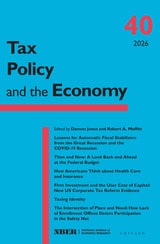
Tax Policy and the Economy, Volume 40
Edited by Damon Jones and Robert A. Moffitt
University of Chicago Press Journals, 2026
Timely and authoritative research on the latest issues in tax policy.
Tax Policy and the Economy publishes current academic research on taxation and government spending with both immediate bearing on policy debates and longer-term interest.
This volume presents new research on taxation, transfer programs, and related issues. Karen Dynan and Douglas Elmendorf examine the potential impact of automatic fiscal stabilizers on fiscal policy and economic activity. They find that a stabilizer providing direct payments could have produced faster unemployment decline after the Great Recession without raising inflation and much lower inflation after COVID-19 at the cost of a slower unemployment reduction. Alan J. Auerbach and William Gale review federal budget history and project the US debt-to-GDP ratio over the next 30 years, arguing that high projected debt could constrain future policy actions. They also explore possible fiscal consolidation policies. Beatrice Ferrario and Stefanie Stantcheva survey Americans’ views of health care and insurance, finding broad agreement regarding costs, access, and efficiency but partisan gaps in policy preferences stemming from fundamentally different views of government scope rather than contrasting efficiency or fairness beliefs. Jonathan S. Hartley, Kevin A. Hassett, and Joshua D. Rauh analyze the corporate investment response to the Tax Cut and Jobs Act of 2017, finding a larger response than a number of earlier studies of investment sensitivity would have suggested. Joel Slemrod reviews historical taxation based on racial, religious, and gender identity and examines how tax policies that are not conditioned on any of these attributes can nevertheless differentially impact families as a result of systemic differences in their economic circumstances. Finally, Marianne Bitler, Jason Cook, Chloe N. East, Sonya R. Porter, and Laura Tiehen analyze geographic proximity effects on Supplemental Nutrition Assistance Program (SNAP) participation, finding that when a SNAP office opens, participation increases by about 20%. When an office closes, they find that participation drops by about 8% in the next two years.
Taxing Multinational Corporations
Edited by Martin Feldstein, James R. Hines Jr., and R. Glenn Hubbard
University of Chicago Press, 1995
In ten succinct chapters, the book documents the channels through which tax policy in the United States and abroad affects plant and equipment investments, spending on research and development, the cost of debt and equity finance, and dividend repatriations by United States subsidiaries. It also discusses the impact of U.S. firms' outbound foreign investment on domestic and foreign economies. Especially useful to nonspecialists is an appendix that summarizes current United States rules for taxing international income.
The Conservative Case for Class Actions
Brian T. Fitzpatrick
University of Chicago Press, 2019
Conservatives have opposed class actions in recent years, but Fitzpatrick argues that they should see such litigation not as a danger to the economy, but as a form of private enforcement of the law. He starts from the premise that all of us, conservatives and libertarians included, believe that markets need at least some rules to thrive, from laws that enforce contracts to laws that prevent companies from committing fraud. He also reminds us that conservatives consider the private sector to be superior to the government in most areas. And the relatively little-discussed intersection of those two beliefs is where the benefits of class action lawsuits become clear: when corporations commit misdeeds, class action lawsuits enlist the private sector to intervene, resulting in a smaller role for the government, lower taxes, and, ultimately, more effective solutions.
Offering a novel argument that will surprise partisans on all sides, The Conservative Case for Class Actions is sure to breathe new life into this long-running debate.
The Corporate Contract in Changing Times
Is the Law Keeping Up?Edited by Steven Davidoff Solomon and Randall Stuart Thomas
University of Chicago Press, 2019
With The Corporate Contract in Changing Times, Steven Davidoff Solomon and Randall Stuart Thomas bring together leading corporate law scholars, judges, and lawyers from top corporate law firms to explore what needs to change and what has prevented reform thus far. Among the topics addressed are how the law could be adapted to the reality that activist hedge funds pose a more serious threat to corporations than the hostile takeovers and how statutory laws, such as the rules governing appraisal rights, could be reviewed in the wake of appraisal arbitrage. Together, the contributors surface promising paths forward for future corporate law and public policy.
The Effects of Taxation on Multinational Corporations
Edited by Martin Feldstein, James R. Hines Jr., and R. Glenn Hubbard
University of Chicago Press, 1995
In an attempt to quantify the effect of tax policy on international investment choices, this volume presents in-depth analyses of the interaction of international tax rules and the investment decisions of multinational enterprises. Ten papers assess the role played by multinational firms and their investment in the U.S. economy and the design of international tax rules for multinational investment; analyze channels through which international tax rules affect the costs of international business activities; and examine ways in which international tax rules affect financing decisions of multinational firms. As a group, the papers demonstrate that international tax rules have significant effects on firms' investment and other financing decisions.
The Failure of Corporate Law
Fundamental Flaws and Progressive PossibilitiesKent Greenfield
University of Chicago Press, 2007
When used in conjunction with corporations, the term “public” is misleading. Anyone can purchase shares of stock, but public corporations themselves are uninhibited by a sense of societal obligation or strict public oversight. In fact, managers of most large firms are prohibited by law from taking into account the interests of the public in decision making, if doing so hurts shareholders. But this has not always been the case, as until the beginning of the twentieth century, public corporations were deemed to have important civic responsibilities.
With The Failure of Corporate Law, Kent Greenfield hopes to return corporate law to a system in which the public has a greater say in how firms are governed. Greenfield maintains that the laws controlling firms should be much more protective of the public interest and of the corporation’s various stakeholders, such as employees. Only when the law of corporations is evaluated as a branch of public law—as with constitutional law or environmental law—will it be clear what types of changes can be made in corporate governance to improve the common good. Greenfield proposes changes in corporate governance that would enable corporations to meet the progressive goal of creating wealth for society as a whole rather than merely for shareholders and executives.
The Holocaust, Corporations, and the Law
Unfinished BusinessLeora Bilsky
University of Michigan Press, 2017
Leora Bilsky argues class action litigation and settlement offer a mode of accountability well suited to addressing the bureaucratic nature of business involvement in atrocities. Prior to these lawsuits, legal treatment of the Holocaust was dominated by criminal law and its individualistic assumptions, consistently failing to relate to the structural aspects of Nazi crimes. Engaging critically with contemporary debates about corporate responsibility for human rights violations and assumptions about “law,” she argues for the need to design processes that make multinational corporations accountable, and examines the implications for transitional justice, the relationship between law and history, and for community and representation in a post-national world. Her novel interpretation of the restitution lawsuits not only adds an important dimension to the study of Holocaust trials, but also makes an innovative contribution to broader and pressing contemporary legal and political debates. In an era when corporations are ever more powerful and international, Bilsky’s arguments will attract attention beyond those interested in the Holocaust and its long shadow.