Results by title
2 books match the query 'Corpse'
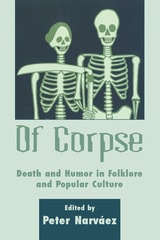
Of Corpse
Death and Humor in Folklore and Popular CulturePeter Narvaez
Utah State University Press, 2003
Laughter, contemporary theory suggests, is often aggressive in some manner and may be prompted by a sudden perception of incongruity combined with memories of past emotional experience. Given this importance of the past to our recognition of the comic, it follows that some "traditions" dispose us to ludic responses. The studies in Of Corpse: Death and Humor in Folklore and Popular Culture examine specific interactions of text (jokes, poetry, epitaphs, iconography, film drama) and social context (wakes, festivals, disasters) that shape and generate laughter. Uniquely, however, the essays here peruse a remarkable paradox---the convergence of death and humor.
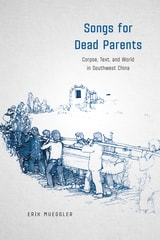
Songs for Dead Parents
Corpse, Text, and World in Southwest ChinaErik Mueggler
University of Chicago Press, 2017
Drawing on more than twenty years of fieldwork in a mountain community in Yunnan Province, Songs for Dead Parents shows how people view the dead as both material and immaterial, as effigies replace corpses, tombstones replace effigies, and texts eventually replace tombstones in a long process of disentangling the dead from the shared world of matter and memory. It is through these processes that people envision the cosmological underpinnings of the world and assess the social relations that make up their community. Thus, state interventions aimed at reforming death practices have been deeply consequential, and Mueggler traces the transformations they have wrought and their lasting effects.