Results by title
3 books match the query 'Creating Community'
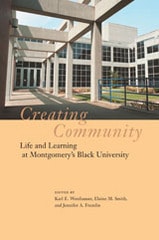
Creating Community
Life and Learning at Alabama State UniversityEdited by Karl E. Westhauser, Elaine M. Smith, and Jennifer A. Fremlin
University of Alabama Press, 2008
Creating Community explores how faculty members at Alabama State University, a historically black university in Montgomery, have been inspired by the legacy of African American culture and the civil rights movement and how they seek to interpret and extend that legacy through teaching, scholarship, and service. Authors describe a wide range of experiences from the era of segregation to the present day. These include accounts of growing up and going to college in Alabama, arriving in the South for the first time to teach at ASU, and the development of programs such as the National Center for the Study of Civil Rights and African American Culture. Together, the essays present viewpoints that reflect the diverse ethnic, cultural, and academic backgrounds of the contributors and of the university.
[more]
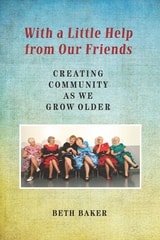
With a Little Help from Our Friends
Creating Community as We Grow OlderBeth Baker
Vanderbilt University Press, 2014
In this book, an award-winning journalist tells the story of people devising innovative ways to live as they approach retirement, options that ensure they are surrounded by a circle of friends, family, and neighbors. Based on visits and interviews at many communities around the country, Beth Baker weaves a rich tapestry of grassroots alternatives, some of them surprisingly affordable:
• a mobile home cooperative in small-town Oregon
• a senior artists colony in Los Angeles
• neighbors helping neighbors in "Villages" or "naturally occurring retirement communities"
• intentional cohousing communities
• best friends moving in together
• multigenerational families that balance togetherness and privacy
• niche communities including such diverse groups as retired postal workers, gays and lesbians, and Zen Buddhists
Drawing on new research showing the importance of social support to healthy aging and the risks associated with loneliness and isolation, the author encourages the reader to plan for a future with strong connections. Baker explores whether individuals in declining health can really stay rooted in their communities through the end of life and concludes by examining the challenge of expanding the home-care workforce and the potential of new technologies like webcams and assistive robots.
This book is the recipient of the annual Norman L. and Roselea J. Goldberg Prize for the best project in the area of medicine.
[more]