Results by title
11 books match the query 'Creationism'
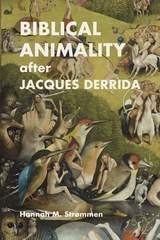
Biblical Animality after Jacques Derrida
Hannah M. Strømmen
SBL Press, 2018
A new theoretical and exegetical angle on the Bible and animal studies
According to Genesis, humans are made in God's image but animals are not. Hannah M. Strømmen challenges this view by critiquing the boundary between humans and animals in the Bible through the work of philosopher Jacques Derrida. Building on Derrida's The Animal That Therefore I Am, Strømmen brings to light significant moments where the lines between the divine, human, and animal are ambiguous in a rich range of biblical texts, from Noah as the first carnivorous man in Genesis 9 to Revelation's beasts.
Features
- A contribution to research on Jacques Derrida and deconstruction
- An examination of Derrida's work on the human/animal boundary
- Critical engagement with the way the Bible is frequently held up as a point of blame for anthropocentrism
Cult Archaeology and Creationism
Understanding Pseudoscientific Beliefs about the PastFrancis B. Harrold
University of Iowa Press, 1995
UFOs and aliens, unexplained mysteries, religious cults, diffusion, creationism. We are all familiar with beliefs about human life that lie outside traditional scientific boundaries. Notions such as these are considered reasonable by vast numbers of us in the Western world, in our modern “technological” and “educated” cultures.
Understanding why this should be so and how we as a society might deal with these widespread pseudoscientific beliefs are the subjects at the heart of this study. The authors—specialists in anthropology, archaeology, sociology, psychology, and history—explore creationism, which claims that there is evidence to support a literal interpretation of the origins of the world and of humanity as narrated in the Book of Genesis, and cult archaeology, which encompasses a wide range of fantastic beliefs about our past.
Cult Archaeology and Creationism contains several essays on the history of pseudoscientific beliefs and their current manifestations as well as the results of a unique research project in which students at five campuses across the country were asked about their beliefs and about such background factors as their school experience and religious faith. This expanded edition also includes two new essays, one on Afrocentrism and another that views cult archaeology and creationism in the 1990s and beyond.
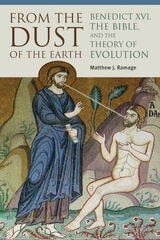
From the Dust of the Earth
Benedict XVI, the Bible , and the Theory of EvolutionMatthew J. Ramage
Catholic University of America Press, 2022
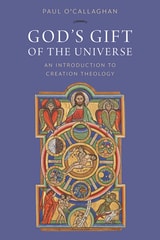
God's Gift of the Universe
An Introduction to Creation TheologyPaul O'Callaghan
Catholic University of America Press, 2021
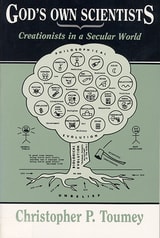
God's Own Scientists
Creationists in a Secular WorldToumey, Christopher P.
Rutgers University Press, 1994
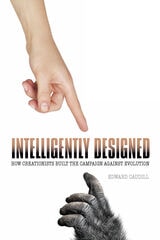
Intelligently Designed
How Creationists Built the Campaign against EvolutionEdward Caudill
University of Illinois Press, 2013
Teaching Evolution in a Creation Nation
Adam Laats and Harvey Siegel
University of Chicago Press, 2016
Laats and Siegel agree with most scientists: creationism is flawed, as science. But, they argue, students who believe it nevertheless need to be accommodated in public school science classes. Scientific or not, creationism maintains an important role in American history and culture as a point of religious dissent, a sustained form of protest that has weathered a century of broad—and often dramatic—social changes. At the same time, evolutionary theory has become a critical building block of modern knowledge. The key to accommodating both viewpoints, they show, is to disentangle belief from knowledge. A student does not need to believe in evolution in order to understand its tenets and evidence, and in this way can be fully literate in modern scientific thought and still maintain contrary religious or cultural views. Altogether, Laats and Siegel offer the kind of level-headed analysis that is crucial to finding a way out of our culture-war deadlock.
The Evidence for Evolution
Alan R. Rogers
University of Chicago Press, 2011
According to polling data, most Americans doubt that evolution is a real phenomenon. And it’s no wonder that so many are skeptical: many of today’s biology courses and textbooks dwell on the mechanisms of evolution—natural selection, genetic drift, and gene flow—but say little about the evidence that evolution happens at all. How do we know that species change? Has there really been enough time for evolution to operate?
With The Evidence for Evolution, Alan R. Rogers provides an elegant, straightforward text that details the evidence for evolution. Rogers covers different levels of evolution, from within-species changes, which are much less challenging to see and believe, to much larger ones, say, from fish to amphibian, or from land mammal to whale. For each case, he supplies numerous lines of evidence to illustrate the changes, including fossils, DNA, and radioactive isotopes. His comprehensive treatment stresses recent advances in knowledge but also recounts the give and take between skeptical scientists who first asked “how can we be sure” and then marshaled scientific evidence to attain certainty. The Evidence for Evolution is a valuable addition to the literature on evolution and will be essential to introductory courses in the life sciences.
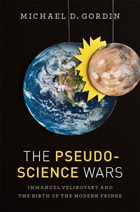
The Pseudoscience Wars
Immanuel Velikovsky and the Birth of the Modern FringeMichael D. Gordin
University of Chicago Press, 2012
Why Evolution Works (and Creationism Fails)
Matt Young and Paul K. Strode
Rutgers University Press, 2009
Focusing on what other books omit, how science works and how pseudoscience works, Matt Young and Paul K. Strode demonstrate the futility of “scientific” creationism. They debunk the notion of intelligent design and other arguments that show evolution could not have produced life in its present form.
Concluding with a frank discussion of science and religion, Why Evolution Works (and Creationism Fails) argues that science by no means excludes religion, though it ought tocast doubt on certain religious claims that are contrary to known scientific fact.
Why Intelligent Design Fails
A Scientific Critique of the New CreationismEdited by Matt Young and Taner Edis
Rutgers University Press, 2004
Is Darwinian evolution established fact, or a dogma ready to be overtaken by "intelligent design"? This is the debate raging in courtrooms and classrooms across the country.
Why Intelligent Design Fails assembles a team of physicists, biologists, computer scientists, mathematicians, and archaeologists to examine intelligent design from a scientific perspective. They consistently find grandiose claims without merit.
Contributors take intelligent design's two most famous claims--irreducible complexity and information-based arguments--and show that neither challenges Darwinian evolution. They also discuss thermodynamics and self-organization; the ways human design is actually identified in fields such as forensic archaeology; how research in machine intelligence indicates that intelligence itself is the product of chance and necessity; and cosmological fine-tuning arguments.
Intelligent design turns out to be a scientific mistake, but a mistake whose details highlight the amazing power of Darwinian thinking and the wonders of a complex world without design.