Results by title
115 books match the query 'Criminal Law' and 9 start with a

A Century of Juvenile Justice
Edited by Margaret K. Rosenheim, Franklin E. Zimring, David S. Tanenhaus, and Be
University of Chicago Press, 2002
A Century of Juvenile Justice is the first standard, comprehensive and comparative reference work to span the history and current state of juvenile justice. An extraordinary assemblage of leading authorities have produced a accessible, illustrated document, designed as a reference for everyone from probation personnel and police to students, educators, lawyers, and social workers.
Editors' introductions place into context each of the book's five sections, which consider the history of the ideas around which the system was organized and the institutions and practices that resulted; the ways in which this set of institutions and practices interacts with other aspects of government policy toward children in the U.S. and in other nations; and also the ways in which changing social and legal meanings of childhood and youth have continued to influence juvenile justice. The doctrine and institutions of juvenile justice in Europe, Japan, England, and Scotland are profiled in depth to show the range of modern responses to youth crime and child endangerment. This comparative material provides a fresh basis for judging the direction of policy in the U.S.
Margaret K. Rosenheim is the Helen Ross professor Emerita in the School of Social Service Administration of the University of Chicago. Franklin Zimring is Professor of Law and Director of the Earl Warren Legal Institute at the University of California, Berkeley. David S. Tanenhaus is Assistant Professor of History at the University of Nevada, Las Vegas. Bernardine Dohrn is Director of the Children and Family Justice Center of Northwestern University Law School.
Contributors:
Anthony Bottoms
Jaap Doek
Bernardine Dohrn
Peter Edelman
John Eekelaar
David Farrington
Frank Furstenberg
Michael Grossberg
John Laub
Paul Lerman
Rolf Loeber
Akira Morita
Margaret K. Rosenheim
Elizabeth Scott
David S. Tanenhaus
Lee Teitelbaum
Mark Testa
Franklin E. Zimring

A Courageous Fool
Marie Deans and Her Struggle against the Death PenaltyTodd C. Peppers
Vanderbilt University Press, 2017
Marie found herself fighting to bring justice to the legal process and to bring humanity not only to prisoners on death row but to the guards and wardens as well. During Marie's time as a death penalty opponent in South Carolina and Virginia, she experienced the highs of helping exonerate the innocent and the lows of standing death watch in the death house with thirty-four condemned men.
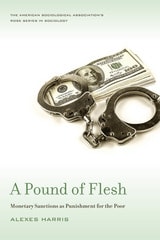
A Pound of Flesh
Monetary Sanctions as Punishment for the PoorAlexes Harris
Russell Sage Foundation, 2016
Over seven million Americans are either incarcerated, on probation, or on parole, with their criminal records often following them for life and affecting access to higher education, jobs, and housing. Court-ordered monetary sanctions that compel criminal defendants to pay fines, fees, surcharges, and restitution further inhibit their ability to reenter society. In A Pound of Flesh, sociologist Alexes Harris analyzes the rise of monetary sanctions in the criminal justice system and shows how they permanently penalize and marginalize the poor. She exposes the damaging effects of a little-understood component of criminal sentencing and shows how it further perpetuates racial and economic inequality.
Harris draws from extensive sentencing data, legal documents, observations of court hearings, and interviews with defendants, judges, prosecutors, and other court officials. She documents how low-income defendants are affected by monetary sanctions, which include fees for public defenders and a variety of processing charges. Until these debts are paid in full, individuals remain under judicial supervision, subject to court summons, warrants, and jail stays. As a result of interest and surcharges that accumulate on unpaid financial penalties, these monetary sanctions often become insurmountable legal debts which many offenders carry for the remainder of their lives. Harris finds that such fiscal sentences, which are imposed disproportionately on low-income minorities, help create a permanent economic underclass and deepen social stratification.
A Pound of Flesh delves into the court practices of five counties in Washington State to illustrate the ways in which subjective sentencing shapes the practice of monetary sanctions. Judges and court clerks hold a considerable degree of discretion in the sentencing and monitoring of monetary sanctions and rely on individual values—such as personal responsibility, meritocracy, and paternalism—to determine how much and when offenders should pay. Harris shows that monetary sanctions are imposed at different rates across jurisdictions, with little or no state government oversight. Local officials’ reliance on their own values and beliefs can also push offenders further into debt—for example, when judges charge defendants who lack the means to pay their fines with contempt of court and penalize them with additional fines or jail time.
A Pound of Flesh provides a timely examination of how monetary sanctions permanently bind poor offenders to the judicial system. Harris concludes that in letting monetary sanctions go unchecked, we have created a two-tiered legal system that imposes additional burdens on already-marginalized groups.
Affective Justice
The International Criminal Court and the Pan-Africanist PushbackKamari Maxine Clarke
Duke University Press, 2019

Against Prediction
Profiling, Policing, and Punishing in an Actuarial AgeBernard E. Harcourt
University of Chicago Press, 2006
From random security checks at airports to the use of risk assessment in sentencing, actuarial methods are being used more than ever to determine whom law enforcement officials target and punish. And with the exception of racial profiling on our highways and streets, most people favor these methods because they believe they’re a more cost-effective way to fight crime.
In Against Prediction, Bernard E. Harcourt challenges this growing reliance on actuarial methods. These prediction tools, he demonstrates, may in fact increase the overall amount of crime in society, depending on the relative responsiveness of the profiled populations to heightened security. They may also aggravate the difficulties that minorities already have obtaining work, education, and a better quality of life—thus perpetuating the pattern of criminal behavior. Ultimately, Harcourt shows how the perceived success of actuarial methods has begun to distort our very conception of just punishment and to obscure alternate visions of social order. In place of the actuarial, he proposes instead a turn to randomization in punishment and policing. The presumption, Harcourt concludes, should be against prediction.

Among the Lowest of the Dead
The Culture of Capital PunishmentDavid Von Drehle
University of Michigan Press, 2010
"Has all the tension of the best true crime stories . . . This is journalism at its best."
--Library Journal
"A compelling argument against capital punishment. . . . Examining politicians, judges (including Supreme Court Justices), prosecutors, defense attorneys and the condemned themselves, the author makes an effective case that, despite new laws, execution is no less a lottery than it has always been."
--Publishers Weekly
"In a fine and important book, Von Drehle writes elegantly and powerfully. . . . Anyone certain of their opinion about the death penalty ought to read this book."
-- Booklist
"An extremely well-informed and richly insightful book of great value to students of the death penalty as well as intelligent general readers with a serious interest in the subject, Among the Lowest of the Dead is also exciting reading. The book is an ideal guide for new generations of readers who want to form knowledgeable judgments in the continuing--and recently accelerating--controversies about capital punishment."
--Anthony Amsterdam, New York University
"Among the Lowest of the Dead is a powerfully written and meticulously researched book that makes an invaluable contribution to the growing public dialogue about capital punishment in America. It's one of those rare books that bridges the gap between mass audiences and scholarly disciplines, the latter including sociology, political science, criminology and journalism. The book is required reading in my Investigative Journalism classes--and my students love it!"
--David Protess, Northwestern University
"Among The Lowest of the Dead deserves a permanent place in the literature as literature, and is most relevant to today's death penalty debate as we moderate advocates and abolitionists search for common ground."
--Robert Blecker, New York Law School
David Von Drehle is Senior Writer, The Washington Post and author of Triangle: The Fire that Changed America.
An American Travesty
Legal Responses to Adolescent Sexual OffendingFranklin E. Zimring
University of Chicago Press, 2004
An American Travesty is the first scholarly book in half a century to analyze the justice system’s response to sexual misconduct by children and adolescents in the United States. Writing with a refreshing dose of common sense, Franklin E. Zimring discusses our society's failure to consider the developmental status of adolescent sex offenders. Too often, he argues, the American legal system ignores age and developmental status when adjudicating young sexual offenders, in many cases responding as they would to an adult.
“An opinionated, articulate, and forceful critique of current politics and practices. . . . I would recommend this book for anyone interested in rethinking the fundamental questions of how our courts and systems should respond to these cases.”—Law and Politics Book Review
“One of the most important new books in the field of juvenile justice. . . . Zimring offers a thoughtful, research-based analysis of what went wrong with legal policy development.”—Barry Krisberg, President, National Council on Crime and Delinquency
Anatomy of a Trial
Public Loss, Lessons Learned from The People vs. O.J. SimpsonJerrianne Hayslett
University of Missouri Press, 2008
Aquinas on Crime
Charles P. Nemeth
St. Augustine's Press, 2008
Not much escapes the intellect and imagination of the Angelic Doctor, St. Thomas Aquinas. Whether it be love, children, education, moral reasoning, happiness or the proper dispositions for human existence, St. Thomas seems an expert in all of it. Crime and criminal conduct are no exceptions to this general tendency with him. Not only does he have much to say about it, what he relates is perpetually fresh and surely the bedrock of what is now taken for granted. In this short treatise, the focus targets St. Thomas’s criminal codification – his law of crimes.
Indeed the magnanimity of his crimes code is a subject matter not yet treated in any detail in the scholarly literature. While parts and pieces are covered in many quarters, the literature has yet to develop a systematic, codified examination of Thomistic criminal law. The essence of the endeavor is threefold: first, how does St. Thomas factor the nature of the human person into the concept of criminal culpability and personal responsibility; second, what types of criminal conduct does St. Thomas specifically delineate and define; and lastly, what is Thomas’s view of mitigation and defense, as well as the corresponding punishment meted out for criminal conduct? This short commentary zeroes in on Thomistic Criminal Law – a project which will illuminate the root, the heritage and the foundation of modern criminal codification.