Results by title
22 books match the query 'Cross'
Contemplation and the Cross
A Catholic Introduction to the Spiritual LifeThomas Joseph White, OP
Catholic University of America Press, 2025
Cross and Creation
A Theological Introduction to Origen of AlexandriaMark E. Therrien
Catholic University of America Press, 2022
Cross and Cruciform in the Anglo-Saxon World
Studies to Honor the Memory of Timothy ReuterSARAH LARRATT KEEFER
West Virginia University Press, 2010
Cross and Cruciform in the Anglo-Saxon World: Studies to Honor the Memory of Timothy Reuter is edited by Sarah Larratt Keefer, Karen Louise Jolly, and Catherine E. Karkov and is the third and final volume of an ambitious research initiative begun in 1999 concerned with the image of the cross, showing how its very material form cuts across both the culture of a society and the boundaries of academic disciplines—history, archaeology, art history, literature, philosophy, and religion—providing vital insights into how symbols function within society. The flexibility, portability, and adaptability of the Anglo-Saxon understanding of the cross suggest that, in pre-Conquest England, at least, the linking of word, image, and performance joined the physical and spiritual, the temporal and eternal, and the earthly and heavenly in the Anglo-Saxon imaginative landscape.
This volume is divided into three sections. The first section of the collection focuses on representations of “The Cross: Image and Emblem,” with contributions by Michelle P. Brown, David A. E. Pelteret, and Catherine E. Karkov. The second section, “The Cross: Meaning and Word,” deals in semantics and semeology with essays by Éamonn Ó Carragáin, Helen Damico, Rolf Bremmer, and Ursula Lenker. The third section of the book, “The Cross: Gesture and Structure,” employs methodologies drawn from archaeology, new media, and theories of rulership to develop new insights into subjects as varied as cereal production, the little-known Nunburnholme Cross, and early medieval concepts of political power.
Cross and Cruciform in the Anglo-Saxon World: Studies to Honor the Memory of Timothy Reuter is a major collection of new research, completing the publication series of the Sancta Crux/Halig Rod project. Cross and Culture in Anglo-Saxon England: Studies in Honor of George Hardin Brown, Volume 2 in this series, remains available from West Virginia University Press.
Cross and Culture in Anglo-Saxon England
Studies in Honor of George Hardin BrownKAREN L. JOLLY
West Virginia University Press, 2008
As Volume One in the Sancta Crux/Halig Rod series, this collection of new research offers fascinating glimpses into how the way the cross, the central image of Christianity in the Anglo-Saxon period, was textualized, reified, visualized, and performed. The cross in early medieval England was so ubiquitous it became invisible to the modern eye, and yet it played an innovative role in Anglo-Saxon culture, medicine, and popular practice. It represented one of the most powerful relics, emblems, and images in medieval culture because it could be duplicated in many forms and was accessible to every layer of society. The volume speaks to critical issues of cultural interpretation for Anglo-Saxonists, medievalists of all disciplines, and those interested in cultural studies in general.
Cross and Dragon – Matteo Ricci and China
A Screenplay by Edwin KongEdwin Kong
Hong Kong University Press, 2025
Edwin Kong brings to life the extraordinary journey of Matteo Ricci, the Italian Jesuit whose daring mission to China reshaped the course of East-West relations. Sent by the Pope in the late sixteenth century to convert the Chinese Emperor, Ricci faced an impenetrable barrier—Ming Dynasty China was closed to foreigners. But armed with knowledge and an unmatched mastery of memory techniques, he found another way in.
Disguised as a Buddhist monk, Ricci captivated scholars, officials, and eventually the imperial court, introducing Western science while immersing himself in Chinese culture. His thirty-year odyssey from rural villages to the heart of the Forbidden City proved that engagement, rather than conquest, could bridge civilizations.
Told in the form of a screenplay, Cross and Dragon is a gripping historical drama with urgent contemporary resonance, exploring the power of faith and cultural exchange in the face of division.
Diagramming Devotion
Berthold of Nuremberg’s Transformation of Hrabanus Maurus’s Poems in Praise of the CrossJeffrey F. Hamburger
University of Chicago Press, 2020
I Know It’s Dangerous
Why Mexicans Risk Their Lives to Cross the BorderLynnaire M. Sheridan
University of Arizona Press, 2009
As an Australian national, Lynnaire Sheridan brings a refreshingly neutral voice to this hot-button topic. With data gathered over two years of living in Baja California, Mexico, Sheridan draws out individual stories, motivations, and conceptions of risk that ultimately allow us a deeper understanding of migration. Sheridan enriches the migrants’ stories with examinations of popular songs, graffiti art on the border, analyses of newspaper articles, and in-depth interviews with migrants. Together these narratives show us that risk has become a strong motivating factor for migrants and that stricter border policies have not necessarily stemmed the rates of migration; they have merely changed how people migrate.
Sheridan’s findings have broad implications for both those interested in migration from Mexico to the United States and international migration scholars. This book will appeal to a range of disciplines in the humanities, from anthropology and criminology to art and ethnic studies. It will also resonate among legal professionals, policy makers, and social workers.
While numerous books have focused on the act of migration and its ripples across both the United States and Mexico, this book is unique in its attention to migrants in Mexico and its ability to draw out their individual stories.
Jewish Temple Theology and the Mystery of the Cross
Atonement and the Two Goats of Yom KippurRichard J. Barry IV
Catholic University of America Press, 2023
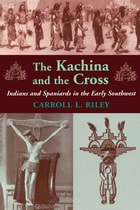
Kachina and the Cross
Carroll L Riley
University of Utah Press, 1999
In The Kachina and the Cross, Carroll Riley weaves elements of archaeology, anthropology, and history to tell a dramatic story of conflict between the Pueblo Indians and Franciscan missionaries in the seventeenth-century Spanish colony of New Mexico.
Until now, histories of the early Southwest have tended to concentrate on the Spanish presence, with little mention of Indian resistance or the decade-long war that eventually erupted. In The Kachina and the Cross Riley completes the picture by utilizing archaeological and anthropological research from the past forty years, fleshing out the story of the first century of sustained Spanish-Pueblo relations.
Laughter at the Foot of the Cross
Michael A. Screech
University of Chicago Press, 2015
But we are fortunate in our guide: drawing on his immense knowledge of the classics and of humanists like Erasmus and Rabelais—who used Plato and Aristotle to interpret the Gospels—and incorporating the thoughts of Aesop, Calvin, Lucian of Samosata, Luther, Socrates, and others, Screech shows that Renaissance thinkers revived ancient ideas about what inspires laughter and whether it could ever truly be innocent. As Screech argues, in the minds of Renaissance scholars, laughter was to be taken very seriously. Indeed, in an era obsessed with heresy and reform, this most human of abilities was no laughing matter.
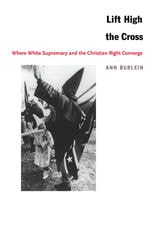
Lift High the Cross
Where White Supremacy and the Christian Right ConvergeAnn Burlein
Duke University Press, 2002
Arguing that today’s right engenders its popularity not by overt bigotry or hatred but by focusing on people’s hopes for their children, Burlein finds a politics of grief at the heart of such rhetoric. While demonstrating how religious symbols, rituals, texts, and practices shape people’s memories and their investment in society, she shows how Peters and Dobson each construct countermemories for their followers that reframe their histories and identities—as well as their worlds—by reversing mainstream perspectives in ways that counter existing power relations. By employing the techniques of niche marketing, the politics of scandal, and the transformation of political issues into “gut issues” and by remasculinizing the body politic, Burlein shows, such groups are able to move people into their realm of influence without requiring them to agree with all their philosophical, doctrinal, or political positions.
Lift High the Cross will appeal to students and scholars of religion, American cultural studies, women’s studies, sociology, and gay and lesbian studies, as well as to non-specialists interested in American politics and, specifically, the right.
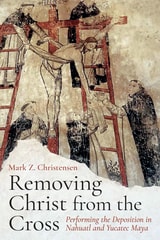
Removing Christ from the Cross
Performing the Deposition in Nahuatl and Yucatec MayaMark Z. Christensen
University Press of Colorado, 2026
Employed on Good Friday, the texts provided mute actors with roles and props with which to reenact the removal of Christ from his cross, his placement into the arms of his grieving mother, and his burial—his Deposition. Through rare translations, vivid historical accounts, and rich cultural insight, the book uncovers how these ceremonies moved audiences to tears, shaped local Catholicisms, and still have the power to stir hearts today.
Such theatrical reenactments were common among Nahuas and Mayas during the colonial period only to become largely overlooked by the scholarly literature on religion. The texts examined here provide not only examples of performances but also insight into how translation altered their content and meaning. More than simply plays or sermons, these hybrid performances merged European tradition with Nahua and Maya storytelling, creating unforgettable moments of faith, grief, and beauty. Familiarized through local worldviews, concerns, preferences, and language, these texts provide additional and important insights into myriad issues including those of gender, agency, and how Christianity adapted its message of the Deposition to accommodate Indigenous audiences of different cultures. Christensen also mines the deep well of existing European literature on the subject to clearly distinguish the aspects derived from the Old World from those from the New.
The first book examining how the Aztec and Maya were taught about and engaged in the Deposition, Removing Christ from the Cross exposes the colonial origins of modern Latin American commemorations, showing the past clearly reflected in the present and making a significant contribution to the literature on the evangelization of New Spain. This is more than history—it is the rediscovery of performances that connected worlds.
Slavery and the Numbers Game
A CRITIQUE OF TIME ON THE CROSSHerbert G. Gutman
University of Illinois Press, 1975
This detailed analysis of slavery in the antebellum South was written in 1975 in response to the prior year's publication of Robert Fogel and Stanley Engerman's controversial Time on the Cross, which argued that slavery was an efficient and dynamic engine for the southern economy and that its success was due largely to the willing cooperation of the slaves themselves.
Noted labor historian Herbert G. Gutman was unconvinced, even outraged, by Fogel and Engerman's arguments. In this book he offers a systematic dissection of Time on the Cross, drawing on a wealth of data to contest that book's most fundamental assertions. A benchmark work of historical inquiry, Gutman's critique sheds light on a range of crucial aspects of slavery and its economic effectiveness.
Gutman emphasizes the slaves' responses to their treatment at the hands of slaveowners. He shows that slaves labored, not because they shared values and goals with their masters, but because of the omnipresent threat of 'negative incentives,' primarily physical violence.
In his introduction to this new edition, Bruce Levine provides a historical analysis of the debate over Time on the Cross. Levine reminds us of the continuing influence of the latter book, demonstrated by Robert W. Fogel's 1993 Nobel Prize in Economic Sciences, and hence the importance and timeliness of Gutman's critique.
Southern Crucifix, Southern Cross
Catholic-Protestant Relations in the Old SouthAndrew Henry Stern
University of Alabama Press, 2012
In sharp contrast to many long-standing presumptions about mistrust or animosity between these two groups, this study proposes that Catholic and Protestant interactions in the South were characterized more by cooperation than by conflict.
Stations of the Cross
Adorno and Christian Right RadioPaul Apostolidis
Duke University Press, 2000
Public ideology and institutional tendencies clash, the author argues, in the restructuring of the welfare state, the financing of the electoral system, and the backlash against women and minorities. These frictions are nowhere more apparent than on Christian right radio. Reinvigorating the intellectual tradition of the Frankfurt School, Apostolidis shows how ideas derived from early critical theory—in particular that of Theodor W. Adorno—can illuminate the political and social dynamics of this aspect of contemporary American culture. He uses and reworks Adorno’s theories to interpret the nationally broadcast Focus on the Family, revealing how the cultural discourse of the Christian right resonates with recent structural transformations in the American political economy. Apostolidis shows that the antidote to the Christian right’s marriage of religious and market fundamentalism lies not in a reinvocation of liberal fundamentals, but rather depends on a patient cultivation of the affinities between religion’s utopian impulses and radical, democratic challenges to the present political-economic order.
Mixing critical theory with detailed analysis, Stations of the Cross provides a needed contribution to sociopolitical studies of mass movements and will attract readers in sociology, political science, philosophy, and history.
The Cross and the Flag
Papal Diplomacy and John Paul II's Struggle Against the Tyranny of the PossibleJohn Tanyi Nquah Lebui
St. Augustine's Press, 2024
What is papal diplomacy and what role does it play on the larger geopolitical stage? Why does it matter what popes say to a global audience? "As John Tanyi points out, papal diplomacy has followed a trajectory all its own over the years. In today’s globalized world, the Holy See stands out as an important communicator with a widely respected moral voice. It is often said that 'When the Pope speaks, the world listens.' What sets the diplomatic voices of the Holy Father and his envoys apart from all others is that they speak and act for the good of humanity––not just for the sovereign entity they represent, and not just for Catholics. As a former foreign minister of the Holy See, Cardinal Jean Louis Tauran, once described the mission of papal diplomats: 'Our duty is to promote and defend not only the freedom and rights of Catholic communities around the world, but also to promote certain principles without which there is no civilization.'"
The particular example of Pope John Paul II is a groundbreaking example of the critical nature of ecclesiastical diplomacy and why popes as diplomats are playing at a greater level than other statesmen. As George Weigel notes, popes must combat all the problems of the world, but also importantly what he calls the 'tyranny of the possible'––that is, in all things compromise and complacency will play a part. It is the position occupied by one man, the heir of St. Peter, to know when to defy the entirety of global politics (and sometimes what seems like common sense) to say 'yes' and 'no' definitively in light of unchanging truths.
The Cross of War
Christian Nationalism and U.S. Expansion in the Spanish-American WarMatthew McCullough
University of Wisconsin Press, 2014

The Lion and the Cross
Early Christianity in Victorian NovelsRoyal W. Rhodes
The Ohio State University Press, 1900
The Poems of St. John of the Cross
St. John of the Cross
University of Chicago Press, 1979
This dual-language edition makes available the original Spanish from the Codex of Sanlúcon de Barrameda with facing English translations. The work concludes with two essays—a critique of the poetry and a short piece on the Spanish text that appears alongside the translation—as well as brief notes on the individual poems.
The Pyramid under the Cross
Franciscan Discourses of Evangelization and the Nahua Christian Subject in Sixteenth-century MexicoViviana Díaz Balsera
University of Arizona Press, 2005
The Pyramid under the Cross looks at the epic project of Christianization as well as the limits of the Spanish spiritual colonizers' power to accomplish it. The book focuses on activities of Franciscan missionaries who, as the first religious order to arrive, occupied the most important political and social centers in the Valley of Mexico and set the strategies of evangelization that others would follow. One such activity, the Nahua theater of evangelization, is represented as an exemplary case of the inevitable cultural negotiation involved in the missionary process. The author explores not only the imposition of a Eurocentric worldview upon the Nahua but also the hybridization of this view as the spiritual colonizer attempted to encompass a new non-Western constituency and the latter interpreted Christianity according to its own cultural paradigms.
The book treats a wide range of texts—the Historia eclesiástica indiana, the Confessionario Mayor, the Coloquios de los Doce, and more—both by renowned Franciscan figures such as Gerónimo de Mendieta, Alonso de Molina, Bernardino de Sahagún, and by Nahua grammarians Antonio Valeriano de Azcapotzalco, Andrés Leonardo de Tlatelolco, and others. Díaz Balsera engages the cultural constraints of all the actors in the episodes she relates in order to show how the exchange between them resulted in the appropriation and/or alteration of the Spanish discourses of spiritual domination—sometimes even in their breakdown—and how it brought about the emergence of Nahua Christian subjects that would never fully leave behind their ancient ways of relating to the gods.
The Pyramid under the Cross will be of interest to readers in the areas of Hispanic literatures, history, religion, anthropology, Latin American and cultural studies, and to those working in the field of colonial studies.
The Seven Last Words of Our Lord Upon the Cross
Mother Catherine Abrikosova, T.O.S.D.
St. Augustine's Press, 2019

The Thief, the Cross, and the Wheel
Pain and the Spectacle of Punishment in Medieval and Renaissance EuropeMitchell B. Merback
University of Chicago Press, 1999
Merback compares the images of Christ's Crucifixion with those of the two thieves who met their fate beside Jesus. In paintings by well-known Northern European masters and provincial painters alike, Merback finds the two thieves subjected to incredible cruelty, cruelty that artists could not depict in their scenes of Christ's Crucifixion because of theological requirements. Through these representations Merback explores the ways audiences in early modern Europe understood images of physical suffering and execution. The frequently shocking works also provide a perspective from which Merback examines the live spectacle of public torture and execution and how audiences were encouraged by the Church and the State to react to the experience. Throughout, Merback traces the intricate and extraordinary connections among religious art, devotional practice, bodily pain, punishment, and judicial spectatorship.
Keenly aware of the difficulties involved in discussing images of atrocious violence but determined to make them historically comprehensible, Merback has written an informed and provocative study that reveals the rituals of medieval criminal justice and the visual experiences they engendered.