Results by title
8 books match the query 'Cuisine'
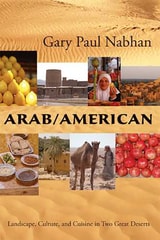
Arab/American
Landscape, Culture, and Cuisine in Two Great DesertsGary Paul Nabhan
University of Arizona Press, 2008
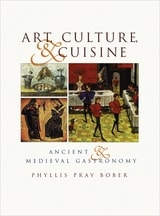
Art, Culture, and Cuisine
Ancient and Medieval GastronomyPhyllis Pray Bober
University of Chicago Press, 1999
Bober draws on archaeology and art history to examine prehistoric eating customs in ancient Turkey; traditions of the great civilizations of Egypt, Mesopotamia, Greece, and Rome; and rituals of the Middle Ages. Both elegant and entertaining, Art, Culture, and Cuisine reveals cuisine and dining's place at the heart of cultural, religious, and social activities that have shaped Western sensibilities.
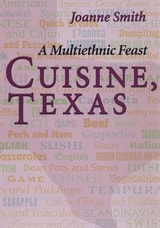
Cuisine, Texas
A Multiethnic FeastBy Joanne Smith
University of Texas Press, 1995
People from around the world have found a home in Texas, bringing with them a multiethnic feast replete with dishes that originated in Mexico, Europe, Africa, the Middle East, and Asia. In these pages you'll discover a magical place called Cuisine, Texas, where you can find all these favorite family recipes in one handy source.
Noted food writer Joanne Smith spent several years gathering the traditional recipes of every major ethnic group in Texas. As a result, Cuisine, Texas is a virtual encyclopedia of Texas cooking, with more than 375 recipes drawn from Native American, Spanish, Japanese, French, Cajun, Mexican, Tex-Mex, Anglo-American, African American, Thai, Czech, Swiss, Dutch, Jewish, Greek, German, Polish, Italian, British, Lebanese, Chinese, Russian, Vietnamese, and Scandinavian cooking.
The recipes cover the full range of foods, from appetizers to entrees, salads, vegetables, breads, and desserts, and all have clear, simple-to-follow instructions. Interspersed among them are engaging discussions of the different ethnic cuisines, flavored with delightful stories of some of the cooks who created or perfected the recipes. And to make your cooking even easier, Joanne Smith includes information on how to readily find imported and specialized ingredients and a word about health-conscious substitutions.
Cuisine, Texas, may not exist on the map, but it can be found everywhere that people enjoy good food and the fellowship that goes with it. Let this book be your one-stop source for all the tastes of Texas.

Fishing for Buffalo
A Guide to the Pursuit and Cuisine of Carp, Suckers, Eelpout, Gar, and Other Rough FishRob Buffler
University of Minnesota Press, 2009
The definitive guide to the eccentric and surprisingly popular sport of rough fishing
Is a carpsucker a carp or a sucker? Where can you find the largest eelpout in the United States? Can you catch creek chubs and fry them for supper?
These questions and more are answered within the pages of Fishing for Buffalo. Rob Buffler and Tom Dickson dispel myths and rumors about rough fish with credible biological information while also demonstrating the joy of angling for nontraditional fish. Its wealth of information qualifies this book as a fishing bible for the growing number of rough fishing enthusiasts in the United States and makes it easy to identify the rough fish you may catch. It even includes a sampling of Dickson and Buffler’s favorite recipes, such as Burbot Boulangère and Deviled Grilled Cisco.Rough fish may be a lot of things—ugly, unruly, or elusive—but they are definitely not boring.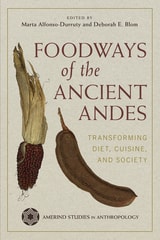
Foodways of the Ancient Andes
Transforming Diet, Cuisine, and SocietyMarta P Alfonso-Durruty
University of Arizona Press, 2023
Exploring the multiple social, ecological, cultural, and ontological dimensions of food in the Andean past, the contributors of Foodways of the Ancient Andes offer diverse theoretical perspectives and methodological approaches that reveal the richness, sophistication, and ingenuity of Andean peoples. The volume spans time periods and localities in the Andean region to reveal how food is intertwined with multiple aspects of the human experience, from production and consumption to ideology and sociopolitical organization. It illustrates the Andean peoples’ resilience in the face of challenges brought about by food scarcity and environmental change. Chapters dissect the intersection of food, power, and status in early states and empires; examine the impact of food during times of conflict and instability; and illuminate how sacred and high-status foods contributed to the building of the Inka Empire.
Featuring forty-six contributors from ten countries, the chapters employ new analytical methods, integrating different food data and interdisciplinary research to show that food can provide not only simple nutrition but also a multitude of strategies, social and political relationships, and ontologies that are otherwise invisible in the archaeological record.
Contributors
Aleksa K. Alaica
Sonia Alconini
Marta Alfonso-Durruty
Sarah I. Baitzel
Véronique Bélisle
Carolina Belmar
Carrie Anne Berryman
Matthew E. Biwer
Deborah E. Blom
Tamara L. Bray
Matthew T. Brown
Maria C. Bruno
José M. Capriles
Katherine L. Chiou
Susan D. deFrance
Lucia M. Diaz
Richard P. Evershed
Maureen E. Folk
Alexandra Greenwald
Chris Harrod
Christine A. Hastorf
Iain Kendall
Kelly J. Knudson
BrieAnna S. Langlie
Cecilia Lemp
Petrus le Roux
Marcos Martinez
Anahí Maturana-Fernández
Weston C. McCool
Melanie J. Miller
Nicole Misarti
Flavia Morello
Patricia Quiñonez Cuzcano
Omar Reyes
Arturo F. Rivera Infante
Manuel San Román
Francisca Santana-Sagredo
Beth K. Scaffidi
Augusto Tessone
Andrés Troncoso
Tiffiny A. Tung
Mauricio Uribe
Natasha P. Vang
Sadie L. Weber
Kurt M. Wilson
Michelle E. Young
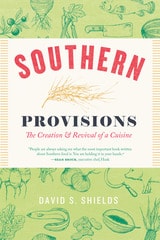
Southern Provisions
The Creation and Revival of a CuisineDavid S. Shields
University of Chicago Press, 2015
Shields’s turf is the southern Lowcountry, from the peanut patches of Wilmington, North Carolina to the sugarcane fields of the Georgia Sea Islands and the citrus groves of Amelia Island, Florida. He takes us on a historical excursion to this region, drawing connections among plants, farms, growers, seed brokers, vendors, cooks, and consumers over time. Shields begins by looking at how professional chefs during the nineteenth century set standards of taste that elevated southern cooking to the level of cuisine. He then turns to the role of food markets in creating demand for ingredients and enabling conversation between producers and preparers. Next, his focus shifts to the field, showing how the key ingredients—rice, sugarcane, sorghum, benne, cottonseed, peanuts, and citrus—emerged and went on to play a significant role in commerce and consumption. Shields concludes with a look at the challenges of reclaiming both farming and cooking traditions.
From Carolina Gold rice to white flint corn, the ingredients of authentic southern cooking are returning to fields and dinner plates, and with Shields as our guide, we can satisfy our hunger both for the most flavorful regional dishes and their history.

The Cuisine of Sacrifice among the Greeks
Marcel Detienne and Jean-Pierre Vernant
University of Chicago Press, 1989
The fundamental myth is that of Prometheus, who introduced sacrifice and, in the process, both joined us to and separated us from the gods—and ambiguous relation that recurs in marriage and in the growing of grain. Thus we can understand why the ascetic man refuses both women and meat, and why Greek women celebrated the festival of grain-giving Demeter with instruments of butchery.
The ambiguity coded in the consumption of meat generated a mythology of the "other"—werewolves, Scythians, Ethiopians, and other "monsters." The study of the sacrificial consumption of meat thus leads into exotic territory and to unexpected findings.
In The Cuisine of Sacrifice, the contributors—all scholars affiliated with the Center for Comparative Studies of Ancient Societies in Paris—apply methods from structural anthropology, comparative religion, and philology to a diversity of topics: the relation of political power to sacrificial practice; the Promethean myth as the foundation story of sacrificial practice; representations of sacrifice found on Greek vases; the technique and anatomy of sacrifice; the interaction of image, language, and ritual; the position of women in sacrificial custom and the female ritual of the Thesmophoria; the mythical status of wolves in Greece and their relation to the sacrifice of domesticated animals; the role and significance of food-related ritual in Homer and Hesiod; ancient Greek perceptions of Scythian sacrificial rites; and remnants of sacrificial ritual in modern Greek practices.
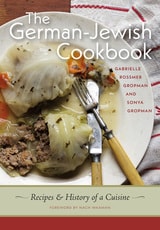
The German-Jewish Cookbook
Recipes and History of a CuisineGabrielle Rossmer Gropman and Sonya Gropman
Brandeis University Press, 2017