Results by title

3 books match the query 'Cultural Difference'

cover of Cultural Difference and the Literary Text: Pluralism and the Limits of Authenticity in North American Literature

Cultural Difference and the Literary Text

Pluralism and the Limits of Authenticity in North American Literature

Winfried Siemerling

University of Iowa Press, 1997

This dynamic, open-minded collection of essays responds to the issues raised by Werner Sollors when he argues against the rigidity of cultural pluralism, against the ethnic group-by-group segregation of American literature. Instead he calls for an openly transethinic recognition of cross-cultural interplays and connections among all so-called groups and their canons. In enthusiastic response to such issues, the contributors explore a variety of approaches to pluralism, multiculturalism, group identity, and the problematics of authenticity in literary texts and criticism both historically and currently.

The scholars in this civil, persuasive volume are at home in an international world that crosses linguistic, cultural, and national boundaries. They thus transcend the customary restrictions of earlier, relatively isolationist scholarship to form new, nonpolemical links among cultural identities. This relationship between oral modes of communal identity and writing in tribal cultures joins an examination of Houston Baker's discursive strategies. A consideration of ethnic humor in the writings of Zora Neale Hurston and Jerre Mangione and a discussion of Jean Toomer's racial persona offer striking contextualizations. Two contributors study discursive constructions of mestizaje in Chicano/a texts, followed by essays on cultural difference in Faulkner's Light in August and Roth's Call It Sleep.Finally, Werner Sollers's essay extends the interactions among all these energetic, nonjudgmental dialogues.
[more]
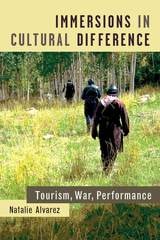
cover of Immersions in Cultural Difference: Tourism, War, Performance

Immersions in Cultural Difference

Tourism, War, Performance

Natalie Alvarez

University of Michigan Press, 2018
In a time of intensifying xenophobia and anti-immigration measures, this book examines the impulse to acquire a deeper understanding of cultural others. Immersions in Cultural Difference takes readers into the heart of immersive simulations, including a simulated terrorist training camp in Utah; mock Afghan villages at military bases in Canada and the UK; a fictional Mexico-US border run in Hidalgo, Mexico; and an immersive tour for settlers at a First Nations reserve in Manitoba, Canada. Natalie Alvarez positions the phenomenon of immersive simulations within intersecting cultural formations: a neoliberal capitalist interest in the so-called “experience economy” that operates alongside histories of colonization and a heightened state of xenophobia produced by War on Terror discourse. The author queries the ethical stakes of these encounters, including her own in relation to the field research she undertakes. As the book moves from site to site, the reader discovers how these immersions function as intercultural rehearsal theaters that serve a diverse set of strategies and pedagogical purposes: they become a “force multiplier” within military strategy, a transgressive form of dark tourism, an activist strategy, and a global, profit-generating practice for a neoliberal capitalist marketplace.
[more]
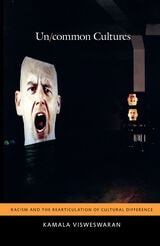
cover of Un/common Cultures: Racism and the Rearticulation of Cultural Difference

Un/common Cultures

Racism and the Rearticulation of Cultural Difference

Kamala Visweswaran

Duke University Press, 2010

In Un/common Cultures, Kamala Visweswaran develops an incisive critique of the idea of culture at the heart of anthropology, describing how it lends itself to culturalist assumptions. She holds that the new culturalism—the idea that cultural differences are definitive, and thus divisive—produces a view of “uncommon cultures” defined by relations of conflict rather than forms of collaboration. The essays in Un/common Cultures straddle the line between an analysis of how racism works to form the idea of “uncommon cultures” and a reaffirmation of the possibilities of “common cultures,” those that enact new forms of solidarity in seeking common cause. Such “cultures in common” or “cultures of the common” also produce new intellectual formations that demand different analytic frames for understanding their emergence. By tracking the emergence and circulation of the culture concept in American anthropology and Indian and French sociology, Visweswaran offers an alternative to strictly disciplinary histories. She uses critical race theory to locate the intersection between ethnic/diaspora studies and area studies as a generative site for addressing the formation of culturalist discourses. In so doing, she interprets the work of social scientists and intellectuals such as Elsie Clews Parsons, Alice Fletcher, Franz Boas, Louis Dumont, Claude Lévi-Strauss, Clifford Geertz, W. E. B. Du Bois, and B. R. Ambedkar.
[more]