Results by title
2 books match the query 'Cultural Economy'
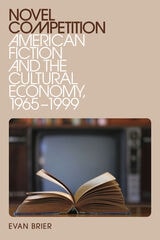
Novel Competition
American Fiction and the Cultural Economy, 1965-1999Evan Brier
University of Iowa Press, 2024
Novel Competition describes the literary and institutional struggle to make American novels matter between 1965 and 1999. As corporations took over the book business, Hollywood movies, popular music, and other forms of mass-produced culture competed with novels as never before for a form of prestige that had mostly been attached to novels in previous decades. In the context of this competition, developments like the emergence of Rolling Stone magazine, regional publishers, Black studies programs, and “New Hollywood” became key events in the life of the American novel. Novels by Truman Capote, Ann Beattie, Toni Cade Bambara, Cynthia Ozick, and Larry McMurtry—among many others—are recast as prescient reports on, and formal responses to, a world suddenly less hospitable to old claims about the novel’s value. This book brings to light the story of the novel’s perceived decline and the surprising ways American fiction transformed in its wake.
[more]
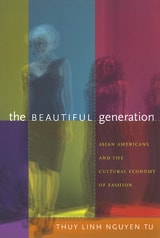
The Beautiful Generation
Asian Americans and the Cultural Economy of FashionThuy Linh Nguyen Tu
Duke University Press, 2011
Since the 1990s, young Asian Americans including Doo-Ri Chung, Derek Lam, Thakoon Panichgul, Alexander Wang, and Jason Wu have emerged as leading fashion designers. They have won prestigious awards, been chosen to head major clothing labels, and had their designs featured in Vogue, Harper’s Bazaar, and other fashion magazines. At the same time that these designers were rising to prominence, the fashion world was embracing Asian chic. During the 1990s, “Asian” shapes, fabrics, iconography, and colors filled couture runways and mass-market clothing racks. In The Beautiful Generation, Thuy Linh Nguyen Tu explores the role of Asian American designers in New York’s fashion industry, paying particular attention to how they relate to the garment workers who produce their goods and to Asianness as a fashionable commodity. She draws on conversations with design students, fashion curators, and fashion publicists; interviews with nearly thirty Asian American designers who have their own labels; and time spent with those designers in their shops and studios, on their factory visits, and at their fashion shows. The Beautiful Generation links the rise of Asian American designers to historical patterns of immigration, racial formation, and globalized labor, and to familial and family-like connections between designers and garment workers.
[more]