Results by title
6 books match the query 'Cultural Perspectives'
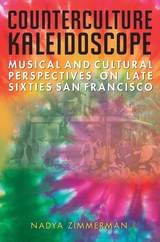
Counterculture Kaleidoscope
Musical and Cultural Perspectives on Late Sixties San FranciscoNadya Zimmerman
University of Michigan Press, 2013
In a bold reconsideration of the late sixties San Francisco counterculture movement, Counterculture Kaleidoscope takes a close look at the cultural and musical practices of that era. Addressing the conventional wisdom that the movement was grounded in rebellion and opposition, the book exposes two myths: first, that the counterculture was an organized social and political movement of progressives with a shared agenda who opposed the mainstream (dubbed "hippies"); and second, that the counterculture was an innocent entity hijacked by commercialism and transformed over time into a vehicle of so-called "hip consumerism."
Seeking an alternative to the now common narrative, Nadya Zimmerman examines primary source material including music, artwork, popular literature, personal narratives, and firsthand historical accounts. She reveals that the San Francisco counterculture wasn't interested in commitments to causes and made no association with divisive issues---that it embraced everything in general and nothing in particular.
"Astute and accessible, Counterculture Kaleidoscope provides thought-provoking insights into the historical, cultural and social context of the San Francisco counter-culture and its music scene, including discussions of Vietnam and student protest, the Haight-Ashbury Diggers, the Grateful Dead, Led Zeppelin, Altamont, and Charlie Manson. A must for students and scholars of socio-musical activity and for all of us to whom music matters."
---Sheila Whiteley, author of The Space Between the Notes: Rock and the Counter-Culture and Too Much Too Young: Popular Music, Age and Gender
"The hippie counterculture has never garnered the scholarly attention accorded the new left and the black freedom struggle. Overviews of the period ritualistically mention it as part and parcel of that apparently incandescent era---the Sixties---but rarely capture its distinctiveness. Counterculture Kaleidoscope is a timely and provocative intervention in Sixties scholarship that significantly deepens our understanding of this important but understudied phenomenon."
—Alice Echols, Associate Professor, University of Southern California, and author of Scars of Sweet Paradise: The Life and Times of Janis Joplin

Darwin's Footprint
Cultural Perspectives on Evolution in Greece (1880–1930s)Maria Zarimis
Central European University Press, 2015
Darwin’s Footprint examines the impact of Darwinism in Greece, investigating how it has shaped Greece in terms of its cultural and intellectual history, and in particular its literature.
The book demonstrates that in the late 19th to early 20th centuries Darwinism and associated science strongly influenced celebrated Greek literary writers and other influential intellectuals, which fueled debate in various areas such as ‘man’s place in nature’, eugenics, the nature-nurture controversy, religion, as well as class, race and gender.
In addition, the study reveals that many of these individuals were also considering alternative approaches to these issues based on Darwinian and associated biological post-Darwinian ideas. Their concerns included the Greek “race” or nation, its culture, language and identity; also politics and gender equality.
Zarimis’s monograph devotes considerable space to Xenopoulos (1867-1951), notable novelist, journalist and playwright.
The NFL
Critical and Cultural PerspectivesThomas Oates
Temple University Press, 2015
The National Football League is one of the most significant cultural engines in contemporary American life. Yet despite intense and near ubiquitous media coverage, commentators rarely turn a critical lens on the league to ask what material and social forces have contributed to its success, and how the NFL has influenced public life in the United States.
The editors of and contributors to The NFL examine the league as a culturally, economically, and politically powerful presence in American life. The essays, by established and up-and-coming scholars, explore how the NFL is packaged for commercial consumption, the league's influence on American identity, and its relationship to state and cultural militarism.
The NFL is the first collection of critical essays to focus attention on the NFL as a cultural force. It boldly moves beyond popular celebrations of the sport and toward a fuller understanding of football's role in shaping contemporary sport, media, and everyday life.
Contributors include: David L. Andrews, Aaron Baker, Michael Butterworth, Jacob Dittmer, Dan Grano, Samantha King, Kyle Kusz, Toby Miller, Ronald L. Mower, Dylan Mulvin, Oliver J.C. Rick, Katie Rodgers, and the editors.
The Whole Book
Cultural Perspectives on the Medieval MiscellanyStephen G. Nichols and Siegfried Wenzel, Editors
University of Michigan Press, 1996
This group of papers, edited by two well-known scholars of the medieval world, offers both general and particular approaches to the issues surrounding manuscripts produced in the medieval habit of "miscellany," works of seemingly diverse natures bound together into one volume. Julia Boffey investigates how certain poetical miscellanies came to be assembled, for example, while Sylvia Huot suggests that the miscellany had many different sorts of function and significance. Siegfried Wenzel considers a taxonomy of such collections, and A. S. G. Edwards' paper considers Bodleian Selden B.24 as an example of how the notions of canon, authorship, and attribution might come into play. Ann Matter's final chapter offers the notion that what we call "miscellanies" are likely to have an internal logic that we have been trained to miss, but can come to understand. Other contributors are Ralph Hanna III, Georg Knauer, Stephen Nichols, James J. O'Donnell, and Barbara A. Shailor.
Because The Whole Book deals not only with the content of miscellanies but also with contemporary literary principles, this volume will be of interest to a wide circle of literary critics and historians, as well as to students of the survival of literature and of cultural values.
Stephen G. Nichols is James M. Beall Professor of French and Chair of the Department of French, The Johns Hopkins University. Siegfried Wenzel is Professor of English, University of Pennsylvania.

To Have and To Hit
CULTURAL PERSPECTIVES ON WIFE BEATINGEdited by Dorothy Ayers Counts, Judith K. Brown, and Jacquelyn C. Campbell
University of Illinois Press, 1999
Transmitting the Past
Historical and Cultural Perspectives on BroadcastingEdited by J. Emmett Winn and Susan L. Brinson
University of Alabama Press, 2005
Original essays exploring important developments in radio and television broadcasting
The essays included in this collection represent some of the best cultural and historical research on broadcasting in the U. S. today. Each one concentrates on a particular event in broadcast history—beginning with Marconi’s introduction of wireless technology in 1899.
Michael Brown examines newspaper reporting in America of Marconi's belief in Martians, stories that effectively rendered Marconi inconsequential to the further development of radio. The widespread installation of radios in automobiles in the 1950s, Matthew Killmeier argues, paralleled the development of television and ubiquitous middle-class suburbia in America. Heather Hundley analyzes depictions of male and female promiscuity as presented in the sitcom Cheers at a time concurrent with media coverage of the AIDS crisis. Fritz Messere examines the Federal Radio Act of 1927 and the clash of competing ideas about what role radio should play in American life. Chad Dell recounts the high-brow programming strategy NBC adopted in 1945 to distinguish itself from other networks. And George Plasketes studies the critical reactions to Cop Rock, an ill-fated combination of police drama and musical, as an example of society's resistance to genre-mixing or departures from formulaic programming.
The result is a collection that represents some of the most recent and innovative scholarship, cultural and historical, on the intersections of broadcasting and American cultural, political, and economic life.