Results by title
12 books match the query 'Cultural relations'
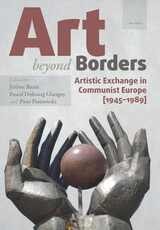
Art beyond Borders
Artistic Exchange in Communist Europe (1945-1989)Jérôme Bazin
Central European University Press, 2016
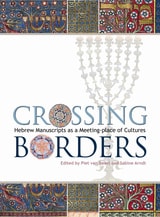
Crossing Borders
Hebrew Manuscripts as a Meeting-place of CulturesEdited by Piet van Boxel and Sabine Arndt
Bodleian Library Publishing, 2010
Crossing Borders tells the intriguing but largely unfamiliar story of the exchange of culture and knowledge between Jews and non-Jews in the Muslim and Christian worlds during the late Middle Ages as part of the preparation of Hebrew manuscripts. The book is composed of ten narratives, each of which brings to light a different aspect of Jewish life in a non-Jewish medieval society—highlighting the practical cooperation, social interaction, and religious toleration that was surprisingly common between the groups involved in the early enterprise of book production.
Alongside the narratives, Crossing Borders is beautifully illustrated with images from the Hebrew holdings at the Bodleian Library—one of the largest and most important collections of Hebrew manuscripts worldwide. The art includes Christian codex fragments from the third century, a copy of Moses Maimonides’ Mishneh Torah signed by Maimonides himself, a thirteenth century German Jewish prayer book, and lavishly illuminated Spanish Bible manuscripts from the fifteenth century. This exquisitely illustrated book takes a fascinating look at the often-ignored role of Jews in the written transmission of culture and science throughout medieval Europe.
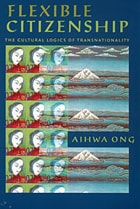
Flexible Citizenship
The Cultural Logics of TransnationalityAihwa Ong
Duke University Press, 1998
Explaining how intensified travel, communications, and mass media have created a transnational Chinese public, Aihwa Ong argues that previous studies have mistakenly viewed transnationality as necessarily detrimental to the nation-state and have ignored individual agency in the large-scale flow of people, images, and cultural forces across borders. She describes how political upheavals and global markets have induced Asian investors, in particular, to blend strategies of migration and of capital accumulation and how these transnational subjects have come to symbolize both the fluidity of capital and the tension between national and personal identities. Refuting claims about the end of the nation-state and about “the clash of civilizations,” Ong presents a clear account of the cultural logics of globalization and an incisive contribution to the anthropology of Asia-Pacific modernity and its links to global social change.
This pioneering investigation of transnational cultural forms will appeal to those in anthropology, globalization studies, postcolonial studies, history, Asian studies, Marxist theory, and cultural studies.

Myth, Magic, and Farce
Four Multicultural Plays by Sterling HoustonSterling Houston
University of North Texas Press, 2005

Practices of Coexistence
Constructions of the Other in Early Modern PerceptionsMarianna D. Birnbaum
Central European University Press, 2017
Re-Mapping Centre and Periphery
Asymmetrical Encounters in European and Global ContextsEdited by Tessa Hauswedell, Axel Körner, and Ulrich Tiedau
University College London, 2019
Rituals Of Mediation
International Politics And Social MeaningFrancois Debrix
University of Minnesota Press, 2003
A timely consideration of the meaning of transnational cultural interactions today
In an era of increasing globalization, the cultural and the international have borders as permeable as most nations’s—and an understanding of one requires making sense of the other. Foregrounding the role of mediation—understood here as a site of representation, transformation, and pluralization—the authors engage two specific questions: How might we make theoretical and practical sense of transnational cultural interactions? And how are we to understand the ways in which the sites of mediation represent, transform, and remediate internationals? Accordingly, the authors consider international issues like security, development, political activism, and the war against terrorism through the lens of cultural practices such as traveling through airports, exhibiting art and photography, logging on to the Internet, and spinning news stories.
Contributors: Robin Brown, U of Leeds; David Campbell, U of Newcastle upon Tyne; Michael Dillon, U of Lancaster; Debbie Lisle, Queen’s U, Belfast; Moya Lloyd, Queen’s U, Belfast; Timothy W. Luke, Virginia Polytechnic Institute and State U; Patricia L. Price, Florida International U; Jayne Rodgers, U of Leeds; Marysia Zalewski, Queen’s U, Belfast.
Russian-American Dialogue on Cultural Relations, 1776-1914
Edited by Norman E. Saul & Richard D. McKinzie
University of Missouri Press, 1996
Russian-American Dialogue on Cultural Relations, 1776-1914, the third volume in the Russian-American Dialogues series, provides English translations of the best Russian scholarship on cultural relations. Each essay originally appeared as an article in the former Soviet Union. Five issues are discussed: the contributions that each country made to the cultural life of the other; the correspondence and interactions between scientists, writers, and others from the two nations; the development of public perceptions and how these changed over time; the "American focus" in Russian periodicals during the nineteenth century; and the significant roles of Russians and the Russian presence in American history. The Russian articles on each of these subjects are followed by comments from American historians.
The articles by the Russian scholars make extensive use of and liberally cite material from Russian archives and publications. As a result, they provide American readers with new scientific exchanges, personalities, and points of view. The result is a plethora of new material for Western historians of Russia as well as of the United States. The book provides an opportunity for scholars to examine more thoroughly the relevant issues of Russian-American cultural relations.
An important scholarly contribution, Russian-American Dialogue on Cultural Relations, 1776-1914 brings a new dimension to the relationship between the United States and Russia before 1914. It will be of interest not only to historians of this period but to all historians and students of international cultural relations.

Savage Kin
Indigenous Informants and American AnthropologistsMargaret M. Bruchac
University of Arizona Press, 2018
This book reconceptualizes the intimate details of encounters with Native interlocutors who by turns inspired, facilitated, and resisted the anthropological enterprise. Like other texts focused on this era, Savage Kin features some of the elite white men credited with salvaging material that might otherwise have been lost. Unlike other texts, this book highlights the intellectual contributions and cultural strategies of unsung Indigenous informants without whom this research could never have taken place.
These bicultural partnerships transgressed social divides and blurred the roles of anthropologist/informant, relative/stranger, and collector/collected. Yet these stories were obscured by collecting practices that separated people from objects, objects from communities, and communities from stories. Bruchac’s decolonizing efforts include “reverse ethnography”—painstakingly tracking seemingly unidentifiable objects, misconstrued social relations, unpublished correspondence, and unattributed field notes—to recover this evidence. Those early encounters generated foundational knowledges that still affect Indigenous communities today.
Savage Kin also contains unexpected narratives of human and other-than-human encounters—brilliant discoveries, lessons from ancestral spirits, prophetic warnings, powerful gifts, and personal tragedies—that will move Native and non-Native readers alike.
The Cultures of Globalization
Fredric Jameson and Masao Miyoshi, eds.
Duke University Press, 1998
Discussing overlapping themes of transnational consequence, the contributors to this volume describe how the global character of technology, communication networks, consumer culture, intellectual discourse, the arts, and mass entertainment have all been affected by recent worldwide trends. Appropriate to such diversity of material, the authors approach their topics from a variety of theoretical perspectives, including those of linguistics, sociology, economics, anthropology, and the law. Essays examine such topics as free trade, capitalism, the North and South, Eurocentrism, language migration, art and cinema, social fragmentation, sovereignty and nationhood, higher education, environmental justice, wealth and poverty, transnational corporations, and global culture. Bridging the spheres of economic, political, and cultural inquiry, The Cultures of Globalization offers crucial insights into many of the most significant changes occurring in today’s world.
Contributors. Noam Chomsky, Ioan Davies, Manthia Diawara, Enrique Dussel, David Harvey, Sherif Hetata, Fredric Jameson, Geeta Kapur, Liu Kang, Joan Martinez-Alier, Masao Miyoshi, Walter D. Mignolo, Alberto Moreiras, Paik Nak-chung, Leslie Sklair, Subramani, Barbara Trent
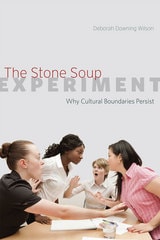
The Stone Soup Experiment
Why Cultural Boundaries PersistDeborah Downing Wilson
University of Chicago Press, 2015
The experience of the Stoners and Traders is a profound testament to human sociality. Even in the form of simulation, even as a game, the participants found themselves quickly—and with real conviction—bound to the ideologies and practices of their in-group. The Stoners enjoyed their days lounging, chatting, and making crafts, while the Traders—through a complex market of playing cards—competed for the highest bankrolls. When they came into contact, misunderstanding, competition, and even manipulation prevailed, to the point that each group became so convinced of its own superiority that even after the simulation’s end the students could not reconcile.
Throughout her riveting narrative, Downing Wilson interweaves fascinating discussions on the importance of play, emotions, and intergroup interaction in the formation and maintenance of group identities, as well as on the dynamic social processes at work when different cultural groups interact. A fascinating account of social experimentation, the book paints a vivid portrait of our deepest social tendencies and the powers they have over how we make friends and enemies alike.
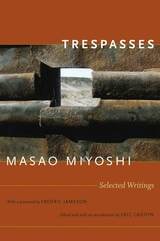
Trespasses
Selected WritingsMasao Miyoshi
Duke University Press, 2010
This volume brings together eleven selections of Miyoshi’s previously published writing, a major new essay, a critical introduction to his life and work, and an interview in which Miyoshi reflects on the trajectory of his thought and the institutional history of modern Japan studies. In the new essay, “Literary Elaborations,” he provides a masterful overview of the nature of the contemporary university, closing with a call for a global environmental protection studies that would radically reconfigure academic disciplines and merge the hard sciences with the humanities and the social sciences. In the other, chronologically arranged selections, Miyoshi addresses cross-culture relations between Japan and the United States, English literary studies in Japan, and Japan studies in the U.S., as well as the organization of urban space and the integrity of art and architecture in aggressively marketed-oriented environments. Trespasses is an invaluable introduction to the work of a fearless cultural critic.