Results by title
9 books match the query 'Curet, L. Antonio'
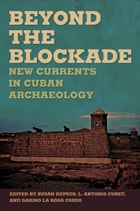
Beyond the Blockade
New Currents in Cuban ArchaeologyEdited by Susan Kepecs, L. Antonio Curet, and Gabino La Rosa Corzo
University of Alabama Press, 2011
An important collection of essays and scholarship by Cuban archaeologists about precontact human settlement on the island.
An important and timely collection of essays that greatly expands knowledge of the human settlement of Cuba and the activities of its indigenous peoples. The collection is a testament to the tenacity of Cuban and US scholars determined to dismantle the political and economic barriers that have impeded collaborative archaeological scholarship in Cuba. Despite economic and political challenges that have limited the pursuit of archaeological research in Cuba, these essays show that Cuban archaeology has made valuable contributions to understanding the cultural processes that have shaped life in the Caribbean in both prehispanic and historic periods and added significantly to our understanding of past Cuban peoples.
The collection, one of only a few studies of Cuban archaeology published in English in the United States, includes essays by both Cuban and US scholars that highlight trends in Cuban archaeology. It recognizes the past pioneers of joint Cuban-US archaeological projects and pays homage to those researchers, including Betty Meggers and Lourdes Dominguez, who sustained scholarly contact across the Florida Straits despite geopolitical roadblocks.
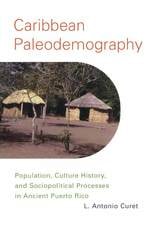
Caribbean Paleodemography
Population, Culture History, and Sociopolitical Processes in Ancient Puerto RicoL. Antonio Curet
University of Alabama Press, 2005
Unearthing the demographic past of the Caribbean to illuminate its cultural origins and transformations.
According to the European chronicles, at the time of contact, the Greater Antilles were inhabited by the Taino or Arawak Indians, who were organized in hierarchical societies. Since its inception Caribbean archaeology has used population as an important variable in explaining many social, political, and economic processes such as migration, changes in subsistence systems, and the development of institutionalized social stratification.
In Caribbean Paleodemography, L. Antonio Curet argues that population has been used casually by Caribbean archaeologists and proposes more rigorous and promising ways in which demographic factors can be incorporated in our modeling of past human behavior. He analyzes a number of demographic issues in island archaeology at various levels of analysis, including inter- and intra-island migration, carrying capacity, population structures, variables in prehistory, cultural changes, and the relationship with material culture and social development. With this work, Curet brings together the diverse theories on Greater Antilles island populations and the social and political forces governing their growth and migration.
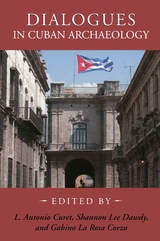
Dialogues in Cuban Archaeology
Edited by L. Antonio Curet, Shannon Lee Dawdy, and Gabino La Rosa Corzo
University of Alabama Press, 2005
A critical, dialogic examination of Cuban and Caribbean archaeology, advancing contemporary interpretations of heritage and identity.
Many Americans are aware of the political, economic, and personal impacts of the U.S. embargo on Cuba. But the communication blockade between scholars has also affected the historical course of academic disciplines and research in general. With the easing of restrictions in the 1990s, academics are now freer to conduct research in Cuba, and the Cuban government has been more receptive to collaborative projects.
This volume provides a forum for the principal Cuban and American archaeologists to update the current state of Cuban archaeological research--from rock art and potsherds to mortuary practices and historical renovation--thereby filling in the information gap created by the political separation. Each group of researchers brings significant new resources to the effort, including strong conservation regulations, innovative studies of lithic and shell assemblages, and transculturation theories. Cuban research on the hacienda system, slavery, and urban processes has in many ways anticipated developments in North American archaeology by a decade or more. Of special interest are the recent renovation projects in Old Havana that fully integrate the work of historians, architects, and archaeologists--a model project conducted by agreement between the Cuban government and UNESCO.
The selection of papers for this collection is based on a desire to answer pressing research questions of interest for North American Caribbeanists and to present a cross-section of Cuban archaeological work. With this volume, then, the principal players present results of recent collaborations and begin a renewed conversation, a dialogue, that can provide a foundation for future coordinated efforts.
Islands at the Crossroads
Migration, Seafaring, and Interaction in the CaribbeanL. Antonio Curet
University of Alabama Press, 2011
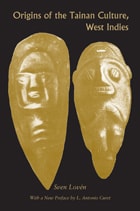
Origins of the Tainan Culture, West Indies
Sven Loven, with a new preface by L. Antonio Curet
University of Alabama Press, 2010
When originally published in German in 1924, this volume was hailed as the first modern, comprehensive archaeological overview of an emerging area of the world. Yes, the Caribbean islands had long been known and owned, occupied, or traded among by the economically advanced nations of the world. However, the original inhabitants—as well as their artifacts, languages, and culture—had been treated by explorers and entrepreneurs alike as either slaves or hindrances to progress, and were used or eliminated. There was no publication that treated seriously the region and the peoples until this work. In the following ten years, additional pertinent publications emerged, along with a request to translate the original into Spanish. Based on those recent publications, Loven decided to update and reissue the work in English, which he thought to be the future international language of scholarship. This work is a classic, with enduring interpretations, broad geographic range, and an eager audience.
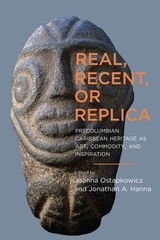
Real, Recent, or Replica
Precolumbian Caribbean Heritage as Art, Commodity, and InspirationEdited by Joanna Ostapkowicz and Jonathan A. Hanna
University of Alabama Press, 2021
A CHOICE OUTSTANDING ACADEMIC TITLE, 2022
Examines the largely unexplored topics in Caribbean archaeology of looting of heritage sites, fraudulent artifacts, and illicit trade of archaeological materials
Real, Recent, or Replica: Precolumbian Caribbean Heritage as Art, Commodity, and Inspiration is the first book-length study of its kind to highlight the increasing commodification of Caribbean Precolumbian heritage. Amerindian art, including “Taíno” art, has become highly coveted by collectors, spurring a prolific and increasingly sophisticated black market of forgeries, but also contemporary artistic engagement, openly appreciated as modern artworks taking inspiration from the past. The contributors to this volume contend with difficult subject matter including the continued looting of archaeological sites in the region, the seismic increase of forgeries, and the imbalance of power and economic relations between the producers and consumers of neo-Amerindian art.
The case studies document the considerable time depth of forgeries in the region (since the late nineteenth century), address the policies put in place by Caribbean governments and institutions to safeguard national patrimony, and explore the impact looted and forged artifacts have on how museums and institutions collect and ultimately represent the Caribbean past to their audiences. Overall, the volume emphasizes the continued desire for the “authentic” Precolumbian artifact, no matter the cost. It provides insights for archaeologists, museum professionals, art historians, and collectors to combat illegal trade and support communities in creating sustainable heritage industries.
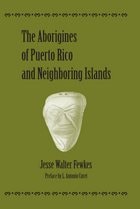
The Aborigines of Puerto Rico and Neighboring Islands
Jesse Walter Fewkes
University of Alabama Press, 2009
Originally published as the Twenty-Fifth Annual Report of the Bureau of American Ethnology to the Secretary of the Smithsonian Institution in 1907, this book was praised in an article in American Anthropologist as doing “more than any other to give a comprehensive idea of the archaeology of the West Indies.”
Until that time, for mainly political reasons, little scientific research had been conducted by Americans on any of the Caribbean islands. Dr. Fewkes' unique skills of observation and experience served him well in the quest to understand Caribbean prehistory and culture. This volume, the result of his careful fieldwork in Puerto Rico in 1902-04, is magnificently illustrated by 93 plates and 43 line drawings of specimens from both public and private collections of the islands.
A 1907 article in the Journal of the Royal Anthropological Institute of Great Britain and Ireland described the volume as “a most valuable contribution to ethnographical science.”
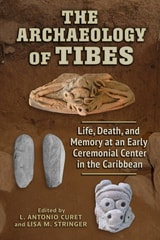
The Archaeology of Tibes
Life, Death, and Memory at an Early Ceremonial Center in the CaribbeanEdited by L. Antonio Curet and Lisa M. Stringer
University of Alabama Press, 2025
A collection of new essays that brings archaeological insights and discoveries at the Tibes Ceremonial Center up to date
The Archaeology of Tibes is a collection of essays offering a fresh analysis of this important ceremonial center. It brings new insights about social structure, illuminating the smaller-scale daily lives of ancient peoples rather than focusing on large-scale chiefdoms.
Tibes is the earliest known (ca. 400 to 1300 CE) ceremonial center in Puerto Rico. It has been the focus of one of the largest and longest-running archaeological programs in the Caribbean. Early researchers interpreted evidence in the area of a shift from dispersed villages to a ceremonial center as suggesting the development of social stratification and accumulation of power. Seen as the seat of an early chiefdom, Tibes served as a model applied broadly across the Greater Antilles.
New discoveries prompted archaeologists to question their original assumptions about ancient Puerto Rico, and later research failed to produce evidence of social stratification at Tibes. The Archaeology of Tibes therefore incorporates updated and wider perspectives on social formation. It considers agency, decisions, and events and the possibility of more than one form of social organization. It also presents a more accurate “humanized” past: the sociological meanings of that space and its significance for the people who created, used, and occupied it and who influenced rituals, social memory, and community.
Summarizing findings from excavations at Tibes after 2010, the collection also reviews the geoarchaeology of the site. Additional essays cover ceramic pastes, lithic production, faunal remains, coral, burials, and rock art. This work will engender discussion and future research by archaeologists across the Caribbean and beyond.
Tibes
People, Power, and Ritual at the Center of the CosmosEdited by L. Antonio Curet and Lisa M. Stringer
University of Alabama Press, 2009
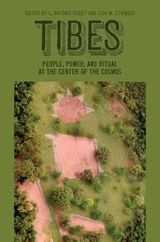
The prehistoric civic-ceremonial center of Tibes is located on the southern coast of Puerto Rico, just north of the modern coastal city of Ponce. Protected on two sides by a river, and on the other two sides by hills, this approximately 10.5-acre site remains as fertile and productive today as when first occupied over 2,000 years ago. Such a rich region would have been a choice location for native peoples because of the diversity in all resources, from land, air, and sea--and also symbolically crucial as a liminal space within the landscape. It may have been regarded as a space charged with numen or cosmic energy where different parts of the cosmos (natural vs. supernatural, or world of the living vs. world of the dead) overlap. Archaeological evidence reveals a long occupation, about 1,000 years, possibly followed by an extensive period of sporadic ceremonial use after the site itself was practically abandoned.
In this volume, nineteen Caribbeanists, across a wide academic spectrum, examine the geophysical, paleoethnobotanical, faunal, lithics, base rock, osteology, bone chemistry and nutrition, social landscape, and ceremonial constructs employed at Tibes. These scholars provide a concise, well-presented, comprehensive analysis of the evidence for local level changes in household economy, internal organization, accessibility to economic, religious, and symbolic resources related to the development and internal operation of socially stratified societies in the Caribbean.