Results by title
22 books match the query 'Dancing'
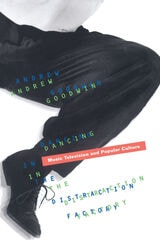
Dancing In The Distraction Factory
Music Television and Popular CultureAndrew Goodwin
University of Minnesota Press, 1992
Cultural Studies
“Entertaining proof that good sense means good theory, this book is the first to treat music TV as vision and sound. Academically, I had most fun applauding Andrew Goodwin’s elegant skewering of postmodernists; as a rock fan I was constantly startled by Goodwin’s exposes of my most deeply held prejudices. I’m now convinced; there’s much more to MTV than meets the eye.”Simon FrithThe John Logie Baird Centre“Dancing in the Distraction Factory is the best study of MTV I have read. At a time when many critics dismiss music videos either as advertisements for interchangeable commodities or as tiny, soundless movies, Goodwin manages both to analyze the business components of this new medium and also to take videos seriously as complex cultural texts involving music, visuals, stars, and much else. Dancing in the Distraction Factory is a smart book; it will have an impact on the debates surrounding popular culture, and also offers a great deal that will interest the pop music fan.”Susan McClaryMcGill University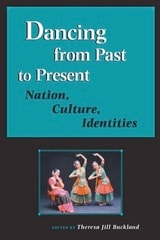
Dancing from Past to Present
Nation, Culture, IdentitiesEdited by Theresa Jill Buckland
University of Wisconsin Press, 2007
Dancing in Odessa
Ilya Kaminsky
Tupelo Press, 2004
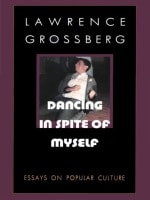
Dancing in Spite of Myself
Essays on Popular CultureLawrence Grossberg
Duke University Press, 1997
In the course of conducting this exploration into the meaning of "popularity," he investigates the nature of fandom, the social effects of rock music and youth culture, and the possibilities for understanding the history of popular texts and practices. Describing what he calls "the postmodernity of everyday life," Grossberg offers important insights into the relation of pop music to issues of postmodernity and inton the growing power of the new cultural conservatism and its relationship to "the popular." Exploring the limits of existing theories of hegemony in cultural studies, Grossberg reveals the ways in which popular culture is being mobilized in the service of economic and political struggles. In articulating his own critical practice, Grossberg surveys and challenges some of the major assumptions of popular culture studies, including notions of domination and resistance, mainstream and marginality, and authenticity and incorporation.
Dancing in Spite of Myself provides an introduction to contemporary theories of popular culture and a clear statement of relationships among theories of the nature of rock music, postmodernity, and conservative hegemony.
Dancing in the Movies
Robert Boswell
University of Iowa Press, 1986
Encompassing a vast gamut of personalities, situations, and emotions, these stories penetrate our motives for doing what is right. Often there is no right or wrong, and the characters' motives for the choices they make are as diverse as the childhood memories they cherish and abhor. In the end, this book probes individual impulse and responsibility, creating stories so unerringly authentic that they become—irrepressibly—part of everyone who reads them.
"The Darkness of Love" narrates three days in the life of a black policeman, distressed by his inner fears of racism and irresistibly attracted by his wife's sister. In "Dancing in the Movies" a college student returns to his hometown, where he finds his girlfriend—a heroin addict—and tries to convince her to overcome her habit. There are stories of men at war, of lovers trying to begin a relationship, of others trying to sustain their love. Each story revolves around characters with a choice to make, and Robert Boswell renders these characters in all of their fine, vulnerable, and relentless attributes.
With this prize-winning collection, Boswell proves himself a mature craftsperson, weaving stories both poignant and profound. Each story is a vision of life, alternately dark and joyous, gritty and hopeful.
Dancing on Blades
Rare and Exquisite Folktales from the Carpathian MountainsCsenge Virág Zalka
Parkhurst Brothers, Inc., 2018
Dancing on Violent Ground
Utopia as Dispossession in Euro-American Theater DanceArabella Stanger
Northwestern University Press, 2021
Developing a new theory of choreographic space, Arabella Stanger shows how embodied forms of hope promised in ballet and progressive dance modernisms conceal and depend on spatial operations of imperial, colonial, and racial subjection. Stanger unearths dance’s violent ground by interrogating the expansionist fantasies of Marius Petipa’s imperial ballet, settler colonial and corporate land practices in the modern dance of Martha Graham and George Balanchine, reactionary discourses of the human in Rudolf von Laban’s and Oskar Schlemmer’s movement geometries; Merce Cunningham’s experimentalism as a white settler fantasy of the land of the free, and the imperial amnesia of Boris Charmatz’s interventions into metropolitan museums. Drawing on materialist thought, critical race theory, and indigenous studies, Stanger ultimately advocates for dance studies to adopt a position of “critical negativity,” an analytical attitude attuned to how dance’s exuberant modeling of certain forms of life might provide cover for life-negating practices. Bold in its arguments and rigorous in its critique, Dancing on Violent Ground asks how performance scholars can develop a practice of thinking hopefully, without expunging history from their site of analysis.
Dancing on the Fault Lines of History
Selected EssaysSusan Manning
University of Michigan Press, 2025
Like the artists at the center of her research, Manning’s writing dances on the fault lines of history. Her introduction and annotations to the essays reflect on how and why these keywords became central to her research, revealing the autobiographical resonances of her scholarship as she confronts the cultural politics of the late twentieth and early twenty-first centuries.
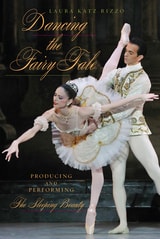
Dancing the Fairy Tale
Producing and Performing The Sleeping BeautyLaura Katz Rizzo
Temple University Press, 2015
Using extensive archival research, dance analysis, and American feminist theory, Dancing the Fairy Tale places women at the center of a historical narrative to reveal how the production and performance of The Sleeping Beauty in the years between 1937 and 2002 made significant contributions to the development and establishment of an American classical ballet. Katz Rizzo highlights not only what women have done not only behind the scenes, as administrators, producers, or directors of ballet companies and schools, but also as active interpreters embodying the ballet's title role.
In the process, Katz Rizzo also emphasizes the importance of regional sites outside of locations traditionally understood as central to the development of ballet in the United States.
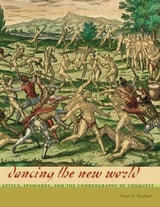
Dancing the New World
Aztecs, Spaniards, and the Choreography of ConquestBy Paul A. Scolieri
University of Texas Press, 2013
Winner, Oscar G. Brockett Book Prize in Dance Research, 2014
Honorable Mention, Sally Banes Publication Prize, American Society for Theatre Research, 2014
de la Torre Bueno® Special Citation, Society of Dance History Scholars, 2013
From Christopher Columbus to “first anthropologist” Friar Bernardino de Sahagún, fifteenth- and sixteenth-century explorers, conquistadors, clerics, scientists, and travelers wrote about the “Indian” dances they encountered throughout the New World. This was especially true of Spanish missionaries who intensively studied and documented native dances in an attempt to identify and eradicate the “idolatrous” behaviors of the Aztec, the largest indigenous empire in Mesoamerica at the time of its European discovery.
Dancing the New World traces the transformation of the Aztec empire into a Spanish colony through written and visual representations of dance in colonial discourse—the vast constellation of chronicles, histories, letters, and travel books by Europeans in and about the New World. Scolieri analyzes how the chroniclers used the Indian dancing body to represent their own experiences of wonder and terror in the New World, as well as to justify, lament, and/or deny their role in its political, spiritual, and physical conquest. He also reveals that Spaniards and Aztecs shared an understanding that dance played an important role in the formation, maintenance, and representation of imperial power, and describes how Spaniards compelled Indians to perform dances that dramatized their own conquest, thereby transforming them into colonial subjects. Scolieri’s pathfinding analysis of the vast colonial “dance archive” conclusively demonstrates that dance played a crucial role in one of the defining moments in modern history—the European colonization of the Americas.
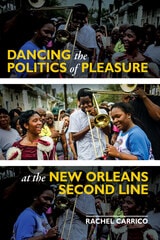
Dancing the Politics of Pleasure at the New Orleans Second Line
Rachel Carrico
University of Illinois Press, 2024
On many Sundays, Black New Orleanians dance through city streets in Second Lines. These processions invite would-be spectators to join in, grooving to an ambulatory brass band for several hours. Though an increasingly popular attraction for tourists, parading provides the second liners themselves with a potent public expression of Black resistance.
Rachel Carrico examines the parading bodies in motion as a form of negotiating and understanding power. Seeing pleasure as a bodily experience, Carrico reveals how second liners’ moves link joy and liberation, self and communal identities, play and dissent, and reclamations of place. As she shows, dancers’ choices allow them to access the pleasure of reclaiming self and city through motion and rhythm while expanding a sense of the possible in the present and for the future.
In-depth and empathetic, Dancing the Politics of Pleasure at the New Orleans Second Line blends analysis with a chorus of Black voices to reveal an indelible facet of Black culture in the Crescent City.

Dancing to Transform
How Concert Dance Becomes Religious in American ChristianityEmily Wright
Intellect Books, 2020
In response to a scarcity of writings on the intersections between dance and Christianity, Dancing to Transform examines the religious lives of American Christians who, despite the historically tenuous place of dance within Christianity, are also professional dancers.
Through a multi-site study of four professional dance companies, Wright conducted participant-observations and ethnographic interviews with artistic directors, choreographers, and company members who self-identify as Christian. She then analyzed choreography from each company to determine how concert dance becomes religious and what effects danced religious practices have for these participants. Her research reveals that the participants turn what they perceive as secular professional dance into different kinds of religious practices in order to actualize individual and communal religious identities—they dance to transform.
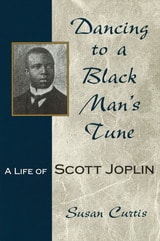
Dancing to a Black Man's Tune
A Life of Scott JoplinSusan Curtis
University of Missouri Press, 1994
By using Scott Joplin's life as a window onto American social and cultural development at the turn of the century, this biography dramatizes the role of one brilliant African American musician in defining the culture of a still-young nation.
Dancing with Parkinson's
Sara Houston
Intellect Books, 2019
Presenting personal narratives from a study that investigates the experience of people with Parkinson’s who dance, intertwined with the social and political contexts in which the dancers live, this volume examines the personal and systemic issues as well as the attitudes and identities that shape people’s relationship to dance. Taking this new primary research as a starting point, Dancing with Parkinson’s builds an argument for how dance becomes a way of helping people live well with Parkinson’s.
Dancing with Poets
Reed Turchi
University Press of Colorado, 2026
Reed Turchi’s debut collection, Dancing with Poets, explores what it means to make—and re-make—oneself amid a swirl of love, loss, and memory. In dive bars and art museums, baseball stadiums and blues clubs, Turchi summons his ghosts and invites them to sing their songs. A Grammy Award–winning musician as well as poet, Turchi is guided by finely honed rhythm and a singular sonic sensibility that coaxes music from poems that are narrative and lyric in turn. As a collection, Dancing with Poets remembers those the author has loved and lost, but avoids nostalgia, asking instead what futures may be built from grief and how love may grow on the other side of devastation. While the poems may swirl, their emotional truth remains crystalline: The characters, moments, and stories in each poem are infinitely recognizable—fantastic and quotidian in equal measure. Within these poems there are chicken tenders and high art, motorcycles and funerals—a familiar boyhood that happened to be spent surrounded by some of the finest American poets of the late twentieth century. In Dancing with Poets, Turchi invites his reader to join him—“to strut and spin” in grief and joy alike.
Dancing with Poets
Reed Turchi
University Press of Colorado, 2026
Reed Turchi’s debut collection, Dancing with Poets, explores what it means to make—and re-make—oneself amid a swirl of love, loss, and memory. In dive bars and art museums, baseball stadiums and blues clubs, Turchi summons his ghosts and invites them to sing their songs. A Grammy Award–winning musician as well as poet, Turchi is guided by finely honed rhythm and a singular sonic sensibility that coaxes music from poems that are narrative and lyric in turn. As a collection, Dancing with Poets remembers those the author has loved and lost, but avoids nostalgia, asking instead what futures may be built from grief and how love may grow on the other side of devastation. While the poems may swirl, their emotional truth remains crystalline: The characters, moments, and stories in each poem are infinitely recognizable—fantastic and quotidian in equal measure. Within these poems there are chicken tenders and high art, motorcycles and funerals—a familiar boyhood that happened to be spent surrounded by some of the finest American poets of the late twentieth century. In Dancing with Poets, Turchi invites his reader to join him—“to strut and spin” in grief and joy alike.
Dancing with Tears in My Eyes
Gerald Stern
University of Iowa Press, 2014
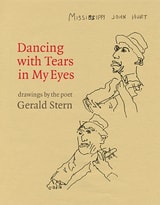
Long recognized as one of the most original poets in America, Stern is known for his tragi-comic, irascible vision that has been vividly rendered in hundreds of poems. All along, he has also been drafting these whimsical sketches. The Thurber-esque drawings represented here are daft, graphic expressions of Stern’s fearless and shameless sense of self.
In addition to expressing a forgiving and cavalier attitude toward aging, these saucy drawings, until now a well-kept secret of Stern’s creative life, capture something essential about his character. By turns profane and playfully romantic, they are another expression of the cutting wit and inimitable charm of Gerald Stern.
Dancing with the Dead
Memory, Performance, and Everyday Life in Postwar OkinawaChristopher T. Nelson
Duke University Press, 2008
Nelson analyzes the practices of specific performers, showing how memories are recalled, bodies remade, and actions rethought as Okinawans work through fragments of the past in order to reconstruct the fabric of everyday life. Artists such as the popular Okinawan actor and storyteller Fujiki Hayato weave together genres including Japanese stand-up comedy, Okinawan celebratory rituals, and ethnographic studies of war memory, encouraging their audiences to imagine other ways to live in the modern world. Nelson looks at the efforts of performers and activists to wrest the Okinawan past from romantic representations of idyllic rural life in the Japanese media and reactionary appropriations of traditional values by conservative politicians. In his consideration of eisā, the traditional dance for the dead, Nelson finds a practice that reaches beyond the expected boundaries of mourning and commemoration, as the living and the dead come together to create a moment in which a new world might be built from the ruins of the old.

Dancing with the Devil
Society and Cultural Poetics in Mexican-American South TexasJose Limon
University of Wisconsin Press, 1994
Combining shrewd applications of current cultural theory with compelling autobiography and elegant prose, José E. Limón works at the intersection of anthropology, folklore, popular culture, history, and literary criticism. A native of South Texas, he renders a historical and ethnographic account of its rich Mexican-American folk culture. This folk culture, he shows—whether expressed through male joking rituals, ballroom polka dances, folk healing, or eating and drinking traditions—metaphorically dances with the devil, both resisting and accommodating the dominant culture of Texas.
Critiquing the work of his precursors— John Gregory Bourke, J. Frank Dobie, Jovita Gonzalez, and Americo Paredes—Limón deftly demonstrates that their accounts of Mexican-Americans in South Texas contain race, class, and gender contradictions, revealed most clearly in their accounts of the folkloric figure of the devil. Limón's own field-based ethnography follows, and again the devil appears as a recurrent motif, signaling the ideological contradictions of folk practices in a South Texas on the verge of postmodernity.
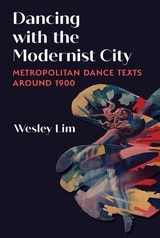
Dancing with the Modernist City
Metropolitan Dance Texts around 1900Wesley Lim
University of Michigan Press, 2024
Drawing on cultural, literary, dance, performance, and queer studies, Dancing with the Modernist City analyzes an array of material from 1896 to 1914—essays, novels, short stories, poetry, newspaper articles, photographs, posters, drawings, and early film. It argues that these writers and artists created a genre called the metropolitan dance text, which depicts dancing figures not on a traditional stage, but with the streets, advertising pillars, theaters, cafes, squares, and even hospitals of an urban setting. Breaking away from the historically male, heteronormative view, this posthumanist mode of writing highlights the visual and episodic unexpectedness of urban encounters. These literary depictions question traditional conceptualizations of space and performance by making the protagonist and the reader feel like they embody the dancer and the movement. In doing so, they upset the conventional depictions of performance and urban spaces in ways paralleling modern dance.

Dancing with the Zapatistas
Diana Taylor and Lorie Novak, editors
Duke University Press, 0
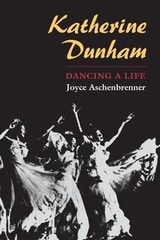
Katherine Dunham
DANCING A LIFEJoyce Aschenbrenner
University of Illinois Press, 2002
Founder of the first self-supporting African American dance company, Dunham relied on her fieldwork as an anthropologist to fundamentally change modern dance. She shaped new dance techniques and introduced other cultures to U.S. and European audiences by fusing Caribbean and African-based movement with ballet and modern dance. Her revolutionary approaches to dance and its greater connection to the world have influenced a generation of dancers, theatrical performers, and scholars. She believes that dance involves the development of an entire person and the rituals and traditions of dance are integral to the study of culture. Throughout her career she has been a living model of the socially responsible artist working to whet cultural appetites and combat social injustice.
Joyce Aschenbrenner's multifaceted portrait blends personal observations based on her own interactions with Dunham, archival documents, and interviews with Dunham's colleagues, students, and members of the Katherine Dunham Dance Company.
Integrating these sources, Aschenbrenner characterizes the social, familial, and cultural environment of Dunham's upbringing and the intellectual and artistic community she embraced at the University of Chicago that laid the groundwork for her development as a dancer, anthropologist, and humanitarian. The book vividly depicts Dunham's and her dancers' touring experiences and includes detailed descriptions of her community cultural and educational programs in East St. Louis.