Results by title
3 books match the query 'Darío, Rubén'
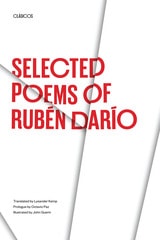
Selected Poems of Rubén Darío
By Rubén Darío
University of Texas Press, 1965
Toward the close of the last century, the poetry of the Spanish-speaking world was pallid, feeble, almost a corpse. It needed new life and a new direction. The exotic, erratic, revolutionary poet who changed the course of Spanish poetry and brought it into the mainstream of twentieth-century Modernism was Félix Rubén García Sarmiento (1867-1916) of Nicaragua, who called himself Rubén Darío.
Since its original publication in 1965, this edition of Darío's poetry has made English-speaking readers better acquainted with the poet who, as Enrique Anderson Imbert said, "divides literary history into 'before' and 'after.'" The selection of poems is intended to represent the whole range of Darío's verse, from the stinging little poems of Thistles to the dark, brooding lines of Songs of the Argentine and Other Poems. Also included, in the Epilogue, is a transcript of a radio dialogue between two other major poets, Federico García Lorca of Spain and Pablo Neruda of Chile, who celebrate the rich legacy of Rubén Darío.
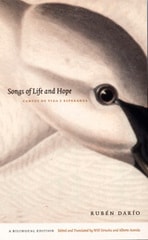
Songs of Life and Hope/Cantos de vida y esperanza
Rubén Darío
Duke University Press, 2004
Written over the course of seven years and in many locales in Latin America and Europe, the poems in Cantos de vida y esperanza reflect both Darío’s anguished sense of modern life and his ecstatic visions of transcendence, freedom, and the transformative power of art. They reveal Darío’s familiarity with Spanish, French, and English literature and the wide range of his concerns—existential, religious, erotic, and socio-political. Derusha and Acereda’s translation renders Darío’s themes with meticulous clarity and captures the structural and acoustic dimensions of the poet’s language in all its rhythmic sonority. Their introduction places this singular poet—arguably the greatest to emerge from Latin America in modern literature—and his best and most widely known work in historical and literary context. An extensive glossary offers additional information, explaining terms related to modernismo, Hispanic history, mythological allusions, and artists and writers prominent at the turn of the last century.
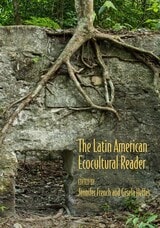
The Latin American Ecocultural Reader
Edited by Jennifer French and Gisela Heffes
Northwestern University Press, 2021
The Latin American Ecocultural Reader is a comprehensive anthology of literary and cultural texts about the natural world. The selections, drawn from throughout the Spanish-speaking countries and Brazil, span from the early colonial period to the present. Editors Jennifer French and Gisela Heffes present work by canonical figures, including José Martí, Bartolomé de las Casas, Rubén Darío, and Alfonsina Storni, in the context of our current state of environmental crisis, prompting new interpretations of their celebrated writings. They also present contemporary work that illuminates the marginalized environmental cultures of women, indigenous, and Afro-Latin American populations. Each selection is introduced with a short essay on the author and the salience of their work; the selections are arranged into eight parts, each of which begins with an introductory essay that speaks to the political, economic, and environmental history of the time and provides interpretative cues for the selections that follow.
The editors also include a general introduction with a concise overview of the field of ecocriticism as it has developed since the 1990s. They argue that various strands of environmental thought—recognizable today as extractivism, eco-feminism, Amerindian ontologies, and so forth—can be traced back through the centuries to the earliest colonial period, when Europeans first described the Americas as an edenic “New World” and appropriated the bodies of enslaved Indians and Africans to exploit its natural bounty.