Results by title
10 books match the query 'Dark Humor'
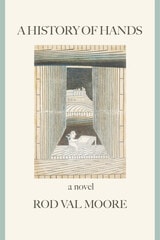
A History of Hands
A NovelRod Val Moore
University of Massachusetts Press, 2014
Soon, however, an elderly and possibly criminal doctor, offering free therapy, moves in, much to the dismay of bedridden Virge. While the physician endeavors to restore the patient's hands with a series of highly suspect injections, Virge recovers his sense of autonomy and an urge to escape the suffocating domestic circumstances that have perhaps caused his illnesses in the first place.
A History of Hands is a novel that invites the reader into a richly and eccentrically detailed world where fevered imaginations and dark comedy prevail, but where the determination to escape the ambiguities of illness leads to the equal ambiguities of health and freedom.
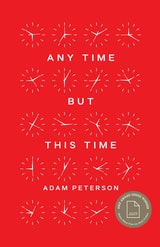
Any Time But This Time
Adam Peterson
The Ohio State University Press, 2026
The stories of Adam Peterson’s funny, daring, and deliciously outrageous debut Any Time But This Time span our history and confront our future. From the first woman on Earth grieving among the Neanderthals to the last man alive nursing the dying flame of love, this collection moves across human history and geography to reveal us at our best and lament our worst. Jesus declares himself a superhero. Lost sailors launch an ill-fated attempt to colonize medieval England. A young woman fights to commandeer the founding of America. A pioneer’s wife satisfies her endless sexual appetite in barren Nebraska. Children hurtle into space to confront alien life—even though they really, really just want love. For fans of George Saunders and Kelly Link, these voices, unbound by time and undaunted by consequence, show us that there are truly no limits to what a short story—so long as it centers our relentless human heart—can do.
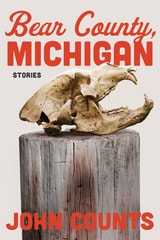
Bear County, Michigan
StoriesJohn Counts
Northwestern University Press, 2025
Following desperate characters in desperate circumstances in the rural Midwest
In these colorful, darkly comic stories, veteran journalist and crime reporter John Counts takes readers to an often-ignored part of the country: a fictional Great Lakes coastal town in northern Michigan defined by beauty and bleakness. The cast of characters in these connected stories ranges from addicts to backwoods misfits to ruined lumber families, all bound together by their desire to obtain something just out of reach. Big Frank breaks out of a rehab facility trying to outrun grief. The women in the village of Brotherhood grapple with sterility resulting from an environmental calamity. A local politician must convince her mother to leave a nudist colony. And in the final, sweeping story, a splinter group from the local tribe attempts to reclaim its ancestral land by force. The people of Bear County and their predicaments encompass the wildly original and yet totally ordinary truths about American life off the beaten track.
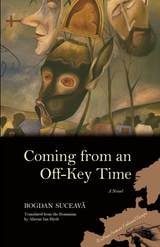
Coming from an Off-Key Time
A NovelBogdan Suceava
Northwestern University Press, 2011
The fall of communism in Eastern Europe in 1989 marked, in one famous formulation, the "end of history." In his apocalyptic novel Coming from an Off-Key Time, Bogdan Suceavă satirizes the events in his native Romania since the violent end of the Ceauşescu regime that fateful year.
Suceavă uses three interrelated narratives to illustrate the destructive power of Romanian society’s most powerful mythologies. He depicts madness of all kinds but especially religious beliefs and their perversion by all manner of outrageous sects. Here horror and humor reside impossibly in the same time and place, and readers experience the vertiginous feeling of living in the middle of a violent historical upheaval.
Even as Coming from an Off-Key Time suggests the influence of such writers as Mikhail Bulgakov, the fantastic satirist of the early Soviet Union, Suceavă engages the complexities of a quickly changing country in search of its bearings and suspicious of its past. Bogdan Suceavă is an associate professor of mathematics at California State University, Fullerton. One of Romanian literature’s most promising and original young writers, he is the author of four novels, two books of short stories, and several collections of poems.
Alistair Ian Blyth’s previous translations include Filip Florian, Little Fingers (2009); Lucian Dan Teodorovici, Our Circus Presents (2009); and Catalin Avramescu’s An Intellectual History of Cannibalism (2009).
Dear Future Occupants
Keith Stahl
University of Wisconsin Press, 2026
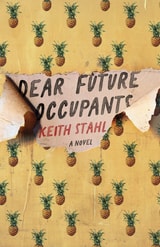
It is 1979 and patriarch Bud relocates his family to his conservative hometown of Greenhill, Connecticut. Despite dubious restaurant experience, he uses his wife’s inheritance to purchase a diner in hopes of proving himself. Things begin to fall apart when police find an all-too-literal skeleton in the family’s basement. A series of misfortunes, accidents, and comedic events follow, including the creation of a vending-machine-sandwich/drug-dealing business and a protest-turned-siege at the local hospital.
Charting one family’s rise to subversive glory in a genteel New England town, this colonial gothic novel is told through found documents and multiple perspectives, including those of Bud; Victor, the middle son; and Herman, the ahead-of-their time, nonbinary, eldest child whose journal entries serve as a kind of Greek chorus throughout. In this breathless, exuberant work, Keith Stahl brilliantly captures the foundational dichotomies at the heart of the American experience: a puritanical distrust of anything fun and a nearly anarchic love of pleasure and freedom. Moving and bitterly humorous, Dear Future Occupants is a paean to the working class and the diversity that holds a family together.
Lodgers
Nenad Velickovic
Northwestern University Press, 2005
Published as the siege of Sarajevo ended, Lodgers is a hilarious, unsentimental report from the front lines of the Balkan wars of the 1990s. Detergent mixed with flour, museum relics sold to U.N. peacekeepers, the magic power of laminated accreditation-all of the folly and the horror of that time are revealed in the sarcastic report of the novel's teenage would-be authoress.
Maja lives in the basement of a Sarajevo museum, enduring with equal annoyance Serb artillery and vegetarian meals that taste like fried sponge. Her father, the museum director, zealously guards the treasures upstairs while their aged co-lodger Julio plots to trade them away. Maja's mother copes with yoga while dour stepbrother Davor endures the endless crying and cravings of his pregnant wife. Floating amidst it all is Maja's grandmother, blind and deaf, yet drawn to any conversation involving food.
Need and crisis propel Maja and her companions from one humorous situation to another. Yet her pitch-perfect gallows humor makes it clear that the brutalities of war penetrate these small moments of life-and even the self-centeredness of a teenaged girl. A best seller in the Balkans and widely translated in Europe, Lodgers is an uncompromising novel about a modern tragedy.
Oh, Serafina!
A Fable of Ecology, Lunacy, and LoveGiuseppe Berto
Rutgers University Press, 2023
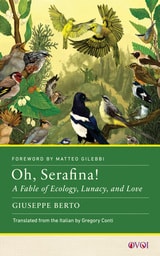
Newly translated into English, Giuseppe Berto’s charming 1973 novel Oh, Serafina! was one of the first works of Italian literature to deal with ecological themes while also questioning the destructive effects of industrial capitalism, the many forms spirituality might take, and the ways our society defines madness. This translation includes a foreword from literary scholar Matteo Gilebbi that provides biographical, historical, and philosophical context for appreciating this whimsical fable of ecology, lunacy, and love.
Performance Art
StoriesDavid Kranes
University of Nevada Press, 2021
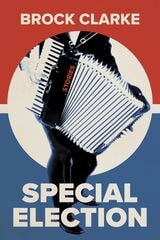
Special Election
StoriesBrock Clarke
Acre Books, 2025
In Special Election, ingenious fictions target our all-too-familiar preoccupations and vulnerabilities—belonging, (dis)engagement, the struggle for self-worth, the difficulty of loving and being loved, the banality and absurdity of existence. Brock Clarke’s rapier wit, inexhaustible imagination, and brilliant leaps of illogic transform his characters’ desperation and distress into tragicomic delight. In the title story, Lawrence Welk is ousted from heaven to run for governor in present-day North Dakota. In “One Goes Where One Is Needed,” we follow the former Provisional Coalition Administrator of post-liberation Iraq, now a youth ski instructor at Okemo Mountain in Vermont. In “The Slim Jim,” the protagonist finds himself (literally and figuratively) very slowly choking to death on a frozen microwavable burrito.
“There is something wrong with me,” states the narrator of “The Big Book of Useless Saturdays.” This could be said of all the characters in Special Election, and through loopy misdirection and mordant observation, Clarke devotes himself to showing his characters and his readers exactly what is wrong. Yet the sharpness of his attention and lavish ludicrousness of his storylines belie a sneaking affection for this imperfect, disappointing world filled with imperfect, disappointing humans. Though Clarke has been compared to such greats as Barthelme, Bellow, and Saunders, the nine stories in Special Election vibrate at a frequency all his own, showcasing the strengths of one of our most gifted comic writers.
The Last People You’d Expect
Spencer Wise
Carnegie Mellon University Press, 2027
A budding journalist and a housing advocate join forces to investigate a series of crimes spurred by an act of vandalism at the Boston Holocaust Memorial.
On the eve of the “Summer of Hate,” Mark Bergman, a young struggling Bar Mitzvah photographer trying to break into serious journalism, meets fellow tenant Annie Holt, a Catholic housing activist. The same night, across town, someone vandalizes the Boston Holocaust Memorial, which at first appears to be an isolated event, but when Mark joins Annie at an eviction protest across town, they soon discover it was a part of a more sinister and coordinated series of attacks. From the Vilna Shul in Beacon Hill down to South Carolina low country, Mark and Annie’s relationship deepens as they hunt the perpetrators and ultimately reach a point, both with each other and the crimes they’re investigating, where they must make the most difficult decisions they ever faced. Told from alternating points of view, Last People follows both Mark and Annie and a series of humorous minor characters, all of whom are searching for identity and a place in a fractured, volatile, and dangerous America. Part love story, part mystery, part coming of age, Last People is a novel about homelessness—literally, metaphorically—and the ways in which people grasp onto labels in order to find meaning and purpose in their lives even when those labels fail to adequately define them.