Results by title
20 books match the query 'Darkness'
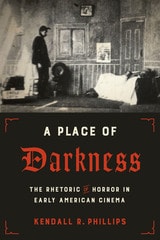
A Place of Darkness
The Rhetoric of Horror in Early American CinemaBy Kendall R. Phillips
University of Texas Press, 2018
Horror is one of the most enduringly popular genres in cinema. The term “horror film” was coined in 1931 between the premiere of Dracula and the release of Frankenstein, but monsters, ghosts, demons, and supernatural and horrific themes have been popular with American audiences since the emergence of novelty kinematographic attractions in the late 1890s. A Place of Darkness illuminates the prehistory of the horror genre by tracing the way horrific elements and stories were portrayed in films prior to the introduction of the term “horror film.”
Using a rhetorical approach that examines not only early films but also the promotional materials for them and critical responses to them, Kendall R. Phillips argues that the portrayal of horrific elements was enmeshed in broader social tensions around the emergence of American identity and, in turn, American cinema. He shows how early cinema linked monsters, ghosts, witches, and magicians with Old World superstitions and beliefs, in contrast to an American way of thinking that was pragmatic, reasonable, scientific, and progressive. Throughout the teens and twenties, Phillips finds, supernatural elements were almost always explained away as some hysterical mistake, humorous prank, or nefarious plot. The Great Depression of the 1930s, however, constituted a substantial upheaval in the system of American certainty and opened a space for the reemergence of Old World gothic within American popular discourse in the form of the horror genre, which has terrified and thrilled fans ever since.
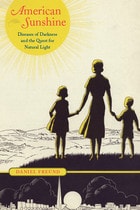
American Sunshine
Diseases of Darkness and the Quest for Natural LightDaniel Freund
University of Chicago Press, 2012
In the second half of the nineteenth century, American cities began to go dark. Hulking new buildings overspread blocks, pollution obscured the skies, and glass and smog screened out the health-giving rays of the sun. Doctors fed anxities about these new conditions with claims about a rising tide of the "diseases of darkness," especially rickets and tuberculosis.
In American Sunshine, Daniel Freund tracks the obsession with sunlight from those bleak days into the twentieth century. Before long, social reformers, medical professionals, scientists, and a growing nudist movement proffered remedies for America’s new dark age. Architects, city planners, and politicians made access to sunlight central to public housing and public health. and entrepreneurs, dairymen, and tourism boosters transformed the pursuit of sunlight and its effects into a commodity. Within this historical context, Freund sheds light on important questions about the commodification of health and nature and makes an original contribution to the histories of cities, consumerism, the environment, and medicine.
Art of Darkness
A Poetics of GothicAnne Williams
University of Chicago Press, 1995
Building on the psychoanalytic and feminist theory of Julia Kristeva, Williams argues that Gothic conventions such as the haunted castle and the family curse signify the fall of the patriarchal family; Gothic is therefore "poetic" in Kristeva's sense because it reveals those "others" most often identified with the female. Williams identifies distinct Male and Female Gothic traditions: In the Male plot, the protagonist faces a cruel, violent, and supernatural world, without hope of salvation. The Female plot, by contrast, asserts the power of the mind to comprehend a world which, though mysterious, is ultimately sensible. By showing how Coleridge and Keats used both Male and Female Gothic, Williams challenges accepted notions about gender and authorship among the Romantics. Lucidly and gracefully written, Art of Darkness alters our understanding of the Gothic tradition, of Romanticism, and of the relations between gender and genre in literary history.
Driven to Darkness
Jewish Emigre Directors and the Rise of Film NoirBrook, Vincent
Rutgers University Press, 2009
Driven to Darkness explores the influence of Jewish TmigrT directors and the development of this genre. While filmmakers such as Fritz Lang, Billy Wilder, Otto Preminger, and Edward G. Ulmer have been acknowledged as crucial to the noir canon, the impact of their Jewishness on their work has remained largely unexamined until now. Through lively and original analyses of key films, Vincent Brook penetrates the darkness, shedding new light on this popular film form and the artists who helped create it.
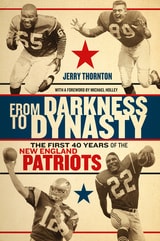
From Darkness to Dynasty
The First 40 Years of the New England PatriotsJerry Thornton
University Press of New England, 2016
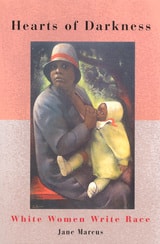
Hearts of Darkness
White Women Write RaceMarcus, Jane
Rutgers University Press, 2004
The centerpiece of the book is Marcus's dialogue with one of her best-known essays, "Britannia Rules The Waves." In that piece, she argues that The Waves makes a strong anti-imperialist statement. Although many already support that argument, she now goes further in order to question the moral value of such a buried critique on Woolf's part. In "A Very Fine Negress" she analyzes the painful subject of Virginia Woolf's racism in A Room of One's Own. Other chapters traverse the connected issues of modernism, race, and imperialism. In two of them, we follow Nancy Cunard through the making of the Negro anthology and her appearance in a popular novel of the freewheeling Jazz Age. Elsewhere, Marcus delivers a complex analysis of A Passage to India, in a reading that interrogates E. M. Forster's displacement of his fear of white Englishwomen struggling for the vote.
Marcus, as always, brings considerable gifts as both researcher and writer to this collection of new and reprinted essays, a combination resulting in a powerful interpretation of many of modernism's most cherished figures.
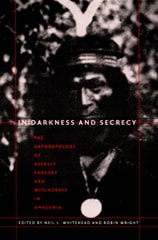
In Darkness and Secrecy
The Anthropology of Assault Sorcery and Witchcraft in AmazoniaNeil L. Whitehead and Robin Wright, eds.
Duke University Press, 2004
These essays, by leading anthropologists of South American shamanism, consider assault sorcery as it is practiced in parts of Brazil, Guyana, Venezuela, and Peru. They analyze the social and political dynamics of witchcraft and sorcery and their relation to cosmology, mythology, ritual, and other forms of symbolic violence and aggression in each society studied. They also discuss the relations of witchcraft and sorcery to interethnic contact and the ways that shamanic power may be co-opted by the state. In Darkness and Secrecy includes reflections on the ethical and practical implications of ethnographic investigation of violent cultural practices.
Contributors. Dominique Buchillet, Carlos Fausto, Michael Heckenberger, Elsje Lagrou, E. Jean Langdon, George Mentore, Donald Pollock, Fernando Santos-Granero, Pamela J. Stewart, Andrew Strathern, Márnio Teixeira-Pinto, Silvia Vidal, Neil L. Whitehead, Johannes Wilbert, Robin Wright
Inheritance of Night
Early Drafts of Lie Down in DarknessWilliam Styron
Duke University Press, 1993
Although Styron began the narrative twice, he realized both times that his writing was derivative and his characters not yet fully conceived. These drafts show young Stryon feeling his way into the story with various narrative voices and strategies, and attempting to work out his plot. Influence from William Faulkner, F. Scott Fitzgerald, and Robert Penn Warren is apparent in the text, and there is a character present named Marcus Bonner who is an early rendition of Stingo in Sophie's Choice.
The typescript drafts of Inheritance of Night for many years were thought to have been lost, but in 1980 were discovered in the files of one of Styron's former literary agents. These drafts, eventually made their way to the archive of Styron's papers assembled at Duke University Library. This facsimile is published here in two different limited editions for collectors: a lettered, signed, and boxed edition (26 copies) and a numbered, signed edition (250). A general interest trade volume is also available.
With a preface by Styron and an introduction by James L. W. West III, these drafts afford much insight into the creation of Lie Down in Darkness and the writing of a major twentieth-century American writer.
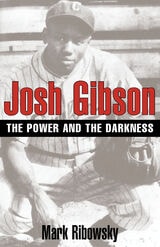
Josh Gibson
The Power and the DarknessMark Ribowsky
University of Illinois Press, 1996
Though Gibson is best remembered as "the black Babe Ruth," Ruth became a beloved symbol of the national pastime, while Gibson lived a life veiled in the darkness that came both from the shadow world of the Negro leagues and from within his own tortured soul.
Mark Ribowsky, the widely acclaimed biographer of Satchel Paige, pulls no punches in his portrait of this magnificent, troubled athlete. This is the most complete, thorough, and authoritative account of the life of black ball's greatest hitter, and one of its most important stars.
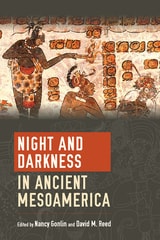
Night and Darkness in Ancient Mesoamerica
Nancy Gonlin
University Press of Colorado, 2021
The anthropological study of night and darkness enriches and strengthens the understanding of human behavior, power, economy, and the supernatural. In eleven case studies featuring the residents of Teotihuacan, the Classic period Maya, inhabitants of Rio Ulúa, and the Aztecs, the authors challenge archaeologists to consider the influence of the ignored dimension of the night and the role and expression of darkness on ancient behavior. Chapters examine the significance of eclipses, burials, tombs, and natural phenomena considered to be portals to the underworld; animals hunted at twilight; the use and ritual meaning of blindfolds; night-blooming plants; nocturnal foodways; fuel sources and lighting technology; and other connected practices.
Night and Darkness in Ancient Mesoamerica expands the scope of published research and media on the archaeology of the night. The book will be of interest to those who study the humanistic, anthropological, and archaeological aspects of the Aztec, Maya, Teotihuacanos, and southeastern Mesoamericans, as well as sensory archaeology, art history, material culture studies, anthropological archaeology, paleonutrition, socioeconomics, sociopolitics, epigraphy, mortuary studies, volcanology, and paleoethnobotany.
Contributors: Jeremy Coltman, Christine Dixon, Rachel Egan, Kirby Farah, Carolyn Freiwald, Nancy Gonlin, Julia Hendon, Cecelia Klein, Jeanne Lopiparo, Brian McKee, Jan Marie Olson, David M. Reed, Payson Sheets, Venicia Slotten, Michael Thomason, Randolph Widmer, W. Scott Zeleznik
Of Darkness and Light
Poems by Kim CornwallEdited by Wendy Erd
University of Alaska Press, 2019
An honest work, stunningly passionate: Kim Cornwall’s spirit-infused poetry weaves family and myth—strong women, wild landscapes, the search for reconciliation in circumstances beyond control—in a radiant language of pain, solace, wonder, and gratitude. This remarkable first and last collection of poetry celebrates and chronicles the borderless area between joy and suffering, like breath after long submersion: for one must breech the surface/where what we most need/ lives.
Out of the Darkness
Classic Short Fiction from SwedenVendela Vida
University of Minnesota Press, 2026
A treasure chest of stories by Swedish authors from the 1880s to the 1950s, many appearing for the first time in English
In the late nineteenth century, Swedish romanticism gave way to vibrant new literary styles that flourished through the 1950s. Out of the Darkness is the first anthology to bring the short fiction of this golden age of Swedish literature to English readers, celebrating the country’s rich literary tradition and several of its most renowned authors. The stories in this volume (many in entirely new translations, and most never before published in English) reflect the arc of the short story in Sweden, from realism to symbolism to modernist experimentation, and stand as lyrical exemplars of the creativity and depth of Swedish literature.
Some stories explore themes of crime and refuge, others ask what makes life meaningful, and some challenge sexual and social constructs of their time. All are fueled by shadows—of evil, madness, or fate, eerie fantasy or grim reality. Including internationally famous authors like August Strindberg, Stig Dagerman, and Nobel laureate Selma Lagerlöf, Out of the Darkness also features writing by influential women such as Victoria Benedictsson and Agnes von Krusenstjerna, who are less familiar to English readers. A showcase of stylistic virtuosity and incisive social commentary, Out of the Darkness at last brings this remarkable period of Swedish prose into the light.
Contributors: Victoria Benedictsson, Hjalmar Bergman, Karin Boye, Stig Dagerman, Thorsten Jonsson, Agnes von Krusenstjerna, Selma Lagerlöf, August Strindberg, Hjalmar Söderberg.
Retail e-book files for this title are screen-reader friendly.
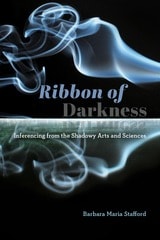
Ribbon of Darkness
Inferencing from the Shadowy Arts and SciencesBarbara Maria Stafford
University of Chicago Press, 2019
Stafford organizes these essays around three concepts that structure the book: inscrutability, ineffability, and intuitability. All three, she explains, allow us to examine how both the arts and the sciences imaginatively infer meaning from the “veiled behavior of matter,” bringing these historically divided subjects into a shared intellectual inquiry and imbuing them with an ethical urgency. A vanguard work at the intersection of the arts and sciences, this book will be sure to guide readers from either realm into unfamiliar yet undeniably fertile territory.

Smiling in the Darkness
Adelaide Freitas, Translated by Katharine F. Baker, with Bobby J. Chamberlain, Reinaldo F. Silva, and Emanuel Melo
Tagus Press, 2020
Many people of Portuguese descent take pride in claiming that the word “saudade” is untranslatable. In reality, we come close with a melding of bittersweet nostalgia, bone-deep longing, and an endless yearning for what one can never have again—or indeed may never have had. Adelaide Freitas dipped her pen in saudade to tell of family separation and bonds that never loosen. In her authentic Azorean voice, she recounts the immigrant experience and centrifugal impulses that force people apart in spite of their desperation to cling to one another. In their sensitive rendering, the translators have captured the nuances of Freitas's novel Smiling in the Darkness, with special care for those who have her native language in their heritage and heartfelt saudade for its loss.
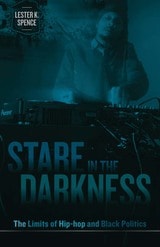
Stare in the Darkness
The Limits of Hip-hop and Black PoliticsLester K. Spence
University of Minnesota Press, 2010
A growing number of black activists and artists claim that rap and hip-hop are the basis of an influential new urban social movement. Simultaneously, black citizens evince concern with the effect that rap and hip-hop culture exerts on African American communities. According to a recent Pew survey conducted on the opinions of Black Americans, 71 percent of blacks think that rap is a bad influence. To what extent are African American hopes and fears about hip-hop’s potential political power justified? In Stare in the Darkness, Lester K. Spence answers this question using a blend of neoliberal analysis, survey data, experiments, and case studies.
Spence finds that rap does in fact influence black political attitudes. However, rap also reproduces rather than critiques neoliberal ideology. Furthermore, black activists seeking to create an innovative model of hip-hop politics are hamstrung by their reliance on outmoded forms of organizing. By considering the possibilities inherent in the most prolific and prominent activities of hip-hop politics, Stare in the Darkness reveals, in a clear and practical manner, the political consequences of rap culture for black publics.
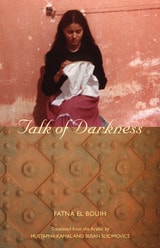
Talk of Darkness
By Fatna El Bouih
University of Texas Press, 2008
Fatna El Bouih was first arrested in Casablanca as an 18-year-old student leader with connections to the Marxist movement. Over the next decade she was rearrested, forcibly disappeared, tortured, and transferred between multiple prisons. While imprisoned, she helped organize a hunger strike, completed her undergraduate degree in sociology, and began work on a Master's degree.
Beginning with the harrowing account of her kidnapping during the heightened political tension of the 1970s, Talk of Darkness tells the true story of one woman's struggle to secure political prisoners' rights and defend herself against an unjust imprisonment.
Poetically rendered from Arabic into English by Mustapha Kamal and Susan Slyomovics, Fatna El Bouih's memoir exposes the techniques of state-instigated "disappearance" in Morocco and condemns the lack of laws to protect prisoners' basic human rights.
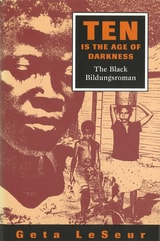
Ten Is the Age of Darkness
The Black BildungsromanGeta LeSeur
University of Missouri Press, 1995
In Ten Is the Age of Darkness, Geta LeSeur explores how black authors of the United States and English- speaking Caribbean have taken a European literary tradition and adapted it to fit their own needs for self-expression. LeSeur begins by defining the structure and models of the European genre of the bildungsroman, then proceeds to show how the circumstances of colonialism, oppression, race, class, and gender make the maturing experiences of selected young black protagonists different from those of their white counterparts.
Examining the parallels and differences in attitudes toward childhood in the West Indies and the United States, as well as the writers' individual perspectives in each work of fiction, LeSeur reaches intriguing conclusions about family life, community participation in the nurturing of children, the timing and severity of the youngsters' confrontation of adult society, and the role played by race in the journey toward adulthood.
LeSeur's readings of African American novels provide new insights into the work of Langston Hughes, James Baldwin, Toni Morrison, Paule Marshall, and Richard Wright, among others. When read as examples of the bildungsroman rather than simply as chronicles of black experiences, these works reveal an even deeper significance and have a more powerful impact. LeSeur convincingly demonstrates that such African American novels as Baldwin's Go Tell It on the Mountain, Wright's Black Boy, and Morrison's The Bluest Eye concentrate to a large extent on protest, while such African West Indian works as George Lamming's In the Castle of My Skin, Austin Clarke's Amongst Thistles and Thorns, Jamaica Kincaid's Annie John, and Erna Brodber's Jane and Louisa Will Soon Come Home reflect a more naive, healthy re-creation of what childhood can and should be, despite economic and physical impoverishment. She also gives a special space within the genre to Paule Marshall's BrownGirl, Brownstones and Ntozake Shange's Betsey Brown and the importance of "woman time," "woman voice," and mothers.
While enlarging our understanding of both the similarities and the differences in the black experiences of the Carribean and American youngsters coming of age, Ten Is the Age of Darkness also suggests that children of color in similar spheres share many common experiences. LeSeur concludes that the bildungsromane by black writers provide uniquely revealing contributions to the Afro-World literary canon and point the way for others to examine literary pieces in Third World communities of color.
The Children of Light and the Children of Darkness
A Vindication of Democracy and a Critique of Its Traditional DefenseReinhold Niebuhr
University of Chicago Press, 2011
The Children of Light and the Children of Darkness, first published in 1944, is considered one of the most profound and relevant works by the influential theologian Reinhold Niebuhr, and certainly the fullest statement of his political philosophy. Written and first read during the prolonged, tragic world war between totalitarian and democratic forces, Niebuhr’s book took up the timely question of how democracy as a political system could best be defended.
Most proponents of democracy, Niebuhr claimed, were “children of light,” who had optimistic but naïve ideas about how society could be rid of evil and governed by enlightened reason. They needed, he believed, to absorb some of the wisdom and strength of the “children of darkness,” whose ruthless cynicism and corrupt, anti-democratic politics should otherwise be repudiated. He argued for a prudent, liberal understanding of human society that took the measure of every group’s self-interest and was chastened by a realistic understanding of the limits of power. It is in the foreword to this book that he wrote, “Man’s capacity for justice makes democracy possible; but man’s inclination to injustice makes democracy necessary.”
The Darkness of the Present
Poetics, Anachronism, and the AnomalySteve McCaffery
University of Alabama Press, 2012
To Rise in Darkness
Revolution, Repression, and Memory in El Salvador, 1920–1932Jeffrey L. Gould, Aldo A. Lauria-Santiago
Duke University Press, 2008
Gould conducted more than two hundred interviews with survivors of la Matanza and their descendants. He and Lauria-Santiago combine individual accounts with documentary sources from archives in El Salvador, Guatemala, Washington, London, and Moscow. They describe the political, economic, and cultural landscape of El Salvador during the 1920s and early 1930s, and offer a detailed narrative of the uprising and massacre. The authors challenge the prevailing idea that the Communist organizers of the uprising and the rural Indians who participated in it were two distinct groups. Gould and Lauria-Santiago demonstrate that many Communist militants were themselves rural Indians, some of whom had been union activists on the coffee plantations for several years prior to the rebellion. Moreover, by meticulously documenting local variations in class relations, ethnic identity, and political commitment, the authors show that those groups considered “Indian” in western El Salvador were far from homogeneous. The united revolutionary movement of January 1932 emerged out of significant cultural difference and conflict.