Results by title
4 books match the query 'Dartmouth College'
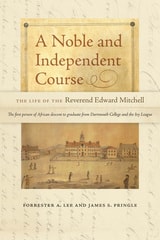
A Noble and Independent Course
The Life of the Reverend Edward MitchellForrester A. Lee and James S. Pringle
Dartmouth College Press, 2018
In 1828 Edward Mitchell was the first student of African descent to graduate from Dartmouth College, more than thirty-five years before any other Ivy League school admitted a black student. This book tells Mitchell’s life story with the help of a recently rediscovered trove of his college essays, notes on his religious conversion, and hand-copied versions of his sermons. Born and raised in the French slave colony of Martinique, Mitchell immigrated to the United States and came of age in Philadelphia, where he broke bread with the city’s African American clerics and civic leaders. The Dartmouth trustees initially denied Mitchell admission but yielded to unified student protest. After his graduation, Mitchell continued his northward journey to serve as a Baptist preacher and evangelist in the pulpits of northern New England. His religious odyssey concluded in Lower Canada, where he was remembered as “the most profound theologian ever settled.” During his travels throughout the Atlantic world in an age of revolution and religious revival, Mitchell encountered the dominant social, economic, and political realities of his time. Although long celebrated as the inspiration for Dartmouth’s legacy of educating men and women of African ancestry, Mitchell’s life story remained unknown for almost two centuries. This book, which embodies history as recovery, is a testament to the authors’ desire to know the man behind the story.
[more]
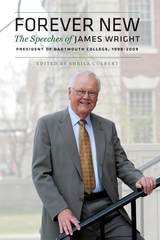
Forever New
The Speeches of James Wright, President of Dartmouth College, 1998–2009James Wright
Dartmouth College Press, 2012
Jim Wright is an unabashed optimist. Reading his speeches, it doesn’t take long to see that he believes in the fundamental values that shaped the American republic: opportunity and accessibility, individuality and a shared sense of community. He carried this idealism into his presidency of Dartmouth College and, indeed, throughout his career as teacher and historian. At heart, Jim Wright was always a teacher. His election to the presidency of Dartmouth College gave him the opportunity not only to lead the college he loved, but also to use the presidency as a bully pulpit to encourage his students to make a positive difference in the world. The speeches gathered in this collection, particularly the annual convocation and commencement addresses, illustrate that calling. It is in these addresses that he was the most intentional about his goals and his aspirations for Dartmouth, for the Dartmouth faculty, and ultimately for Dartmouth students.
[more]
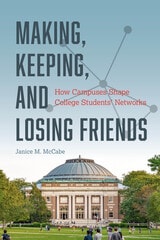
Making, Keeping, and Losing Friends
How Campuses Shape College Students' NetworksJanice M. McCabe
University of Chicago Press, 2025
Draws attention to the importance of support networks for students as they make, keep, and lose friends throughout college and beyond.
We’re all familiar with the sentiment that “college is the best time of your life.” Along with a newfound sense of freedom, students have a unique opportunity to forge lifelong friendships at a point in life when friendship is particularly important. Why is it, then, that so many college students are falling victim to what the US Surgeon General termed an “epidemic of loneliness and isolation”? How do different aspects of college life help or hinder students’ ability to form deep connections?
In Making, Keeping, and Losing Friends: How Campuses Shape College Students’ Networks, sociologist Janice M. McCabe shows that the way a college is structured—whether students live in dorms or commute, study abroad or stay close to campus, have plentiful common areas for clubs to meet or not—can either encourage or hinder the making of meaningful friendships. Based on interviews with 95 students on three distinct campuses—a small private college (Dartmouth College), a large public university (University of New Hampshire), and a non-residential community college (Manchester Community College)—McCabe captures a wide range of experiences and discovers how features of the campuses make it easier or harder for students to make and keep friends. She shows how and why, across all three institutions, some students thrive in deep and lasting friendships with their peers.
As McCabe’s research reveals, we need to look at the structures of students’ networks, the institutions they attend, and the importance of their identities in these places if we are to truly uncover and address the loneliness epidemic facing today’s young adults.
[more]
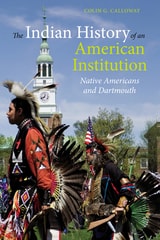
The Indian History of an American Institution
Native Americans and DartmouthColin G. Calloway
Dartmouth College Press, 2010
Dartmouth College began life as an Indian school, a pretense that has since been abandoned. Still, the institution has a unique, if complicated, relationship with Native Americans and their history. Beginning with Samson Occom’s role as the first “development officer” of the college, Colin G. Calloway tells the entire, complex story of Dartmouth’s historical and ongoing relationship with Native Americans. Calloway recounts the struggles and achievements of Indian attendees and the history of Dartmouth alumni’s involvements with American Indian affairs. He also covers more recent developments, such as the mascot controversies, the emergence of an active Native American student organization, and the partial fulfillment of a promise deferred. This is a fascinating picture of an elite American institution and its troubled relationship— at times compassionate, at times conflicted—with Indians and Native American culture.
[more]