Results by title
4 books match the query 'Data Analytics'
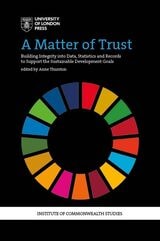
A Matter of Trust
Building Integrity into Data, Statistics and Records to Support the Sustainable Development GoalsEdited by Anne Thurston
University of London Press, 2020
The United Nations Sustainable Development Goals initiative has the potential to set the direction for a future world that works for everyone. Approved by 193 United Nations member countries in September 2016 to help guide global and national development policies through the year 2030, the seventeen goals build on the successes of the Millennium Development Goals, but also include new priority areas, such as climate change, economic inequality, innovation, sustainable consumption, peace, and justice. Assessed against commonly agreed targets and indicators, the goals should facilitate inter-governmental cooperation and the development of regional and even global development strategies. This book explores, through a series of case studies, the substantial challenges for assembling reliable data and statistics to address pressing development challenges, particularly in Africa. By highlighting the enormous potential value of creating and using high quality data, statistics, and records as an interconnected resource and describing how this can be achieved, the book will contribute to defining meaningful and realistic global and national development policies in the critical period to 2030.
[more]
Data as Infrastructure for Smart Cities
Larissa Suzuki
The Institution of Engineering and Technology, 2019
This book describes how smart cities can be designed with data at their heart, moving from a broad vision to a consistent city-wide collaborative configuration of activities. The authors present a comprehensive framework of techniques to help decision makers in cities analyse their business strategies, design data infrastructures to support these activities, understand stakeholders' expectations, and translate this analysis into a competitive strategy for creating a smart city data infrastructure. Readers can take advantage of unprecedented insights into how cities and infrastructures function and be ready to overcome complex challenges. The framework presented in this book has guided the design of several urban platforms in the European Union and the design of the City Data Strategy of the Mayor of London, UK.
[more]
Fact or Fluke?
A Critical Look at Statistical EvidenceRonald Meester
Amsterdam University Press, 2022
Statistics is more topical than ever. Numerous decisions depend on statistical considerations: just think of the Corona crisis or decisions about approving new drugs or other products. If researchers announce they have proved some fact using statistical tests, can we then always be sure that their claim is correct? How, and more importantly why, does statistics work? What can we expect from statistics and what not? 'Fact or Fluke?' is not a textbook that explains statistical tests to the reader; instead, it discusses what comes before those tests: the philosophy behind the statistics. Should one carry out tests, or are there other ways to look at statistics?
Ronald Meester and Klaas Slooten use a variety of examples – from court cases to theoretical physics – to present different views on statistics and provide arguments for what they think is the best point of view. This book is meant for anyone who is in some way concerned with, or interested in, statistical evidence: scientific researchers, students, teachers, mathematicians, philosophers, lawyers, managers, and no doubt many others.
Ronald Meester and Klaas Slooten use a variety of examples – from court cases to theoretical physics – to present different views on statistics and provide arguments for what they think is the best point of view. This book is meant for anyone who is in some way concerned with, or interested in, statistical evidence: scientific researchers, students, teachers, mathematicians, philosophers, lawyers, managers, and no doubt many others.
[more]

The Burden of Choice
Recommendations, Subversion, and Algorithmic CultureJonathan Cohn
Rutgers University Press, 2019
The Burden of Choice examines how recommendations for products, media, news, romantic partners, and even cosmetic surgery operations are produced and experienced online. Fundamentally concerned with how the recommendation has come to serve as a form of control that frames a contemporary American as heteronormative, white, and well off, this book asserts that the industries that use these automated recommendations tend to ignore and obscure all other identities in the service of making the type of affluence they are selling appear commonplace. Focusing on the period from the mid-1990s to approximately 2010 (while this technology was still novel), Jonathan Cohn argues that automated recommendations and algorithms are far from natural, neutral, or benevolent. Instead, they shape and are shaped by changing conceptions of gender, sexuality, race, and class. With its cultural studies and humanities-driven methodologies focused on close readings, historical research, and qualitative analysis, The Burden of Choice models a promising avenue for the study of algorithms and culture.
[more]