Results by title
6 books match the query 'Davis, Michael'
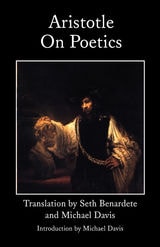
Aristotle On Poetics
Seth Benardete
St. Augustine's Press, 2002
Aristotle’s much-translated On Poetics is the earliest and arguably the best treatment that we possess of tragedy as a literary form. The late Seth Benardete and Michael Davis have translated it anew with a view to rendering Aristotle’s text into English as precisely as possible. A literal translation has long been needed, for in order to excavate the argument of On Poetics one has to attend not simply to what is said on the surface but also to the various puzzles, questions, and peculiarities that emerge only on the level of how Aristotle says what he says and thereby leads one to revise and deepen one’s initial understanding of the intent of the argument. As On Poetics is about how tragedy ought to be composed, it should not be surprising that it turns out to be a rather artful piece of literature in its own right.
Benardete and Davis supplement their edition of On Poetics with extensive notes and appendices. They explain nuances of the original that elude translation, and they provide translations of passages found elsewhere in Aristotle’s works as well as in those of other ancient authors that prove useful in thinking through the argument of On Poetics both in terms of its treatment of tragedy and in terms of its broader concerns. By following the connections Aristotle plots between On Poetics and his other works, readers will be in a position to appreciate the centrality of this little book for his thought on the whole.
In an introduction that sketches the overall interpretation of On Poetics, Davis argues that, while On Poetics is certainly about tragedy, it has a further concern extending beyond poetry to the very structure of the human soul in its relation to what is, and that Aristotle reveals in the form of his argument the true character of human action.
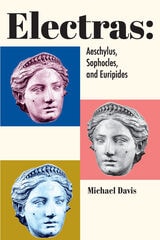
Electras
Aeschylus, Sophocles, and EuripidesMichael Davis
St. Augustine's Press, 2023
Davis accomplishes much more than an exegetical bridge as he connects us with ancient memory and wisdom. "When we cannot resist the temptation to recoil morally from their terminology, we risk the tragedy of losing their profound thoughts about our humanity––their philosophical anthropology." Davis has remarkably made of a niche study a stunning source material for more universal questions. This is a book that is as timely as it is ageless.
New Songs of Innocence
S. J. Hodson
St. Augustine's Press, 2025
But poetry isn't just play, however clever. Language is a serious matter. It's not working unless it opens us up to our world. Beauty is at once at odds with and requires truth. In this ancient quarrel between poetry and philosophy, S.J. Hodson comes down squarely on both sides. At its best poetry teaches without preaching. If Blake's Songs of Innocence calls established religion into question to recover wonder at the religious spirit that gives birth to it, Hodson's New Songs of Innocence means to call into question science, the established religion of our time, to wonder again at what gives birth to it, the scientific spirit. […]
[Hodson] writes not so much to please his audience as to tease and teach his audience-and what a pleasure it is to be taught this way. Making poetry is for him serious-a way to think, a way to wonder. But he is also masterful at playfully seducing others to wonder. If 'philosophy begins in wonder,' these poems are invitations to philosophize. S.J. Hodson is one of the most interesting and talented poets of his generation, and yet he remains known to only a very few. In New Songs of Innocence, we are graced with his first published book of poetry. We should be thankful and hope it will not be his last." Taken from the Introduction by Michael Davis

Street Fight
Mean America and the War on Sesame StreetMichael Davis
Rutgers University Press, 2027
Education in the United States is under attack, but there’s still one street that’s full of hope. Sesame Street was created in 1969 with the aim to help less fortunate children better prepare for school. Since then, it has been viewed by an estimated 190 million children across 150 countries and prepared generations of children for kindergarten. Without Sesame Street, where would they go?
Within the walls of Sesame Workshop’s idea factory, the people behind the show have been battling forces that would have snuffed it out long ago. Its federal funding has been slashed, despite it being the gold standard of children’s educational programming, and only through heroic efforts has it avoided cancellation. Meanwhile, Sesame Workshop continues to address educational and social needs in children that would otherwise go unmet.
Street Fight weighs how the ongoing experiment in educating preschoolers through television has served the world’s children, while also revealing the limitations and complications that left some viewers behind. Drawing from over two hundred interviews and including oral histories from the show’s performers and executives, journalist Michael Davis pulls back the curtain to look at the people and events that shaped Sesame Street from the 1990s to the present. From public scandals to behind-the-scenes tensions, Street Fight traces the evolution of a beloved American institution against the backdrop of a rapidly changing media landscape.
All too often, Sesame Street only makes the news during a media firestorm. This book recounts what happens the other 364 days of the year
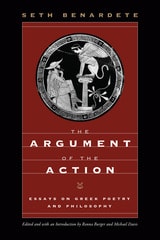
The Argument of the Action
Essays on Greek Poetry and PhilosophySeth Benardete
University of Chicago Press, 2000
This volume brings together Seth Benardete’s studies of Hesiod, Homer, and Greek tragedy, eleven Platonic dialogues, and Aristotle’s Metaphysics.
The Argument of the Action spans four decades of Seth Benardete’s work, documenting its impressive range. Benardete’s philosophic reading of the poets and his poetic reading of the philosophers share a common ground, guided by the key he found in the Platonic dialogue: probing the meaning of speeches embedded in deeds, he uncovers the unifying intention of the work by tracing the way it unfolds through a movement of its own. Benardete’s original interpretations of the classics are the fruit of this discovery of the “argument of the action.”
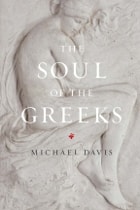
The Soul of the Greeks
An InquiryMichael Davis
University of Chicago Press, 2011
The understanding of the soul in the West has been profoundly shaped by Christianity, and its influence can be seen in certain assumptions often made about the soul: that, for example, if it does exist, it is separable from the body, free, immortal, and potentially pure. The ancient Greeks, however, conceived of the soul quite differently. In this ambitious new work, Michael Davis analyzes works by Homer, Herodotus, Euripides, Plato, and Aristotle to reveal how the ancient Greeks portrayed and understood what he calls “the fully human soul.”
Beginning with Homer’s Iliad, Davis lays out the tension within the soul of Achilles between immortality and life. He then turns to Aristotle’s De Anima and Nicomachean Ethics to explore the consequences of the problem of Achilles across the whole range of the soul’s activity. Moving to Herodotus and Euripides, Davis considers the former’s portrayal of the two extremes of culture—one rooted in stability and tradition, the other in freedom and motion—and explores how they mark the limits of character. Davis then shows how Helen and Iphigeneia among the Taurians serve to provide dramatic examples of Herodotus’s extreme cultures and their consequences for the soul. The book returns to philosophy in the final part, plumbing several Platonic dialogues—the Republic, Cleitophon, Hipparchus, Phaedrus, Euthyphro, and Symposium—to understand the soul’s imperfection in relation to law, justice, tyranny, eros, the gods, and philosophy itself. Davis concludes with Plato’s presentation of the soul of Socrates as self-aware and nontragic, even if it is necessarily alienated and divided against itself.
The Soul of the Greeks thus begins with the imperfect soul as it is manifested in Achilles’ heroic, but tragic, longing and concludes with its nontragic and fuller philosophic expression in the soul of Socrates. But, far from being a historical survey, it is instead a brilliant meditation on what lies at the heart of being human.